

Annapurna Devi Mandir Varanasi timings: Morning darshan 4:00 AM-11:30 AM, Evening darshan 7:00 PM-11:00 PM. Three daily aartis: Mangala Aarti 4-5 AM, Bhog Aarti 12 PM, Sandhya Aarti 7-8 PM. Free vegetarian Annadanam (meals) served 9 AM-3 PM daily. Temple is 15 metres from Kashi Vishwanath, inside Vishwanath Gali. Entry is free. Built in 1729 CE by Baji Rao I. Gold idol visible only during Annakut festival (post-Diwali, 4-5 days). Experience My India includes this temple in all Varanasi tours. WhatsApp +91-7302265809. See our Ayodhya Varanasi Tour Package or message WhatsApp +91 7302265809.
Annapurna Devi Mandir in Varanasi is one of the most significant temples in the Kashi pilgrimage circuit – and one of the most consistently overlooked by first-time visitors who rush to Kashi Vishwanath without pausing at the goddess who is said to feed the entire universe. Located just 15 metres from the Kashi Vishwanath Jyotirlinga, inside Vishwanath Gali, the Annapurna Mandir is the temple of Maa Annapurna – the goddess of food, nourishment and abundance – who according to the Shiva Purana established her cosmic kitchen in Kashi itself.
I am Gurudutt, born and raised in Braj Bhoomi and the founder of Experience My India. Since 2018, I have guided 50,000+ pilgrims through the Kashi darshan circuit – including the Annapurna Mandir at the morning aarti window, the Annadanam (free community meal) at 11 AM and the rare Annakut festival when the gold idol is revealed. Every timing and practical detail in this guide comes from direct weekly experience.
What Is Annapurna Devi Mandir and Why It Matters
Annapurna Devi Mandir is dedicated to Maa Annapurna – the form of the divine goddess (Parvati/Shakti) as the sustainer of life through food and nourishment. “Anna” means food in Sanskrit; “Purna” means complete or abundant. The name means “She who is complete in nourishing.”
In the Kashi pilgrimage tradition, Annapurna Mandir holds a specific and important place alongside Kashi Vishwanath. The theological belief is that Shiva – who is the presiding deity of Kashi – himself came to Maa Annapurna seeking alms (food as bhiksha) in Kashi. This makes Annapurna Mandir not merely a Devi temple in Varanasi, but the temple that feeds Lord Shiva himself. The theological implication is that a Kashi yatra is incomplete without darshan at Annapurna Mandir.
The temple is also one of the few in all of India where free community meals (Annadanam) are served to thousands of pilgrims every single day – a direct expression of the goddess’s attribute as the provider of nourishment.
Experience My India includes Annapurna Devi Mandir in the standard Kashi darshan circuit for all Varanasi tour groups. WhatsApp +91-7302265809.
Annapurna Devi Mandir Varanasi Timings – Complete Darshan Schedule
| Session | Opening Time | Closing Time | Notes |
| Morning darshan | 4:00 AM | 11:30 AM | Begins with Mangala Aarti at 4 AM |
| Afternoon break | 11:30 AM / 12:00 PM | 3:30 PM / 4:00 PM | Deity rest – temple closed |
| Evening darshan | 7:00 PM | 11:00 PM | Begins with Sandhya Aarti at 7 PM |
Important note on timing variations: Some sources list the morning close as 12:00 PM and afternoon open as 3:30 PM – slight variations occur depending on festival calendar and ritual schedule. Experience My India confirms current-day timings for all Varanasi tour groups. WhatsApp +91-7302265809.
Festival day timings: During Annakut (post-Diwali), Navratri and major Shakti festivals, the temple may remain open for extended hours. Confirm locally or through Experience My India before visiting on festival days.
Book Your Sugam Darshan and Rudrabhishek at Kashi Vishwanath
Aarti Schedule – All Three Daily Aartis
| Aarti | Time | Character |
| Mangala Aarti (Morning awakening) | 4:00 AM – 5:00 AM | First and most intimate – very few visitors at 4 AM |
| Bhog Aarti (Afternoon offering) | 12:00 PM | Brief – deity receives midday food offering |
| Sandhya Aarti (Evening) | 7:00 PM – 8:00 PM | Most attended – lamps, incense, devotional atmosphere |
Mangala Aarti (4:00-5:00 AM): The morning awakening ceremony is the most spiritually charged aarti and the least crowded. Pilgrims who arrive for this window experience the temple at its most intimate – fewer than 50 visitors typically present at 4 AM. The goddess is freshly dressed for the day; the inner sanctum with the brass idol of Maa Annapurna holding her golden ladle is fully visible in the lamp-lit pre-dawn.
Sandhya Aarti (7:00-8:00 PM): The most commonly attended aarti. Pilgrims who complete their Kashi Vishwanath darshan and Ganga Aarti viewing at Dashashwamedh Ghat in the evening often include Annapurna Mandir’s Sandhya Aarti as the concluding temple visit of the day – walking the 15 metres between the two temples.
Experience My India schedules the Sandhya Aarti at Annapurna Mandir immediately before or after the Ganga Aarti at Dashashwamedh Ghat for all Varanasi groups. WhatsApp +91-7302265809.
Annadanam – Free Meals at Annapurna Mandir
One of the most remarkable features of Annapurna Devi Mandir is the daily Annadanam – the free community meal served to thousands of pilgrims and visitors.
| Detail | Information |
| What is served | Free high-quality vegetarian meals |
| Serving hours | 9:00 AM – 3:00 PM (peak hours) |
| General service | 7:00 AM to 10:00 PM (light meals available outside peak hours) |
| Who manages it | Kashi Annapurna Annakshetra Trust |
| Who can eat | Any pilgrim or visitor – no restrictions |
| Quality | Hot cooked vegetarian food – well-maintained standard |
| Cost | Completely free |
The Annadanam is not a symbolic gesture – it is a substantial, full daily meal served to thousands. The Kashi Annapurna Annakshetra Trust maintains this tradition as a direct expression of the goddess’s attribute: that no one who comes to Maa Annapurna’s temple in Kashi should go hungry.
Experience My India always mentions the Annadanam to pilgrims visiting between 9 AM and 3 PM – several groups have chosen to take the meal as part of their Kashi experience and the impact of receiving food from the goddess of food in her own temple is consistently described as one of the most meaningful moments of the Varanasi pilgrimage.
The Gold Idol – Annakut Festival Darshan Window
The most uniquely extraordinary feature of Annapurna Devi Mandir is the existence of two separate idols – the brass idol (daily darshan) and the solid gold idol (shown only once a year).
The Brass Idol (Daily Darshan)
The main sanctum houses the brass idol of Maa Annapurna – depicting the goddess holding a golden ladle (sruk) in one hand and a vessel filled with grains in the other. This is the idol available for daily darshan throughout the year.
The Gold Idol (Annakut Festival – Post-Diwali, 4-5 Days Only)
The solid gold idol of Maa Annapurna is kept in the temple’s treasury throughout the year and brought out for public darshan for only 4 to 5 days during the Annakut Festival – celebrated the day after Diwali (in October or November).
| Detail | Information |
| Gold idol darshan | 4-5 days only – Annakut Festival |
| When | Day after Diwali (October/November) |
| Special distribution | Symbolic “blessed coins” from goddess’s treasury distributed to lakhs of devotees |
| Crowd | Among the highest single-event crowds at Annapurna Mandir all year |
| Booking ahead | Experience My India books Varanasi stays for Annakut 2 months ahead |
Experience My India plans Annakut festival visits to Annapurna Mandir specifically – including the gold idol darshan window, crowd management and hotel booking well ahead of the festival. WhatsApp +91-7302265809.
History and Significance of Annapurna Devi Mandir
| Historical Detail | Information |
| Built | 1729 CE |
| Built by | Maratha Peshwa Baji Rao I |
| Architecture | Nagara style – traditional North Indian temple architecture |
| Location | Vishwanath Gali, Varanasi – 15 metres from Kashi Vishwanath |
| Deity | Maa Annapurna – goddess of food, nourishment and abundance |
| Theological status | The temple where Lord Shiva came seeking bhiksha (alms) – mythologically the most important Devi temple in Kashi |
The Shiva Purana story: According to the Shiva Purana, Lord Shiva once told Goddess Parvati that the entire material world – including food – was an illusion (maya). To demonstrate the indispensable importance of material nourishment, Parvati vanished from the universe. Without the goddess’s presence, food ceased to exist and a great famine gripped the cosmos. Witnessing the suffering of all beings – including the gods – Parvati took the form of Maa Annapurna and established a cosmic kitchen in Kashi. Lord Shiva, understanding the truth that material nourishment is as divine as spiritual liberation, came to Kashi with his begging bowl seeking food from the goddess. Maa Annapurna fed Shiva himself – demonstrating that food (anna) is Brahman (the divine absolute) in material form.
This story is the foundation of why Annapurna Mandir in Varanasi is considered a complete pilgrimage in itself – the goddess feeds even the Lord of Kashi.
Read the full Kashi sacred context: Kashi Vishwanath Temple Varanasi
How Far Is Annapurna Devi Mandir from Kashi Vishwanath Temple
Annapurna Devi Mandir is located approximately 15 metres from Kashi Vishwanath Temple – inside Vishwanath Gali, in the same lane complex.
| From | To | Distance | Time |
| Kashi Vishwanath sanctum exit | Annapurna Mandir entrance | 15 metres | 1-2 minutes walk |
| Dashashwamedh Ghat | Annapurna Mandir | 700 metres | 8-10 minutes walk |
| Godowlia Chowk | Annapurna Mandir | 500 metres | 6-8 minutes walk |
| Varanasi Cantt Station (BSB) | Annapurna Mandir | 4-6 km | 20 minutes by auto |
This proximity means that every pilgrim visiting Kashi Vishwanath passes within metres of Annapurna Devi Mandir. Experience My India includes both temples as a single combined stop – darshan at Annapurna Mandir takes approximately 20-30 minutes and adds minimal time to the overall Kashi Vishwanath visit.
The Blessed Rice Grains Tradition
One of Annapurna Devi Mandir’s most distinctive and practically memorable traditions involves prasad distribution:
Devotees visiting the temple receive a handful of blessed rice grains as prasad from Maa Annapurna. The tradition prescribes taking these blessed grains home and mixing them into the household’s rice storage – the belief being that the goddess’s grace will ensure the household never faces a shortage of food or nourishment.
This tradition has a direct mythological connection to the story of Annapurna establishing her cosmic kitchen in Kashi – the goddess who ensured that no being who came to her would go hungry. The prasad rice grains are the domestic extension of that divine promise.
Experience My India explains this tradition to every pilgrim group before they enter Annapurna Mandir – and many pilgrims specifically carry a small cloth bag to store the prasad rice for the journey home.
Correct Kashi Visiting Sequence – Where Annapurna Fits
The traditional Kashi pilgrimage sequence places Annapurna Devi Mandir immediately alongside Kashi Vishwanath – the two temples are visited as one combined sacred stop:
| Step | Temple | Distance | Tradition |
| 1 | Kaal Bhairav Temple | 1.5 km from KV | Visit first – guardian of Kashi |
| 2 | Kashi Vishwanath Temple | Central | Primary Jyotirlinga darshan |
| 3 | Annapurna Devi Mandir | 15 m from KV | Darshan after Kashi Vishwanath – same lane |
| 4 | Dashashwamedh Ghat | 700 m | Ganga Aarti in evening |
The logic of this sequence: Kaal Bhairav gives permission to enter Kashi. Kashi Vishwanath gives the Jyotirlinga darshan. Annapurna Devi gives nourishment and abundance for the journey home. The three together complete the Kashi pilgrimage.
Experience My India follows this exact sequence for every Varanasi tour group. Read the complete Kashi places guide: 30 Best Places to Visit in Kashi 2026
Best Time to Visit Annapurna Devi Mandir
| Timing | Crowd Level | Experience Quality | Verdict |
| Mangala Aarti 4:00-5:00 AM | Very low | ✅ Most intimate – goddess in fresh morning attire | Best for devotional experience |
| Morning 7:00-9:00 AM | Low-Moderate | ✅ Good – post-aarti, Annadanam beginning | Best combined with KV morning visit |
| 9:00 AM-12:00 PM | Moderate | ✅ Annadanam peak – full community meal | Best if you want Annadanam |
| Sandhya Aarti 7:00-8:00 PM | Moderate | ✅ Atmospheric – lamps, incense, evening prayers | Best for atmosphere |
| Annakut Festival (post-Diwali) | Very High | ✅ Gold idol darshan – once a year | Plan 2 months ahead |
| Navratri | High | ✅ Special decorations and extended hours | Book Varanasi ahead |
Best month overall: October to March – same as all Varanasi sightseeing. February offers the least crowded conditions year-round.
Best time to visit guide: Best Time to Visit Varanasi 2026
Practical Visitor Guide – Entry, Rules and Dress Code
| Detail | Information |
| Entry fee | Free |
| Days open | Monday to Sunday – all 7 days |
| Footwear | Must be removed – designated deposit area |
| Dress code | Covered shoulders and knees – traditional Indian attire preferred |
| Mobile phones | Check current policy at gate – some restrictions on photography inside sanctum |
| Bags | Small bags usually permitted – confirm at entry |
| Location | D9, Annapurna Math Mandir, 1, Vishwanath Gali, Varanasi |
| Parking | No parking at temple – park at Godowlia and walk |
| Prasad | Blessed rice grains – available at darshan |
| Annadanam | Free meals 9 AM-3 PM – no restrictions on who can eat |
Getting to Annapurna Mandir: The temple is inside Vishwanath Gali – the lane that leads to Kashi Vishwanath Temple. All visitors to Kashi Vishwanath pass through this lane. From Godowlia Chowk, walk through the lane toward the temple complex – Annapurna Mandir is on the right side approximately 15 metres before the Kashi Vishwanath Corridor security checkpoint area.
Ground Truth – What Nobody Tells You About Annapurna Devi Mandir
1. Almost every Kashi Vishwanath visitor walks past Annapurna Devi Mandir at 15 metres distance without entering – this is one of the most consistent observations of my 8 years guiding Kashi. The temple is in the same lane. It takes 20 minutes. The darshan is free. The mythology makes it an integral part of the Kashi circuit. Yet the majority of first-time Kashi Vishwanath visitors never enter. Experience My India adds Annapurna Mandir to every Varanasi itinerary as a mandatory 20-minute stop.
2. The gold idol darshan during Annakut (4-5 days, post-Diwali) is one of the rarest and most remarkable darshan experiences in all of Varanasi – and almost no travel guide covers it. A solid gold idol of Maa Annapurna, visible for 4-5 days per year. Thousands of devotees receive blessed coins from the goddess’s treasury. This is not a common-knowledge event – most Varanasi visitors don’t know it exists. Experience My India books Annakut-period Varanasi tours specifically for this window.
3. The Annadanam (free meals, 9 AM-3 PM) is not a symbolic token – it is a full, cooked vegetarian meal served to thousands daily. The Kashi Annapurna Annakshetra Trust runs one of the larger ongoing community meal programs in Varanasi. Receiving a meal at Maa Annapurna’s temple in Kashi has genuine pilgrimage significance – it is a direct expression of the goddess’s promise that no one who comes to her in Kashi will go hungry.
4. Annapurna Mandir was built in 1729 CE by Maratha Peshwa Baji Rao I – the same Maratha ruler who was responsible for significant temple restoration across North India. The Nagara architecture of the temple has survived nearly 300 years in the dense lanes of Varanasi’s old city. The current structure is essentially the same as built by the Peshwa – a significant piece of 18th-century temple architecture in perfect functional continuity.
5. The afternoon closure (11:30 AM-7:00 PM approximately) is longer than most pilgrims expect. Unlike some temples with a brief 2-hour midday break, Annapurna Devi Mandir has an afternoon closure from approximately 11:30 AM to 7:00 PM – nearly 7.5 hours. Pilgrims planning to visit in the late afternoon between 3:00-6:00 PM will find the temple closed. The Sandhya Aarti opens the evening session at 7:00 PM. Plan accordingly.
Frequently Asked Questions – Annapurna Devi Mandir Varanasi Timings
Annapurna Devi Mandir Varanasi is dedicated to Maa Annapurna – the goddess of food, nourishment and abundance – who according to the Shiva Purana established her cosmic kitchen in Kashi. The theological significance is profound: Lord Shiva himself came to Maa Annapurna at this site seeking alms (bhiksha) after realising that material nourishment is as divine as spiritual liberation. Built in 1729 CE by Maratha Peshwa Baji Rao I, the temple is located 15 metres from Kashi Vishwanath and is considered an inseparable part of the complete Kashi yatra. Experience My India includes it in every Varanasi tour. WhatsApp +91-7302265809.
Annapurna Devi Mandir Varanasi is famous for five things: its location 15 metres from Kashi Vishwanath in Vishwanath Gali; the daily Annadanam (free vegetarian meals served 9 AM-3 PM to thousands); the blessed rice grains prasad tradition (devotees mix the grains in household rice for lifelong abundance); the solid gold idol of Maa Annapurna visible only 4-5 days per year during the Annakut Festival (post-Diwali); and its Nagara architecture built in 1729 CE by Maratha Peshwa Baji Rao I. Experience My India plans all five experiences for Varanasi pilgrim groups. WhatsApp +91-7302265809.
The distance between Annapurna Devi Mandir and Kashi Vishwanath Temple is approximately 15 metres – they are in the same Vishwanath Gali lane, with Annapurna Mandir located just before the Kashi Vishwanath Corridor security entry. Every pilgrim visiting Kashi Vishwanath walks past Annapurna Devi Mandir. From Dashashwamedh Ghat, both temples are approximately 700 metres walk through the Kashi Vishwanath Corridor. Experience My India always includes both temples as a single combined stop in the Kashi darshan circuit. WhatsApp +91-7302265809.
Annapurna Devi Mandir Varanasi is not one of the 51 official Shakti Peethas (sacred sites where Sati’s body parts fell, according to the Devi Bhagavata Purana). However, Varanasi has its own Shakti Peeth – the Vishalakshi Temple near Mir Ghat, where Mata Sati’s eyes (akshi) are believed to have fallen. Annapurna Mandir’s significance is distinct – it is the site of Maa Annapurna’s divine kitchen and the place where Lord Shiva received alms – theologically a different but equally important form of sacred power. Experience My India includes both Vishalakshi and Annapurna in extended Varanasi circuits. WhatsApp +91-7302265809.
Annapurna Devi Mandir Varanasi is open from 4:00 AM to 11:30 AM (morning session) and 7:00 PM to 11:00 PM (evening session) daily. The afternoon break runs approximately 11:30 AM to 7:00 PM – nearly 7.5 hours. Three daily aartis: Mangala Aarti 4-5 AM, Bhog Aarti 12 PM, Sandhya Aarti 7-8 PM. On festival days (Annakut, Navratri, Diwali), hours may be extended – confirm with Experience My India before visiting. WhatsApp +91-7302265809.
Yes – the Annadanam (free community meal) at Annapurna Devi Mandir is available to any pilgrim or visitor without restriction. Managed by the Kashi Annapurna Annakshetra Trust, hot vegetarian meals are served from 9:00 AM to 3:00 PM daily, with lighter food service from 7 AM to 10 PM. The meals are free of charge and of good quality. This is a direct expression of Maa Annapurna’s divine attribute – no one who comes to her temple in Kashi goes hungry. Experience My India guides visiting between 9 AM and 12 PM often include Annadanam in the itinerary. WhatsApp +91-7302265809.
The solid gold idol of Maa Annapurna is kept in the temple treasury throughout the year and is brought out for public darshan for only 4 to 5 days during the Annakut Festival – celebrated the day after Diwali (October or November). During this window, lakhs of devotees come to see the gold idol and symbolic blessed coins from the goddess’s treasury are distributed. Outside this annual window, daily darshan is with the brass idol in the main sanctum. Experience My India books Varanasi stays for the Annakut gold idol darshan 2 months ahead. WhatsApp +91-7302265809.
Annapurna Devi Mandir is inside Vishwanath Gali – the lane leading to Kashi Vishwanath Temple. From Godowlia Chowk (the main pedestrian hub near Kashi Vishwanath), walk into Vishwanath Gali – Annapurna Mandir is approximately 500 metres inside, 15 metres before the Kashi Vishwanath Corridor security checkpoint. From Varanasi Cantt Station (BSB), take an auto to Godowlia (4-6 km, 20 minutes, ₹60-₹100), then walk. No vehicle access to the lane – the final approach is always on foot. Experience My India arranges all station-to-temple logistics. WhatsApp +91-7302265809.
Recommended products
-
1 Night 2 Days Varanasi Tour Package
Original price was: ₹7,000.00.₹6,000.00Current price is: ₹6,000.00. -
2 Night 3 Days Ayodhya Varanasi Tour Package
Original price was: ₹9,000.00.₹8,000.00Current price is: ₹8,000.00. -
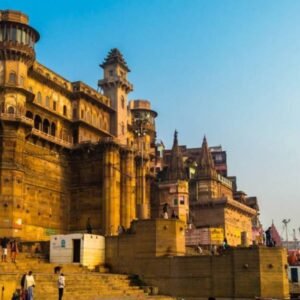
5 Days Ayodhya Varanasi Tour Package
-
3 Nights 4 Days Ayodhya Varanasi Tour Package
Original price was: ₹11,000.00.₹10,000.00Current price is: ₹10,000.00.


🙏 Ready to Include Annapurna Devi Mandir in Your Varanasi Visit?
WhatsApp Experience My India and receive a complete Kashi Vishwanath + Annapurna Devi Mandir itinerary within 30 minutes – Annapurna timing confirmed, Annadanam window planned, Annakut festival dates checked and all Varanasi transport arranged.
WhatsApp +91-7302265809 – Book Now
Jai Shri Ram 🙏