
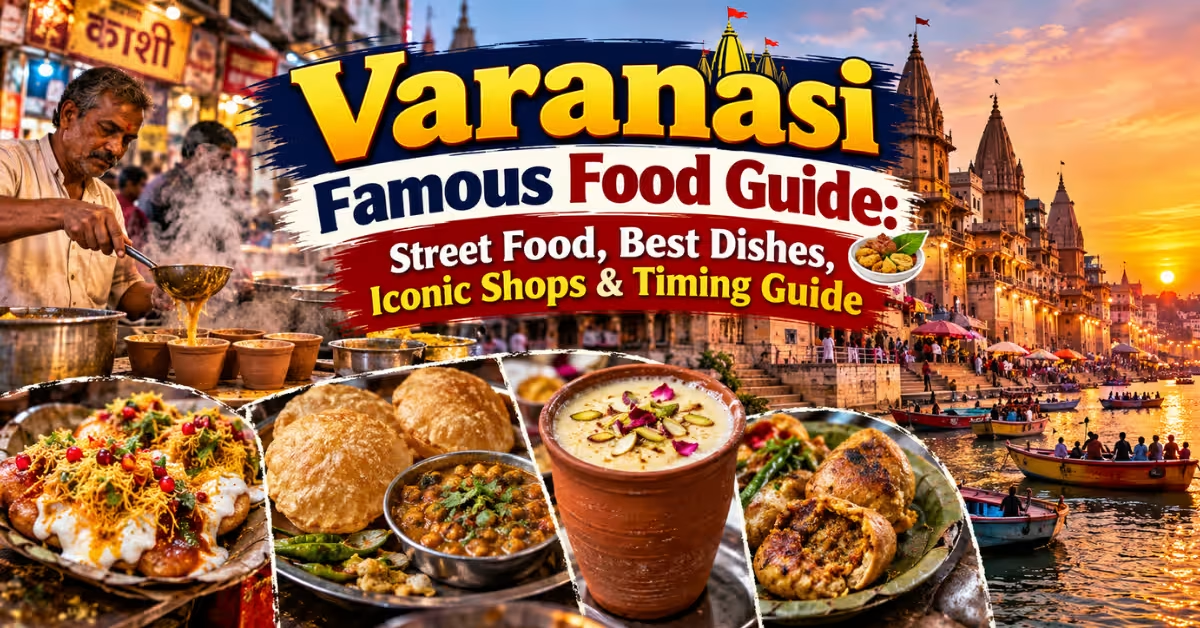
Varanasi famous food: Breakfast (6-10 AM only) – Ram Bhandar Gol Kachori + Jalebi, Lakshmi Chai Wale Safed Makkhan Toast. Afternoon/evening – Kashi Chat Bhandar Tamatar Chaat (pure desi ghee, no onion-garlic), Deena Chooda Matar. Drinks – Blue Lassi in kulhad (spoon required), Mishrambu Thandai (optional bhang). Winter only (Nov-Feb) – Malaiyo from Chaukhamba Gali at dawn. Finish with Banarasi Paan (dissolves completely, no residue). Most Varanasi street food is sattvic (no onion, no garlic). Experience My India. See our Ayodhya Varanasi Tour Package or message WhatsApp +91 7302265809.
Varanasi does not perform its food culture – it simply lives it. The city’s most celebrated dishes are not served in restaurants with printed menus and table service. They are cooked in huge iron karais on the side of ancient lanes at 6 AM, ladled into clay pots that are crushed after one use and consumed while standing on the steps of a 17th-century building watching the rest of the city wake up.
I am Gurudutt, born and raised in Braj Bhoomi and the founder of Experience My India. Since 2018, I have guided 50,000+ pilgrims through Varanasi – and the consistent food advice I give every group: the best of Varanasi is eaten between 6 AM and 11 AM, most of it is sattvic (no onion, no garlic), most of it costs between ₹20 and ₹100 and one specific dessert (Malaiyo) disappears entirely for eight months of the year and reappears in October for the pure reason that the winter night air of Varanasi produces the right kind of dew.
This guide gives you the complete Varanasi food map. WhatsApp +91-7302265809.
Why Varanasi Food Is Unlike Any Other City in India
Three things make Varanasi’s food tradition distinct:
1. The breakfast event: In most Indian cities, breakfast is a private domestic meal. In Varanasi, breakfast is a public event – thousands of people eating at street stalls simultaneously, between 6 AM and 10 AM, as part of the same daily urban ritual that includes the Ganga Aarti and the temple circuit. The street stall is the Varanasi breakfast table.
2. The sattvic constraint: Because Varanasi is a pilgrimage city, its dominant food culture is sattvic – prepared without onion and without garlic, relying on pure ghee, robust spices and fresh milk for flavour. This constraint has produced one of the most creative pure-vegetarian food traditions in the world – where the absence of onion and garlic is not a limitation but an invitation to invent.
3. The seasonal wonder: One dessert – Malaiyo – exists only for four months of the year (October/November to February) because it requires the specific combination of Varanasi’s winter night air, open-sky milk exposure and morning temperature to form. No other city in India has this dish.
For the complete Varanasi sightseeing context: 30 Best Places to Visit in Kashi 2026. Experience My India includes a food orientation briefing for every Varanasi tour group. The Same Day Varanasi Tour Package from ₹2,999 includes specific food stop timing guidance. WhatsApp +91-7302265809.
The Sattvic Tradition – Why Most Varanasi Food Has No Onion or Garlic
Sattvic food (food prepared without onion, garlic, meat or eggs) is the dietary standard of Hindu pilgrimage – following the Ayurvedic and yogic understanding that onion and garlic stimulate Rajas (agitation) and Tamas (heaviness) rather than Sattva (purity and clarity), which is the desired mental state for sacred practice.
In Varanasi – a city where a significant proportion of residents are pilgrims, temple priests, widows on sacred retreat, monks and sadhus – sattvic food is the dominant culinary mode. This means:
- Flavour comes from ghee, spices, milk and technique – not from the aromatics that most Indian cooking depends on
- The dishes are simultaneously digestible and deeply flavoured – the ghee-based preparation produces a richness without heaviness
- Pilgrims from across India recognise the food as safe and appropriate – regardless of their own regional traditions
The sattvic tradition is why Varanasi’s street food is consistently described as some of the most flavourful pure-vegetarian food in India – the constraint has produced extraordinary culinary ingenuity.
Book Your Sugam Darshan and Rudrabhishek at Kashi Vishwanath
Breakfast (6-10 AM) – Miss This Window and You Miss Varanasi
The most important food timing in Varanasi: arrive at breakfast stalls between 6:00 AM and 10:00 AM.
After 10:00 AM, the best items (Gol Kachori, fresh Jalebi, Safed Makkhan Toast) sell out at the most famous stalls. After 11:00 AM, the morning kitchen at many stalls simply closes – the day’s food has been cooked and served.
This timing is directly connected to the Varanasi pilgrimage schedule: pilgrims who complete their Ganga Aarti sunrise boat (5:00-6:30 AM) and early temple visits (Kaal Bhairav, 7:00 AM) arrive at the breakfast stalls at exactly the right time. Experience My India builds a 20-30 minute breakfast stop into the Day 1 morning programme between the sunrise boat and the Kashi Vishwanath queue. WhatsApp +91-7302265809.
Ram Bhandar – The King of Banarasi Breakfast
Location: Thatheri Bazaar, near Kachori Gali, old city Varanasi Open: 6:00 AM-11:00 AM (or until sold out – often earlier on busy days) Signature dish: Gol Kachori + Jalebi
Ram Bhandar is the most celebrated breakfast institution in Varanasi – possibly in all of UP. The queue begins before 6:00 AM on weekdays and by 7:00 AM on weekends it can stretch back 20-30 metres.
What makes Ram Bhandar’s Kachori different: The Gol Kachori here is large, perfectly round and made with a specific ratio of maida (fine flour) and a lentil-and-spice filling that has been kept consistent for generations. The critical element: it is fried in pure desi ghee – not vegetable oil – giving it a flavour depth that machine-fried kachori cannot replicate.
The sabzi: A fiery potato curry (aloo sabzi) is served alongside the kachori – cooked in the same ghee, heavy on the whole spices (black pepper, cloves, the Varanasi-style chilli heat) and designed specifically to contrast with the richness of the fried pastry.
The Jalebi: Hot, freshly fried jalebis are placed directly on top of the kachori – the hot sugar syrup (chasni) soaks into the porous kachori as you eat, creating a simultaneous sweet-spicy-savoury experience that is the most characteristic single taste of a Varanasi morning.
Cost: ₹30-₹60 per plate depending on portion size.
Lakshmi Chai Wale – Safed Makkhan Toast and Kulhad Chai
Location: Near Bhelupura / old city area, Varanasi Open: 6:00 AM-11:00 AM Signature items: Safed Makkhan Toast, Kulhad Chai
For 80+ years, Lakshmi Chai Wale has been Varanasi’s premier institution for the morning combination that defines the city’s quieter breakfast tradition.
Safed Makkhan Toast: “Safed Makkhan” means “white butter” – fresh, unsalted, hand-churned butter with a pale cream colour completely unlike the yellow salted butter of commercial production. At Lakshmi Chai Wale:
- Thick slices of local bakery bread are toasted over live charcoal embers (not electric toaster)
- The charcoal toasting creates a specific smoky-crisp exterior
- The toasted bread is slit open and a generous dollop of Safed Makkhan is placed inside
- The butter melts into the hot bread interior
The kulhad chai: Served in unglazed clay pots (kulhads) – one of the few things that genuinely changes the flavour of milk tea. The porous clay absorbs some of the liquid, the clay’s mineral character infuses into the tea and the thermal properties of the kulhad keep the tea hot while the outside remains comfortable to hold.
Cost: ₹25-₹40 per toast + chai combination.
For the complete Varanasi morning programme: Kashi Vishwanath Temple Varanasi. The 1 Night 2 Days Varanasi Tour Package from ₹3,000 includes a dedicated Day 1 breakfast stop at the Varanasi street food stalls. WhatsApp +91-7302265809.
Evening Chaats – When Twilight and Tamatar Collide
From approximately 3:00 PM until 9:00-10:00 PM, Varanasi’s food identity shifts from breakfast culture to chaat culture – tangy, spicy, ghee-rich preparations that are eaten standing up in front of the stall as the city moves toward the evening Ganga Aarti.
The word chaat (from “chaatna” – to lick) describes a category of street food designed specifically for immediate, sensory-intense consumption. Varanasi’s chaat tradition is considered one of the three most distinctive regional chaat traditions in India (alongside Delhi’s and Lucknow’s) – and the defining dish is the Tamatar Chaat.
Kashi Chat Bhandar – Varanasi’s Most Famous Street Food Spot
Location: Near Dashashwamedh Ghat, Godowlia area, central Varanasi Open: 10:00 AM-10:00 PM (chaat peak: 4:00-9:00 PM) Signature dishes: Tamatar Chaat, Palak Patta Chaat
The Tamatar Chaat: This is Varanasi’s most specific and most celebrated street food – a preparation that has no precise equivalent outside the city.
What goes into it:
- Boiled potatoes (mashed, not chunked)
- Fresh tomatoes
- A set of local spices – black salt, roasted cumin, Varanasi chilli
- Pure desi ghee – not oil, not refined fat
- A finishing drizzle of sweet sugar syrup infused with roasted cumin
What makes it unique: The preparation happens in a large iron kadai (wok) in front of you – the potatoes and tomatoes are cooked together in the ghee until they form a unified paste, then plated and finished with the sugar syrup. No onion, no garlic. The sweetness of the syrup against the heat of the spices against the richness of the ghee against the tartness of the tomato creates the flavour profile that is uniquely Varanasi.
Palak Patta Chaat: Spinach leaves dipped in a light batter, fried in pure ghee until crisp, topped with seasoned yoghurt (sweetened slightly), tamarind chutney and coriander chutney – the crunch of the fried leaf against the cool curd is the textural counterpoint to the Tamatar Chaat’s unified paste character.
The crowd: Kashi Chat Bhandar is genuinely chaotic at peak evening hours. The stall has been at this location for decades and the line can be 15-20 people deep. No seating. Order, pay, receive, eat standing. Plates back to the counter when done.
Cost: ₹40-₹80 per item.
For the Dashashwamedh Ghat context: Manikarnika Ghat. The 2 Nights 3 Days Varanasi Tour Package includes pre-Ganga Aarti chaat time at Kashi Chat Bhandar. WhatsApp +91-7302265809.
Deena Chaat Bhandar – The Calmer Alternative
Location: Near Dashashwamedh area, slightly off the main ghat lane Open: 11:00 AM-9:00 PM Signature dishes: Tamatar Chaat, Chooda Matar
When Kashi Chat Bhandar’s crowd is at its most intense – or when you want a slightly more spacious experience – Deena Chaat Bhandar is the informed local’s second choice, not a consolation.
The Chooda Matar: Varanasi’s own version of poha (flattened rice) – technically the same base ingredient but prepared with a local character:
- Flattened rice (chura/poha) – soaked briefly until just softened but not mushy
- Cooked with fresh green peas (matar) – the defining green element
- Finished with pure ghee, cream and a specific set of warm spices (garam masala applied lightly, not heavily)
- Served warm – not at room temperature like many poha preparations
The result is lighter and creamier than standard poha – the ghee and cream give it a richness that makes it genuinely filling without feeling heavy.
Cost: ₹40-₹80.
Book Your Sugam Darshan and Rudrabhishek at Kashi Vishwanath
Liquid Gold – Lassi and Thandai
Milk and yoghurt dominate Varanasi’s drink culture – in a tradition that is simultaneously sacred (milk is the purest food in Hindu dietary philosophy), culinary (the city’s dairy product quality is outstanding) and deeply commercial (the lassi shops near the ghats are among the most visited food establishments in the city).
Blue Lassi Shop – The Legendary Kulhad Lassi
Location: Kachori Gali / Vishwanath Gali area – a narrow blue-painted alley near the burning ghat Open: 7:00 AM-7:00 PM Signature item: Classic and flavoured lassi in kulhad
The Blue Lassi Shop is small enough that four customers simultaneously make it feel crowded. Its fame is global – it has been photographed by every travel photographer who has visited Varanasi in the past 20 years and featured in every international food travel guide that covers India.
What makes the lassi here different:
- Hand-churned fresh yoghurt – not commercial curd
- Thickness: The classic plain lassi is thick enough to require a spoon. It is not a drink in the conventional sense – it is a meal in a kulhad
- The kulhad: Unglazed clay pots, one-use, crushed after consumption. The clay gives a mild mineral character to the yoghurt that no steel or plastic vessel can replicate
- Flavours: Classic Kesar Badam (saffron-almond) is the traditional choice. The shop is also internationally famous for seasonal fruit lassis – mango in season, strawberry, pomegranate – and for the unusual additions that have attracted a backpacker clientele: fresh mashed mushroom, chocolate and other Western-influenced combinations
The experience: You collect your filled kulhad, find a spot on the nearby step or wall, eat the lassi with the provided spoon and crush the kulhad on the ground when done – exactly as the tradition dictates.
Cost: ₹60-₹150 depending on size and flavour.
Experience My India includes a Blue Lassi stop for all Varanasi groups doing the Kachori Gali / Vishwanath Gali morning walk. WhatsApp +91-7302265809.
Mishrambu Thandai – With Optional Bhang
Location: Dashashwamedh Ghat area, Varanasi Open: 8:00 AM-9:00 PM Signature item: Thandai (with or without bhang)
What is Thandai: A cold milk drink prepared with a ground paste of: blanched almonds, pistachios, cashews, black pepper, saffron, dried rose petals, fennel seeds, cardamom and melon seeds – blended with cold whole milk and sweetened with sugar. The result is a dense, complex, spiced cold milk that is simultaneously cooling and invigorating.
The bhang option: Bhang (a paste prepared from cannabis – Cannabis sativa leaves) has been offered to Lord Shiva as a sacred substance for thousands of years – particularly during Shivratri and Holi. In Varanasi, bhang-infused Thandai is available at licensed government shops and at established vendors like Mishrambu.
Practical guidance: Bhang Thandai produces genuine psychoactive effects – the intensity varies by preparation and by individual. First-time visitors should approach with caution. It is legal at licensed shops in Varanasi (Uttar Pradesh government-licensed bhang shops). It is not appropriate for those with any anxiety history, for pilgrims doing significant temple darshan on the same day or for drivers. Experience My India always provides a clear briefing on bhang before visits. WhatsApp +91-7302265809.
Cost: Thandai without bhang ₹50-₹100. With bhang ₹100-₹200 (varies).
Malaiyo – The Winter-Only Dessert You Must Plan For
Season: October/November to February only Location: Chaukhamba Gali and surrounding old city lanes – sold from large brass platters at dawn Time: Available from approximately 6:00 AM – typically sells out by 9:00-10:00 AM
Malaiyo is the most discussed, most missed and most talked-about Varanasi food experience – a dessert that exists for only four months a year because its creation requires specific atmospheric conditions that only Varanasi’s winter produces.
How Malaiyo is made:
| Step | What Happens |
| 1. Evening: Milk is boiled | Fresh whole milk is heated in large flat-bottomed vessels |
| 2. Night: Vessels placed under open sky | The boiled milk is set under the open night sky – winter temperature drops to 8-15°C |
| 3. Overnight: Dew forms on the milk surface | The cold, humid Varanasi winter night causes dew to form on and around the milk |
| 4. Dawn: Milk texture transformed | Overnight exposure creates a specific texture change – the milk surface develops a network of extremely fine protein strands |
| 5. Morning: Whipping creates the foam | The textured milk is whipped rapidly, creating a foam so light it barely registers as substance |
| 6. Finishing: Saffron, pistachios, almonds | The foam is topped with saffron (kesar), crushed green pistachios and almond slivers |
The texture: Malaiyo is not a cream, not a mousse, not a whipped yoghurt – it is a foam of milk that is so light it literally dissolves on the tongue in 2-3 seconds. The sensation is of cold, saffron-scented air with a faint sweetness – not of food in any conventional sense.
The season requirement: Outside October-February, the Varanasi night temperature does not drop to the level required for the dew formation that creates the specific milk texture. No refrigerator, no air conditioning, no industrial process produces the same result. Malaiyo exists only in its season and only in Varanasi (and some parts of Lucknow under the local name “Nimish”).
Where to find it: The most authentic Malaiyo is sold from large brass platters (thaals) by vendors walking or stationary in Chaukhamba Gali, the Chowk area and the lanes near Kachori Gali – starting at 6:00 AM, selling out by 9:00 AM.
Cost: ₹30-₹60 per serving.
Experience My India’s advice: If you are visiting Varanasi between November and February, the 6:00 AM Malaiyo from Chaukhamba Gali is the single food experience that should be non-negotiable in your itinerary. WhatsApp +91-7302265809.
For the winter Varanasi guide: Best Time to Visit Varanasi 2026.
Banarasi Paan – The Grand Finale
Location: Keshav Paan Bhandaar (near Lanka) or Rajendra Chaurasia (Godowlia area) Open: 8:00 AM-10:00 PM Signature item: Meetha Paan (sweet paan)
No culinary journey through Kashi is complete without a Banarasi Paan – the betel leaf preparation that serves as palate cleanser, digestive and cultural closing ritual simultaneously.
Why Banarasi Paan is different: The betel leaf (paan patta) used in Varanasi has been specifically cultivated in the region for a flavour and texture profile unavailable elsewhere. The critical difference:
It dissolves completely. Standard paan from other Indian cities leaves a fibrous residue – the chewed paan must be spat out or disposed of. Banarasi Paan, because of the specific cultivation method of the local betel leaf (which involves a chemical/alkaline treatment during growing), breaks down entirely in the mouth within 3-4 minutes – leaving no residue, no need to spit, just the lingering sweet flavour.
The Meetha Paan contents:
- The Banarasi betel leaf (soft, pale green, slightly sweet in itself)
- Gulkand – rose petal paste, the dominant sweet element
- Fennel seeds (saunf) – digestive and aromatic
- Sweet coconut shreds
- Cardamom powder
- Clove powder
- Lime paste (chuna) – applied to the leaf in tiny quantity
- Optional: silver leaf (vark) on the outside
The rolling: The paan is folded into a tight triangle by the paan-wala with practiced one-handed speed – the result is a perfectly shaped 3 cm parcel that fits entirely in the cheek.
Cost: ₹20-₹60 for a Meetha Paan.
Recommended vendors:
- Keshav Paan Bhandaar – near Lanka, Varanasi (consistent quality, long-established)
- Rajendra Chaurasia – Godowlia area (convenient location near Dashashwamedh)
What Not to Miss – Summary Table
| Dish | Vendor | Timing | Cost | Season |
| Gol Kachori + Jalebi | Ram Bhandar | 6-11 AM | ₹30-₹60 | Year-round |
| Safed Makkhan Toast + Chai | Lakshmi Chai Wale | 6-11 AM | ₹25-₹40 | Year-round |
| Tamatar Chaat | Kashi Chat Bhandar | 3-10 PM | ₹40-₹80 | Year-round |
| Palak Patta Chaat | Kashi Chat Bhandar | 3-10 PM | ₹40-₹80 | Year-round |
| Chooda Matar | Deena Chaat Bhandar | 11 AM-9 PM | ₹40-₹80 | Year-round |
| Kulhad Lassi (Kesar Badam) | Blue Lassi Shop | 7 AM-7 PM | ₹60-₹150 | Year-round |
| Thandai (with/without bhang) | Mishrambu | 8 AM-9 PM | ₹50-₹200 | Year-round |
| Malaiyo | Chaukhamba Gali vendors | 6-9 AM | ₹30-₹60 | Oct-Feb only |
| Meetha Paan | Keshav / Rajendra | 8 AM-10 PM | ₹20-₹60 | Year-round |
How to Plan Your Varanasi Food Day
| Time | Food Activity |
| 5:00-6:30 AM | Sunrise boat (all 84 ghats) |
| 6:30-7:00 AM | Ram Bhandar – Gol Kachori + Jalebi |
| 7:00-9:30 AM | Kashi Vishwanath darshan (Sugam ₹250) |
| 9:30-10:00 AM | Lakshmi Chai Wale – Safed Makkhan Toast (if still open) |
| 10:00-10:15 AM | Blue Lassi Shop – Kulhad Lassi |
| (If Nov-Feb) 6:30-7:00 AM | Malaiyo from Chaukhamba Gali (before Ram Bhandar) |
| 12:00-4:00 PM | Rest (afternoon temple closure window) |
| 5:00-6:30 PM | Kashi Chat Bhandar – Tamatar Chaat + Palak Patta Chaat |
| 6:15 PM | Board boat for Ganga Aarti |
| 7:00-7:45 PM | Ganga Aarti from river-facing boat |
| 8:00-8:30 PM | Mishrambu Thandai |
| 8:45 PM | Banarasi Paan – Rajendra Chaurasia, Godowlia |
Experience My India integrates food stops into every Varanasi tour programme. The 1 Night 2 Days Varanasi Tour Package from ₹3,000 includes Ram Bhandar breakfast on Day 1 and Kashi Chat Bhandar pre-aarti on Day 1 evening. WhatsApp +91-7302265809.
Ground Truth – What Nobody Tells You About Varanasi Food
1. The best Varanasi breakfast is sold out by 10:00-10:30 AM at most stalls. Guides who tell you to “go whenever you want” have never tried to get a Ram Bhandar Kachori at 11:30 AM. You will find the kachoris – but from the third-batch reheats, not the first morning fry. The first batch is the only batch. Experience My India programmes all Varanasi groups for a 6:30-7:30 AM breakfast window as non-negotiable.
2. Malaiyo disappears in March and returns in October – and most Varanasi travel guides describe it without mentioning the season. Pilgrims who visit in May expecting to find Malaiyo are consistently disappointed. It physically cannot be made outside its season. Experience My India tells every group visiting between March and September: Malaiyo is not available. It tells every November-February group: start Day 1 with Malaiyo at 6:30 AM – Chaukhamba Gali.
3. Banarasi Paan dissolves completely – no fibrous residue, no spitting required. This is not a marketing claim but a result of the specific alkaline chemical treatment applied to the betel leaf during cultivation that breaks down cellulose differently from other Indian paan varieties. First-time paan eaters who have only had commercial paan from other cities are consistently surprised by this. Experience My India demonstrates the paan experience at Rajendra Chaurasia for every willing group.
4. The Blue Lassi Shop’s famous lassi is thick enough that drinking it (as you would a standard lassi) results in spillage. A spoon is provided and required. The kulhad is not a drinking vessel – it is a bowl. Many first-time visitors attempt to drink from the kulhad and end up wearing some of the lassi.
5. Kashi Chat Bhandar’s Tamatar Chaat is prepared in pure desi ghee – not oil. The flavour distinction is immediately identifiable to anyone who has had both. The ghee preparation is one of the reasons this specific dish is considered Varanasi’s most representative food.
Frequently Asked Questions – Varanasi Famous Food
The most famous food in Varanasi is the Gol Kachori with Jalebi breakfast combination at Ram Bhandar – a crispy lentil-stuffed puffed pastry served with fiery potato curry and hot jalebis, eaten standing at 6-7 AM. The evening counterpart is the Tamatar Chaat at Kashi Chat Bhandar – mashed potatoes and tomatoes cooked in pure desi ghee (no onion, no garlic) with a sweet cumin sugar syrup finish. The seasonal speciality is Malaiyo – a winter-only (November-February) foam dessert made from overnight dew-exposed milk, saffron and nuts. Most Varanasi street food is sattvic (no onion, no garlic) due to the city’s pilgrimage food tradition. Experience My India plans all food stops. WhatsApp +91-7302265809.
Malaiyo is a dessert unique to Varanasi (and some parts of Lucknow, where it is called Nimish) – made by boiling milk, exposing it overnight under the open winter sky to catch the morning dew, then whipping the textured milk into an extremely light, cloud-like foam infused with saffron, pistachios and almonds. It dissolves on the tongue in 2-3 seconds. Malaiyo is available only from October/November to February – outside this window, Varanasi’s night temperatures do not drop enough to create the dew that transforms the milk texture. It is sold from brass platters in Chaukhamba Gali and surrounding old city lanes from 6:00 AM until sold out (9:00-10:00 AM). Cost: ₹30-₹60. Experience My India includes Malaiyo for all October-February Varanasi visits. WhatsApp +91-7302265809.
Tamatar Chaat is Varanasi’s most distinctive street food – a preparation with no precise equivalent in other Indian cities. Boiled mashed potatoes and fresh tomatoes are cooked together in pure desi ghee (no oil, no onion, no garlic) until they form a unified mixture, then finished with a drizzle of sweet sugar syrup infused with roasted cumin. The result combines sweet-spicy-rich-tangy flavours in a single bite. The best is at Kashi Chat Bhandar near Dashashwamedh Ghat – open 10:00 AM to 10:00 PM, peak hours 4:00-9:00 PM. Cost: ₹40-₹80. The alternative with shorter queues is Deena Chaat Bhandar nearby. Experience My India builds a pre-Ganga Aarti chaat stop into all Varanasi evening programmes. WhatsApp +91-7302265809.
The Blue Lassi Shop in Varanasi (located in a narrow blue-painted alley near Kachori Gali / Vishwanath Gali area) has been hand-churning thick yoghurt lassi for decades, served in unglazed clay kulhads. The lassi is thick enough to require a spoon – not a typical drinkable lassi. Classic flavour: Kesar Badam (saffron-almond). Also available: seasonal fruit lassis (mango, strawberry, pomegranate) and unconventional flavours (mushroom, chocolate) that have made it internationally famous. Open approximately 7:00 AM to 7:00 PM. Cost: ₹60-₹150 depending on size and flavour. The kulhad is crushed after use – the traditional disposal method. Experience My India includes the Blue Lassi Shop in all Varanasi morning circuits. WhatsApp +91-7302265809.
Most traditional Varanasi street food is sattvic – prepared without onion and garlic – because Varanasi is a pilgrimage city whose dominant food tradition caters to pilgrims, temple priests, sadhus and monks who follow the sattvic dietary standard. Sattvic food (from the Sanskrit Sattva – purity, clarity) avoids substances understood in Ayurveda and yoga philosophy to stimulate agitation (Rajas) or heaviness (Tamas). The result is that Varanasi’s food tradition has developed extraordinary flavour depth using only ghee, spices, milk and technique – without the aromatics that most Indian cooking depends on. Experience My India explains this tradition at every Varanasi food stop. WhatsApp +91-7302265809.
Banarasi Paan is the betel leaf preparation unique to Varanasi – distinguished from paan in other Indian cities by one critical feature: it dissolves completely in the mouth, leaving no fibrous residue and requiring no spitting. The local betel leaf is cultivated with an alkaline treatment that breaks down cellulose differently. The classic Meetha (sweet) Paan is filled with gulkand (rose petal paste), fennel seeds, sweet coconut, cardamom and a small amount of lime paste. Best sources: Keshav Paan Bhandaar (near Lanka) and Rajendra Chaurasia (Godowlia area). Cost: ₹20-₹60. Experience My India ends every Varanasi evening with a Banarasi Paan at Godowlia. WhatsApp +91-7302265809.
Varanasi street food operates in three windows. Morning (6:00-10:00 AM): breakfast stalls – Ram Bhandar (Gol Kachori + Jalebi), Lakshmi Chai Wale (Safed Makkhan Toast), Blue Lassi Shop. Arrive by 7:00 AM for the best items; many stalls sell out or close by 10:30-11:00 AM. Afternoon-evening (4:00-9:00 PM): chaat stalls – Kashi Chat Bhandar (Tamatar Chaat, Palak Patta Chaat), Deena Chaat Bhandar (Chooda Matar). Evening and night (8:00-10:00 PM): Mishrambu Thandai, Banarasi Paan. Winter bonus (November-February, 6:00-9:00 AM): Malaiyo from Chaukhamba Gali. Experience My India times all Varanasi food stops correctly for every tour group. WhatsApp +91-7302265809.
Thandai is a cold milk drink prepared with a ground paste of blanched almonds, pistachios, black pepper, saffron, dried rose petals, fennel seeds, cardamom and melon seeds – blended with cold whole milk and sweetened with sugar. It is served cold, typically in a glass or clay vessel, as a cooling and nourishing drink. The name means “that which cools” in Hindi. In Varanasi, Thandai is available at Mishrambu (near Dashashwamedh Ghat) and other established shops. An optional addition is bhang – a paste of cannabis leaves offered to Lord Shiva – which makes the drink mildly psychoactive. Bhang Thandai is legal at licensed government shops. Cost: ₹50-₹100 (without bhang), ₹100-₹200 (with bhang). Experience My India briefs all groups on bhang before any thandai stop. WhatsApp +91-7302265809.
Recommended products
-
1 Night 2 Days Varanasi Tour Package
Original price was: ₹7,000.00.₹6,000.00Current price is: ₹6,000.00. -
2 Night 3 Days Ayodhya Varanasi Tour Package
Original price was: ₹9,000.00.₹8,000.00Current price is: ₹8,000.00. -
2 Nights 3 Days Varanasi Tour Package
Original price was: ₹11,000.00.₹9,500.00Current price is: ₹9,500.00. -
5 Days Ayodhya Varanasi Tour Package


🙏 Ready to Eat Your Way Through Varanasi with Experience My India?
WhatsApp us – Ram Bhandar stop at 6:30 AM, Malaiyo season confirmed, Blue Lassi kulhad experience planned, Kashi Chat Bhandar before the Ganga Aarti, Banarasi Paan at Rajendra Chaurasia as the finale. The complete Varanasi food circuit. Rated 4.5★ by 204+ pilgrims.
WhatsApp +91-7302265809 – Book Now
Jai Shri Ram 🙏