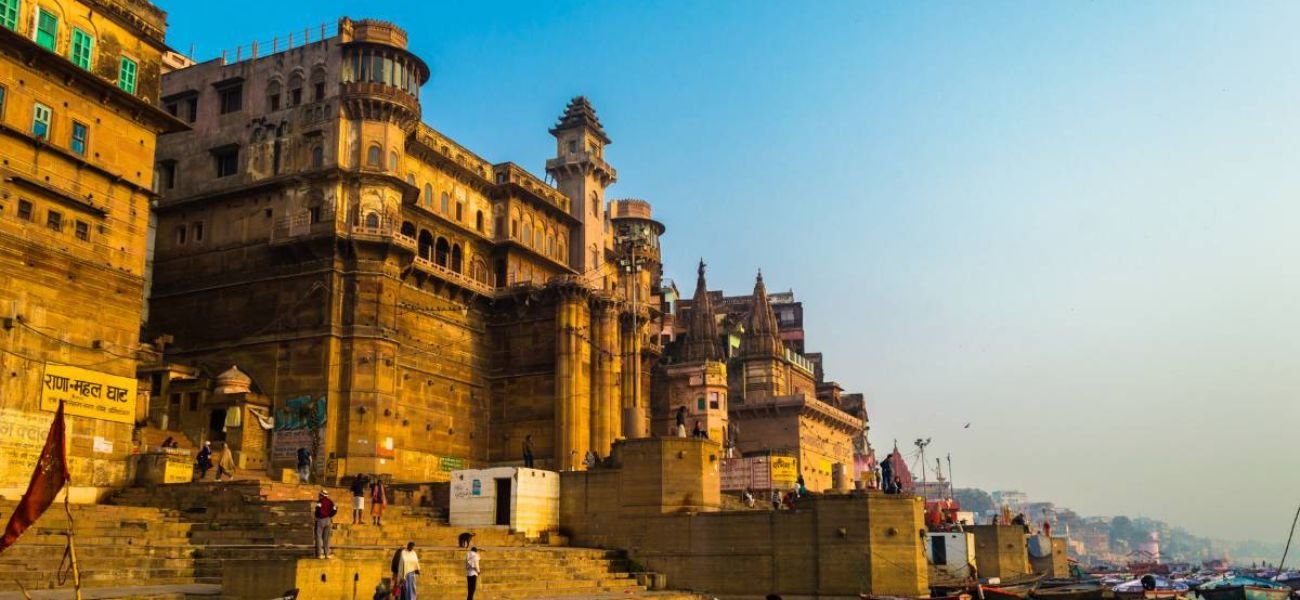

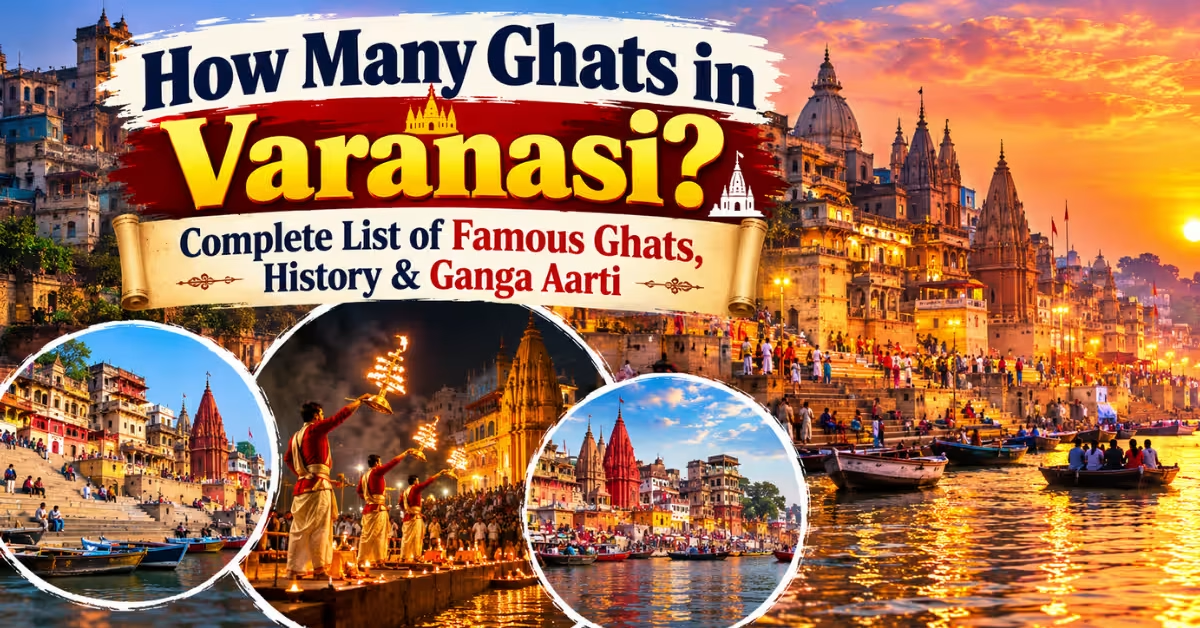
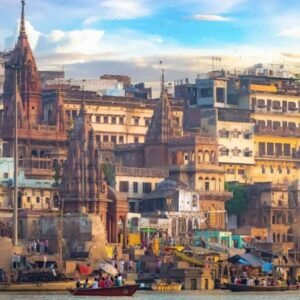
How many ghats in Varanasi? Traditionally 84 ghats – officially 88 ghats (Varanasi Smart City portal). All on the western bank of the Ganges, stretching 6.5 km from Ravidas Ghat (south) to Raj Ghat (north). The 5 most sacred (Panchatirthi): Assi, Dashashwamedh, Manikarnika, Panchganga and Adi Keshav. Only 2 cremation ghats: Manikarnika and Harishchandra. Ganga Aarti at 7 PM at Dashashwamedh – watch from a boat. All 84 ghats light on Dev Deepawali (24 Nov 2026). Experience My India plans complete ghat tours from ₹2,999. WhatsApp +91-7302265809. See our Ayodhya Varanasi Tour Package or message WhatsApp +91 7302265809.
The ghats of Varanasi are one of the most iconic riverfront landscapes in the world – a 6.5 km arc of stone steps along the western bank of the Ganges, connecting 84 (or 88) named sacred sites from the southernmost Ravidas Ghat to the northernmost Raj Ghat. For first-time visitors, the most common question is simple: how many ghats are there, which ones matter most and what is the best way to see them?
I am Gurudutt, born and raised in Braj Bhoomi and the founder of Experience My India. Since 2018, I have guided 50,000+ pilgrims along the Varanasi ghat sequence – from the sunrise boat ride that covers all 84 ghats in 90 minutes to the Dev Deepawali night when every single ghat burns with earthen lamps. This guide gives you the complete answer to the ghat count, the list, the history and the practical visiting guide.
How Many Ghats in Varanasi – The 84 vs 88 Question Answered
The honest answer requires acknowledging both counts:
| Count | Source | Explanation |
| 84 ghats | Traditional, cultural, mythological | The number 84 is sacred in Hinduism – 84 lakh (8.4 million) species of life in the karmic cycle |
| 88 ghats | Varanasi Smart City official portal, some municipal records | Additional ghats created through new construction and subdivision of existing ghats over time |
Why both are correct: The 84 count is theological and cultural – it has been the number associated with Varanasi’s ghats in sacred texts, pilgrim guides and devotional tradition for centuries. The 88 count is administrative – it reflects the current official municipal count including newer additions and subdivisions.
For the purposes of pilgrimage planning and cultural significance, 84 is the number that matters. The additional 4 in the official count are minor extensions or newly recognised sections, not historically distinct sacred sites.
The 6.5 km stretch: All ghats are on the western bank of the Ganges – the bank that faces the rising sun. This is deliberately significant in Hindu sacred geography: the western bank of the Ganges is the sacred side, the eastern bank (Ramnagar side) is considered less sanctified. The 6.5 km stretch from Ravidas Ghat to Raj Ghat encompasses the entire sacred riverfront of Varanasi.
For the complete Varanasi sightseeing guide: 30 Best Places to Visit in Kashi 2026. Experience My India covers all major ghats in every Varanasi tour. WhatsApp +91-7302265809.
Why 84 Is the Sacred Number – The Theological Explanation
The number 84 (and its multiple 84 lakh = 8.4 million) is one of the most theologically significant numbers in Hinduism and related dharmic traditions.
Hindu cosmological significance: According to Hindu cosmology, a soul passes through 84 lakh (8.4 million) species of life – from the most primitive organisms to the most evolved – before attaining a human birth. Human birth is considered the rarest and most precious in this cycle because only a human can consciously pursue moksha (liberation).
The 84 ghats of Varanasi symbolically represent this complete cycle. A pilgrimage along all 84 ghats – or a ritual dip at specific ghats – is understood as an encounter with the full spectrum of existence, culminating in the sacred city where moksha is granted.
The Jain connection: In Jainism, 84 is also significant – there are traditionally 84 disciples of the 24 Tirthankaras (enlightened teachers). The number’s sacred status crosses theological traditions.
The Buddhist connection: In Buddhism, the Pali Canon contains 84,000 teachings of the Buddha – the same underlying numerical symbolism.
For the complete Varanasi spiritual context and Kashi Vishwanath guide: Kashi Vishwanath Temple Varanasi. The 1 Night 2 Days Varanasi Tour Package from ₹3,999 includes the sunrise boat ride covering all 84 ghats. WhatsApp +91-7302265809.
The Panchatirthi – The 5 Most Sacred Ghats in Varanasi
Among all 84 ghats, Hindu tradition identifies five as the Panchatirthi – the five sacred crossing points that form the most concentrated pilgrimage circuit on the Varanasi riverfront:
| # | Ghat | Significance |
| 1 | Assi Ghat | Southern boundary of the sacred Varanasi riverfront – where the Assi stream meets the Ganges |
| 2 | Dashashwamedh Ghat | Brahma’s 10-horse sacrifice site – central ghat, Ganga Aarti venue |
| 3 | Manikarnika Ghat | Parvati’s earring fell here – primary cremation ghat – most sacred in Hinduism |
| 4 | Panchganga Ghat | Confluence of five rivers (3 invisible, 2 visible) – Bindu Madhav Temple above |
| 5 | Adi Keshav (Raj) Ghat | Vishnu’s first footfall in Kashi – northernmost major sacred ghat |
The Panchatirthi Yatra: Pilgrims performing the Panchatirthi Yatra take a sacred bath at each of these five ghats in sequence – beginning at Assi Ghat and proceeding north to Raj Ghat. This is one of the most complete sacred circuits available at the Varanasi riverfront, touching all five types of devotion represented by each ghat’s presiding deity tradition.
Experience My India includes the Panchatirthi ghat sequence in the 2 Nights 3 Days Varanasi Tour Package as an optional Day 3 morning programme. WhatsApp +91-7302265809.
Book Your Sugam Darshan and Rudrabhishek at Kashi Vishwanath
The Complete Varanasi Ghats List – South to North
All 84 traditional ghats in the sequence from Assi Ghat (southernmost) to Raj Ghat (northernmost):
| # | Ghat Name | Notable Feature |
| 1 | Ravidas Ghat | Dedicated to Sant Ravidas – Dalit saint poet tradition |
| 2 | Assi Ghat | Panchatirthi – Subah-e-Banaras morning programme |
| 3 | Ganga Mahal Ghat | Maharaja of Vijayanagaram’s palace |
| 4 | Bhonsla Ghat | Nagpur Bhonsle royal family patronage |
| 5 | Niranjani Ghat | Niranjani Akhara associated |
| 6 | Nirvani Ghat | Nirvani Akhara |
| 7 | Prayag Ghat | Named for Prayagraj confluence symbolism |
| 8 | Dasaswamedh Road Ghat | – |
| 9 | Rajendra Prasad Ghat | – |
| 10 | Kedar Ghat | Kedareshwar Shiva temple – South Indian community |
| 11 | Chauki Ghat | – |
| 12 | Mansarowar Ghat | – |
| 13 | Narad Ghat | – |
| 14 | Raja Ghat | – |
| 15 | Ganga Ghat | – |
| 16 | Jain Ghat | Jain community’s sacred ghat |
| 17 | Pandey Ghat | – |
| 18 | Digpatia Ghat | – |
| 19 | Chausat Ghat | 64 Yoginis tradition |
| 20 | Rana Mahal Ghat | – |
| 21 | Darbhanga Ghat | Darbhanga royal family |
| 22 | Munshi Ghat | – |
| 23 | Ahalya Bai Ghat | Maratha Queen Ahilyabai Holkar patronage |
| 24 | Shivala Ghat | Shiva temple |
| 25 | Guleria Ghat | – |
| 26 | Nishad Ghat | – |
| 27 | Dashashwamedh Ghat | Panchatirthi – Ganga Aarti – most visited |
| 28 | Prayag Ghat (inner) | – |
| 29 | Rajghat (inner) | – |
| 30 | Man Mandir Ghat | Jai Singh II’s astronomical observatory |
| 31 | Tripura Bhairavi Ghat | – |
| 32 | Mir Ghat | Near Vishalakshi Shakti Peeth |
| 33 | Lalita Ghat | Nepali Temple (Kathwala Mandir) – Gate 1 KV Corridor |
| 34 | Manikarnika Ghat | Panchatirthi – cremation – most sacred |
| 35 | Scindia Ghat | Partially submerged Shiva temple |
| 36 | Sankatha Ghat | – |
| 37 | Ganga Mahal Ghat | – |
| 38 | Kali Ghat | – |
| 39 | Ram Ghat | – |
| 40 | Jalsain Ghat | – |
| 41 | Manasarovar Ghat | – |
| 42 | Naya Ghat | – |
| 43 | Panchkot Ghat | – |
| 44 | Khirkiya Ghat | – |
| 45 | Hanuman Ghat | Hanuman temple |
| 46 | Prahlad Ghat | – |
| 47 | Harishchandra Ghat | Second cremation ghat – electric cremation option |
| 48 | Kedar Ghat (north section) | – |
| 49 | Vijayanagaram Ghat | – |
| 50 | Mathur Ghat | – |
| 51 | Janki Ghat | – |
| 52 | Krishna Ghat | – |
| 53 | Bhadon Ghat | – |
| 54 | Sheetla Ghat | – |
| 55 | Lal Ghat | – |
| 56 | Gola Ghat | – |
| 57 | Dhobi Ghat | Washermen’s ghat |
| 58 | Kshameshwar Ghat | – |
| 59 | Trilochana Ghat | Three-eyed Shiva |
| 60 | Tulesidas Ghat | – |
| 61 | Panchganga Ghat | Panchatirthi – Bindu Madhav Temple above |
| 62 | Durga Ghat | – |
| 63 | Brahma Ghat | Brahma’s penance site |
| 64 | Bundi Parka Ghat | – |
| 65 | Sheetla Ghat | – |
| 66 | Lal Ghat | – |
| 67 | Nandeshwar Ghat | – |
| 68 | Telia Nala Ghat | – |
| 69 | Chet Singh Ghat | Maharaja Chet Singh’s fort-palace |
| 70 | Shivaji Ghat | – |
| 71 | Niranjanighat | – |
| 72 | Ganesh Ghat | – |
| 73 | Revati Ghat | – |
| 74 | Gai Ghat | – |
| 75 | Alamgir Ghat | Aurangzeb’s mosque above the ghat |
| 76 | Phuta Ghat | – |
| 77 | Raj Ghat area cluster | – |
| 78 | Teliyabagh Ghat | – |
| 79 | Adi Keshav (Raj) Ghat | Panchatirthi – Vishnu’s first landing in Kashi |
| 80 | Ganga Station Ghat | – |
| 81-84 | Remaining northern ghats | Minor ghats near Raj Ghat |
Key observations from the full list:
- The most historically significant ghats cluster between Assi (south) and Panchganga (north) – approximately 4 km
- The northernmost significant ghats (Panchganga to Raj Ghat) are a 30-45 minute further walk and rarely included in standard tourist circuits
- Most pilgrims see 10-15 ghats in a standard visit; the sunrise boat covers all 84 in 90 minutes
The 2 Cremation Ghats – Manikarnika and Harishchandra
Of all 84 ghats in Varanasi, only two are used exclusively for cremation:
| Cremation Ghat | Location | Character |
| Manikarnika Ghat | Central – between Scindia and Lalita | Largest, most sacred – pyres burn 24/7, 365 days |
| Harishchandra Ghat | South-central | Smaller – also has electric cremation facility |
The critical visitor rule for both: Approach only from a river-facing boat. Never approach the active cremation area on foot. Photography strictly prohibited. Maintain complete silence when viewing from the boat. For the complete Manikarnika guide: Manikarnika Ghat.
Harishchandra Ghat – named for the legendary king Harishchandra who worked here as a cremation attendant to fulfil a vow of truth – is the second and smaller cremation ghat. It is also historically significant as the site associated with the story of Harishchandra’s ultimate redemption. Experience My India passes both cremation ghats on the sunrise boat circuit. WhatsApp +91-7302265809.
Dashashwamedh Ghat – The Ganga Aarti Stage
Dashashwamedh Ghat is the most visited ghat in Varanasi and the stage for the nightly Ganga Aarti. Its name means “Ten Horse Sacrifice” – referring to the Dashashwamedha Yajna (10-horse Vedic ritual) performed here by Lord Brahma to welcome Lord Shiva back to Kashi.
Why it is central: Dashashwamedh sits approximately at the midpoint of the 84-ghat sequence, directly accessible from Godowlia Chowk (the main old city junction) via a 500 m lane. It is 700 m from Kashi Vishwanath Temple via the Corridor. Its central position makes it the natural focus of the entire Varanasi ghat circuit.
The Ganga Aarti:
- Summer (Apr-Sep): 7:00-7:45 PM
- Winter (Oct-Mar): 6:00-6:45 PM
- Watch from river-facing boat – priests face the Ganges (from ghat steps you see their backs)
- Board boat 45 minutes before aarti starts
Experience My India pre-arranges river-facing boat positions for all Varanasi groups. The Same Day Varanasi Tour Package from ₹2,999 ends at the Ganga Aarti from boat. WhatsApp +91-7302265809.
Assi Ghat – The Southern Anchor
Assi Ghat is the southernmost of the Panchatirthi and the most contemplative of the major ghats. The Assi stream (an ancient tributary of the Ganges) meets the river here, marking the southern boundary of the sacred Varanasi riverfront.
Subah-e-Banaras (Morning of Banaras): Every morning from approximately 5:00-5:30 AM, Assi Ghat hosts the Subah-e-Banaras programme – Vedic chanting, morning ragas by classical musicians, mass yoga sessions and the sunrise aarti. This is entirely free and one of the most authentic dawn experiences in Varanasi.
Character: Assi Ghat is preferred by Varanasi’s artistic community – musicians, poets, painters and writers gather here regularly. It has a distinctly different social atmosphere from the commercial busyness of Dashashwamedh.
Southern cluster connection: Assi Ghat is 500 m from Sankat Mochan Hanuman Temple and Tulsi Manas Mandir – making the Assi area the anchor of the southern temple and ghat cluster. The 2 Nights 3 Days Varanasi Tour Package covers Assi Ghat Subah-e-Banaras on Day 2 morning. WhatsApp +91-7302265809.
Scindia Ghat and the Submerged Temple
Scindia Ghat – named for the Maratha Scindia royal family who patronised its construction – is most famous for the partially submerged Shiva temple that leans dramatically into the Ganges at the ghat’s edge.
The temple’s subsidence into the riverbank is visible from the Ganges – the multi-storey structure leans at a significant angle, its lower sections partially underwater. This is best photographed from a passing boat. Experience My India specifically positions the sunrise boat for a clear view of the Scindia leaning temple before reaching Manikarnika.
Panchganga Ghat – The Five Rivers Confluence
Panchganga Ghat – one of the Panchatirthi – is believed to be the mythological confluence of five rivers: the Ganges and Yamuna (visible) and the Saraswati, Dhutapapa and Kirana (invisible, subterranean). The name means “Five Ganges.”
Above Panchganga Ghat stands the Bindu Madhav Temple – a significant Vishnu temple that was rebuilt after the original 11th-century structure was demolished. The elevated position above the ghat gives a panoramic view of the northern ghat sequence.
Panchganga Ghat is in the northern section of the ghat sequence – approximately 1.5 km north of Dashashwamedh, 500 m north of Manikarnika. Most pilgrims visiting by boat reach Panchganga as the northernmost point of the main circuit before returning south.
History of the Varanasi Ghats – Maratha Patronage and 18th-Century Reconstruction
The stone-paved ghats visible today are largely the result of 18th-century Maratha patronage – a fact that surprises many visitors who assume the ghats are ancient in their current form.
The historical reality:
| Period | What Happened |
| Ancient-medieval | Ghats existed as earth-and-stone steps, rebuilt repeatedly after floods |
| 11th-12th century | Several ghats developed under Hindu royal patronage |
| 16th-17th century | Mughal period – some temples demolished, some ghats disrupted |
| 18th century | Maratha rulers reconstruct most ghats in stone |
| Ahilyabai Holkar (1780) | Rebuilt Kashi Vishwanath Temple + patronised multiple ghats |
| Scindia family | Scindia Ghat constructed |
| Peshwa rulers | Multiple ghats funded |
| Nagpur Bhonsle | Bhonsla Ghat |
Key Maratha patrons of Varanasi ghats:
- Ahilyabai Holkar (Indore) – rebuilt Kashi Vishwanath, funded multiple ghats – the most significant single patron
- Scindia family (Gwalior) – Scindia Ghat
- Nagpur Bhonsle – Bhonsla Ghat
- Darbhanga royal family – Darbhanga Ghat
The current permanent stone paving of most Varanasi ghats dates primarily from 1740-1800 CE – giving them a 220-280 year old physical history, even if the sacred sites they occupy are far more ancient.
For the complete Kashi historical context and Kashi Vishwanath darshan guide: Kashi Vishwanath Temple Varanasi. Experience My India explains the Maratha patronage story at every ghat walk. WhatsApp +91-7302265809.
How to Do the Complete Ghat Walk
| Option | Duration | Distance | What You See |
| Sunrise boat (all 84 ghats) | 90 minutes | 6.5 km by river | Complete panoramic view of all ghats from the water |
| Central ghat walk (Assi to Manikarnika) | 90 min walk | 3 km | Main 30-35 ghats, most significant cluster |
| Full ghat walk (Assi to Raj Ghat) | 4-5 hours | 6.5 km on foot | All 84 ghats – requires physical stamina |
| Panchatirthi circuit (5 sacred ghats) | 2-3 hours | 4 km | Assi + Dashashwamedh + Manikarnika + Panchganga + Raj Ghat |
The sunrise boat is the most efficient option: 90 minutes on the Ganges covers all 84 ghats in the best light of the day, includes the Manikarnika cremation viewing at the correct respectful distance and positions you at the central ghats for disembarkation before the 7:00 AM Kashi Vishwanath queue.
Boat fare: Shared ₹100-₹200 per person / Private ₹600-₹1,200 for 2-4 people.
Experience My India arranges sunrise boats for all Varanasi groups. The 3 Nights 4 Days Ayodhya Varanasi Tour Package from ₹5,999 includes the sunrise ghat boat on Day 3. WhatsApp +91-7302265809.
Ganga Aarti Timings by Season
| Month | Evening Aarti (Dashashwamedh) | Morning Aarti (Dashashwamedh) | Assi Subah-e-Banaras |
| Jan | 6:00 PM | 5:30-6:00 AM | 5:30 AM |
| Feb | 6:15 PM | 5:15 AM | 5:30 AM |
| Mar | 6:30-7:00 PM | 5:00 AM | 5:00 AM |
| Apr-Jun | 7:00-7:30 PM | 5:00 AM | 5:00 AM |
| Jul-Sep | 6:45-7:15 PM | 5:15 AM | 5:00 AM |
| Oct | 6:15 PM | 5:45 AM | 5:30 AM |
| Nov | 6:00 PM | 6:00 AM | 5:30 AM |
| Dec | 5:45 PM | 6:15 AM | 5:30 AM |
For the complete Ganga Aarti viewing guide with boat pricing: Best Time to Visit Varanasi 2026. The 5 Days Varanasi Ayodhya Prayagraj Tour Package includes the complete Varanasi ghat circuit across multiple days. WhatsApp +91-7302265809.
Dev Deepawali – When All 84 Ghats Light Simultaneously
The most extraordinary night in the Varanasi ghat calendar is Dev Deepawali (Dev Diwali) – celebrated on Kartik Purnima, 15 days after the main Diwali.
Dev Deepawali 2026 date: 24 November 2026
On this night, over 1 million earthen diyas are placed along all 84 ghats from Ravidas Ghat to Raj Ghat – lit simultaneously at sunset (5:15-5:30 PM). The entire 6.5 km ghat sequence burns in lamp-light, reflected on the Ganges surface.
The correct viewing position: A river-facing boat, boarding by 4:00-4:30 PM before the ghats fill with crowds. From the river, the simultaneous diya lighting across all 84 ghats is visible as a continuous river of fire.
For the complete Dev Deepawali guide: Manikarnika Ghat. For the November festival combination (Deepotsav Ayodhya 7 Nov + Dev Deepawali Varanasi 24 Nov): 3 Nights 4 Days Ayodhya Varanasi Tour Package from ₹5,999. WhatsApp +91-7302265809 by September for hotel and boat booking.
Best Time to Visit Varanasi Ghats
| Season | Months | Ghat Condition | Ganga Aarti | Verdict |
| Post-monsoon | Oct-Nov | Beautiful high water, all ghats accessible | 6:00-6:15 PM | ✅ Best |
| Winter | Dec-Feb | Clear water, cold mornings | 5:45-6:15 PM | ✅ Excellent |
| Spring | Mar-Apr | All accessible, pleasant | 6:30-7:00 PM | ✅ Good |
| Summer | May-Jun | Very low water, extreme heat | 7:30 PM | ⚠️ Sunrise only |
| Monsoon | Jul-Sep | Lower ghats submerged, boats restricted | 7:00-7:15 PM | ⚠️ Restricted |
November is exceptional – Dev Deepawali (24 Nov) makes it the most spectacular month of the year for the ghats. Book hotel and boat by September 2026.
Ground Truth – What Nobody Tells You About the Ghats of Varanasi
1. The 84 ghats are all on the western bank – the eastern bank (Ramnagar side) is sacred geography’s “other shore” and is not counted. The eastern bank of the Ganges at Varanasi is deliberately undeveloped – no construction, no temples, no permanent structures. This preserves the view of the 84 western bank ghats from the river and maintains the sacred principle that the sunrise is seen across the Ganges from the sacred western bank.
2. The sunrise boat covers all 84 ghats in 90 minutes and is 3x more efficient than any land route for seeing the complete ghat sequence. Walking all 84 ghats (6.5 km) takes 4-5 hours. The sunrise boat covers the same sequence in 90 minutes at the best light of the day. Every Experience My India Varanasi programme begins with the sunrise boat rather than the land walk.
3. From the ghat steps at Dashashwamedh during the Ganga Aarti, you see the backs of the seven priests – the Aarti is performed facing the Ganges, not the crowd. This single fact determines the quality of the entire Ganga Aarti experience. The correct position is a river-facing boat. Experience My India gives this briefing before every Varanasi arrival.
4. The physical stone ghats visible today are mostly 18th-century Maratha constructions – the sacred sites they occupy are ancient but the stone paving is 220-280 years old. Many visitors assume the ghats are thousands of years old in their current form. The sacred geography is ancient; the stone construction is primarily 1740-1800 CE Maratha period.
5. Only 2 of the 84 ghats are cremation ghats – the remaining 82 are bathing, ritual and ceremonial ghats that are fully accessible and appropriate for all visitors. Many first-time visitors worry about the cremation ghats affecting their ghat experience. Manikarnika and Harishchandra are the only 2 cremation sites among 84 – seen from a boat, they are a distinct section of the riverfront. The other 82 ghats are completely open bathing and ritual spaces.
Frequently Asked Questions – Ghats in Varanasi
Varanasi has 84 traditional ghats by cultural and mythological count – the number 84 representing the 8.4 million (84 lakh) species of life in the Hindu karmic cycle. The official Varanasi Smart City government portal records 88 ghats due to newer additions and subdivisions over time. For pilgrimage and cultural purposes, 84 is the significant number. All ghats are on the western bank of the Ganges, stretching 6.5 km from Ravidas Ghat (south) to Raj Ghat (north). Experience My India covers all major ghats in every Varanasi tour. WhatsApp +91-7302265809.
The five most sacred ghats of Varanasi – the Panchatirthi (five sacred crossing points) – are: Assi Ghat (southernmost boundary, Subah-e-Banaras morning programme), Dashashwamedh Ghat (central ghat, Ganga Aarti at 7 PM), Manikarnika Ghat (primary cremation ghat, sacred around the clock), Panchganga Ghat (confluence of five rivers, Bindu Madhav Temple above) and Adi Keshav / Raj Ghat (northernmost sacred ghat, Vishnu’s first footfall in Kashi). Pilgrims completing the Panchatirthi Yatra take a sacred bath at each of these five ghats in sequence south to north. Experience My India includes the Panchatirthi circuit on request. WhatsApp +91-7302265809.
The number 84 in Varanasi’s ghat count is theological, not coincidental. In Hindu cosmology, a soul passes through 84 lakh (8.4 million) species of life – from the simplest organisms to the most complex – before attaining a human birth capable of moksha (liberation). The 84 ghats of Varanasi symbolically represent this complete cycle of existence, concentrated along the western bank of the sacred Ganges in the city where moksha is granted. A pilgrimage along all 84 ghats therefore represents an encounter with the totality of existence. The number 84 is also significant in Jain tradition (84 disciples of the Tirthankaras) and Buddhist tradition (84,000 teachings of the Buddha). Experience My India provides this context at the beginning of every Varanasi ghat circuit. WhatsApp +91-7302265809.
Dashashwamedh Ghat is the largest and most prominent ghat in Varanasi – it has the longest continuous stone staircase, the greatest width of ghat frontage and the most elaborate infrastructure (7 aarti platforms, permanent lighting, river access facilities). It is the most visited ghat and the venue for the nightly Ganga Aarti ceremony. By area, Dashashwamedh Ghat is followed in prominence by Assi Ghat (southernmost, widest southern platform), Manikarnika Ghat (largest cremation area) and Man Mandir Ghat (which includes the astronomical observatory). Experience My India makes Dashashwamedh the evening centrepiece of every Varanasi visit. WhatsApp +91-7302265809.
The 84 ghats of Varanasi run south to north along the western bank of the Ganges from Ravidas Ghat to Raj Ghat. The most significant in sequence include: Assi Ghat (Panchatirthi, south anchor), Kedar Ghat (South Indian community), Dashashwamedh Ghat (Panchatirthi, Ganga Aarti), Man Mandir Ghat (astronomical observatory), Lalita Ghat (Nepali Temple), Manikarnika Ghat (Panchatirthi, cremation), Scindia Ghat (submerged leaning temple), Panchganga Ghat (Panchatirthi, five rivers), Chet Singh Ghat (historical fort-palace), Alamgir Ghat (Aurangzeb’s mosque) and Adi Keshav / Raj Ghat (northernmost Panchatirthi). The complete list of all 84 named ghats is provided in the main body of this guide. Experience My India covers all major ghats in the sunrise boat circuit. WhatsApp +91-7302265809.
Dashashwamedh Ghat is the best ghat for the Ganga Aarti – it hosts the most elaborate ceremony (7 priests simultaneously, 40-45 minutes daily), is centrally located (700 m from Kashi Vishwanath via the Corridor) and has the largest infrastructure for the nightly ceremony. The most important practical rule: watch from a river-facing boat – the priests perform the Aarti facing the Ganges, so from the ghat steps you see their backs. A river-facing boat gives the full face-on view of all 7 priests. Board the boat 45 minutes before the aarti. Boat hire: ₹600-₹1,200 for a private 2-4 person boat. Experience My India pre-arranges boat positions for every Varanasi group. WhatsApp +91-7302265809.
The oldest sacred site associated with the Varanasi ghat sequence is generally considered to be Manikarnika Ghat – the cremation ghat where Hindu tradition dates sacred presence to the time of the creation of the universe (the Shiva Purana credits this as where creation began in Kashi). The Adi Keshav / Raj Ghat area is also among the most ancient – associated with Vishnu’s first arrival in Kashi before Shiva. The current stone-paved physical structures of most ghats date to the 18th century under Maratha patronage – but the sacred sites they mark are described in texts far older than the current physical construction. Experience My India provides historical context for all major ghats. WhatsApp +91-7302265809.
After the Ganga Aarti (7:00-7:45 PM in summer), the Dashashwamedh Ghat retains a lamp-lit, atmospheric riverfront character until 9:00-10:00 PM. Manikarnika Ghat’s cremation fires are most dramatic at night – the pyre light reflects on the dark Ganges surface, best seen from a boat after 8:00 PM. Assi Ghat has late evening ghazal and classical music sessions – informal, atmospheric. The Kashi Vishwanath Corridor is well-lit and accessible for the Shringar Aarti (9:00 PM) for pass holders. Many pilgrims do a post-aarti ghat walk between Dashashwamedh and the southern ghats in the post-aarti lamp-lit atmosphere. Experience My India can include the night boat circuit (Manikarnika by night) on request for 2-night+ groups. WhatsApp +91-7302265809.
Recommended products
-
1 Night 2 Days Varanasi Tour Package
Original price was: ₹7,000.00.₹6,000.00Current price is: ₹6,000.00. -
2 Night 3 Days Ayodhya Varanasi Tour Package
Original price was: ₹9,000.00.₹8,000.00Current price is: ₹8,000.00. -
2 Nights 3 Days Varanasi Tour Package
Original price was: ₹11,000.00.₹9,500.00Current price is: ₹9,500.00. -
5 Days Ayodhya Varanasi Tour Package


🙏 Ready to See All 84 Ghats of Varanasi with Experience My India?
WhatsApp us – sunrise boat covering all 84 ghats booked, Ganga Aarti river-facing position confirmed, Manikarnika respectfully viewed from boat, Panchatirthi walk planned. Rated 4.5★ by 204+ pilgrims.
WhatsApp +91-7302265809 – Book Now
Jai Shri Ram 🙏