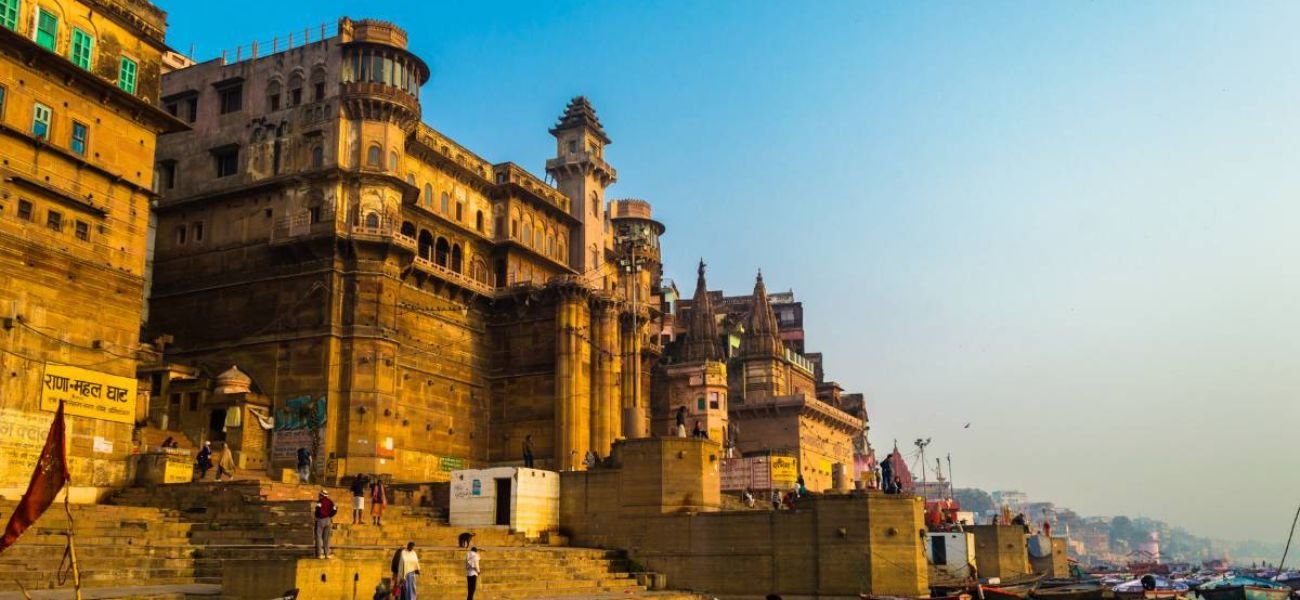


Assi Ghat Ganga Aarti timing: Morning (Subah-e-Banaras) – Summer 5:00 AM, Winter 5:30 AM. Evening Aarti – Summer 6:30-7:00 PM, Winter 6:00 PM. Arrive 30-45 minutes early for ghat steps position. The morning Subah-e-Banaras programme includes Vedic chanting → Ganga Aarti → live classical music → mass yoga as sunrise crosses the Ganges. Assi Ghat is the southernmost of 84 ghats, the confluence of Assi River and Ganges and the first of the five Pancha Tirtha ghats. Entry free. Experience My India. WhatsApp +91-7302265809. See our Ayodhya Varanasi Tour Package or message WhatsApp +91 7302265809.
Varanasi has two major daily Ganga Aarti venues – Dashashwamedh Ghat (central, grand, theatrical, 7 priests) and Assi Ghat (southern, intimate, community-focused, morning-plus-evening). While Dashashwamedh is the famous international spectacle, Assi Ghat is the ghat that Varanasi’s own artistic community, poets, classical musicians, yoga practitioners and long-term pilgrims have chosen for generations. It is where Tulsidas is said to have composed parts of the Ramcharitmanas, where the 19th-century yogi Lahiri Mahasya lived and where the Subah-e-Banaras morning programme – launched in 2014 – has become one of the most distinctive dawn experiences in India.
I am Gurudutt, born and raised in Braj Bhoomi and the founder of Experience My India. Since 2018, I have guided 50,000+ pilgrims through Varanasi – and the Assi Ghat Subah-e-Banaras at 5:00 AM (summer) is the one programme I recommend to every returning visitor who has already seen the Dashashwamedh Ganga Aarti. WhatsApp +91-7302265809.
What Is the Assi Ghat Ganga Aarti – Why It Is Different
Assi Ghat’s Ganga Aarti is one of two daily aarti venues in Varanasi (the other being Dashashwamedh Ghat) but differs fundamentally in character:
Scale: Smaller than Dashashwamedh – 1-2 priests rather than 7. The ceremony is less dramatically choreographed and more devotionally intimate.
Viewing position: Unlike Dashashwamedh (where the priests face the Ganges and the crowd sees their backs – requiring a river-facing boat for the best view), the Assi Ghat aarti takes place in a more open configuration where the ghat steps give a genuinely good view.
The morning programme: Assi Ghat is unique among the 84 Varanasi ghats for its daily morning programme – Subah-e-Banaras – which extends the morning Ganga Aarti into a 2-3 hour cultural event of Vedic chanting, classical music and mass yoga.
The community: Assi Ghat is Varanasi’s “neighbourhood” ghat – the ghat preferred by the city’s own residents, students, artists, musicians and writers. The devotional atmosphere is community rather than tourist.
For the complete Varanasi ghat context: 30 Best Places to Visit in Kashi 2026. Experience My India includes Assi Ghat Subah-e-Banaras in all 2-day+ Varanasi tours. The 1 Night 2 Days Varanasi Tour Package from ₹3,999 schedules Assi Ghat for Day 2 morning. WhatsApp +91-7302265809.
Assi Ghat Ganga Aarti Timing – Complete Monthly Schedule
| Month | Morning Aarti (Subah-e-Banaras) | Evening Aarti | Arrive By (Morning) |
| January | 5:30 AM | 6:00 PM | 5:00 AM |
| February | 5:30 AM | 6:00-6:15 PM | 5:00 AM |
| March | 5:00-5:15 AM | 6:30 PM | 4:30 AM |
| April | 5:00 AM | 7:00 PM | 4:30 AM |
| May | 5:00 AM | 7:00 PM | 4:30 AM |
| June | 5:00 AM | 7:00-7:15 PM | 4:30 AM |
| July | 5:00 AM | 7:00 PM | 4:30 AM |
| August | 5:00-5:15 AM | 6:45-7:00 PM | 4:30 AM |
| September | 5:15-5:30 AM | 6:30-6:45 PM | 4:45 AM |
| October | 5:30 AM | 6:15-6:30 PM | 5:00 AM |
| November | 5:30 AM | 6:00 PM | 5:00 AM |
| December | 5:30 AM | 6:00 PM | 5:00-5:15 AM |
Key principle: Both aartis follow the astronomical sunrise (morning) and sunset (evening) – the exact time shifts daily. The above table gives monthly approximations. For your specific travel date, WhatsApp Experience My India at +91-7302265809 for current-day confirmation.
Book Your Sugam Darshan and Rudrabhishek at Kashi Vishwanath
Evening Aarti Timing by Season
| Season | Months | Evening Aarti | Arrive By |
| Winter | Nov-Feb | 6:00 PM | 5:15-5:30 PM |
| Spring | Mar-Apr | 6:30-7:00 PM | 6:00 PM |
| Summer | May-Aug | 7:00-7:15 PM | 6:15-6:30 PM |
| Monsoon | Jul-Sep | 6:45-7:00 PM | 6:00-6:15 PM |
| Post-monsoon | Oct | 6:15-6:30 PM | 5:45 PM |
Evening aarti character: Smaller, quieter and more community-focused than Dashashwamedh. 50-300 people on normal evenings. The most accessible Varanasi evening aarti for pilgrims who find Dashashwamedh overwhelming.
For pilgrims doing a 2-day Varanasi visit: Experience My India schedules Dashashwamedh Ganga Aarti (boat, 7 PM) on Day 1 and Assi Ghat evening aarti on Day 2 – the contrast between the two gives the most complete picture of Varanasi’s river ceremony tradition.
Subah-e-Banaras – The Morning Programme in Detail
Subah-e-Banaras (“The Morning of Banaras”) is the most distinctive daily programme at Assi Ghat – and the reason why Assi Ghat is more than just an alternative to Dashashwamedh.
Origin: Subah-e-Banaras was initiated in 2014 – a structured morning programme at Assi Ghat that formalised what had been an informal gathering of musicians, yoga practitioners and dawn bathers into a coordinated daily cultural event.
Programme sequence:
| Time | Programme Element |
| 5:00 AM (Summer) / 5:30 AM (Winter) | Vedic chanting begins – Sanskrit mantras addressed to Ganga and the rising sun |
| 5:15-5:45 AM | Morning Ganga Aarti – lamp ceremony facing the river |
| 5:45-6:30 AM | Live Indian classical music – morning raga performance by Varanasi musicians |
| 6:30-7:30 AM | Mass yoga session – as the sun rises fully over the Ganges |
| Throughout | Saryu Snan (ritual bath) at ghat steps |
The music element: The live classical music component is what most distinguishes Subah-e-Banaras from any other Varanasi morning experience. Varanasi’s musical tradition – particularly its classical vocal and instrumental tradition in the Banaras Gharana and the Bhairavi raga tradition – is directly represented in the dawn concert at Assi Ghat. Musicians from the Banaras Hindu University Music Faculty and local gharanas perform at the ghat steps as the sun rises across the Ganges.
The yoga element: The mass yoga session at Assi Ghat – with the sunrise over the Ganges as backdrop and the receding morning mist – has become one of the most-photographed Varanasi experiences and the primary reason international visitors specifically seek out Assi Ghat.
Experience My India schedules Day 2 mornings in Varanasi for Assi Ghat Subah-e-Banaras at 5:00 AM – then the Sankat Mochan Temple (500 m away) at 6:30 AM and the BHU Vishwanath Temple at 8:30 AM. The 2 Nights 3 Days Varanasi Tour Package covers this as Day 2 morning. WhatsApp +91-7302265809.
When to Arrive – The 30-45 Minute Rule
Arrive 30-45 minutes before the aarti starts for the best sitting position on the ghat steps.
| Season | Morning Aarti | Arrive By | Evening Aarti | Arrive By |
| Winter | 5:30 AM | 5:00-5:15 AM | 6:00 PM | 5:15-5:30 PM |
| Summer | 5:00 AM | 4:30 AM | 7:00 PM | 6:15-6:30 PM |
| Monsoon | 5:00-5:15 AM | 4:30-4:45 AM | 6:45 PM | 6:00 PM |
The summer 4:30 AM arrival: Yes – the most atmospherically dramatic Assi Ghat experience (summer) requires arriving at 4:30 AM. In the 30 minutes before the programme starts, the ghat is gradually illuminated as Varanasi begins its day: chai vendors setting up, bathers arriving, lamps being lit. The 4:30 AM arrival is not wasted waiting time – it is the ghat at its quietest and most atmospheric.
Weekend note: Weekends attract higher Subah-e-Banaras crowds – arrive 45-60 minutes early on Saturdays and Sundays.
Assi Ghat vs Dashashwamedh Ghat – An Honest Comparison
Many pilgrims ask which ghat aarti is better. Here is the honest comparison:
| Feature | Assi Ghat | Dashashwamedh Ghat |
| Scale | Smaller – 1-2 priests | Largest – 7 priests synchronized |
| Morning programme | ✅ Subah-e-Banaras (2-3 hours) | Modest morning aarti only |
| Evening crowd | 50-300 people (low) | 500-5,000+ people |
| Best view position | Ghat steps – good view | River-facing boat (priests face river) |
| Character | Intimate, community | Theatrical, spectacular |
| Pancha Tirtha | ✅ First of five sacred ghats | ✅ Second (Dashashwamedh) |
| Best for | Morning culture seekers, returning visitors, meditative experience | First-time visitors, spectacle experience |
| Best month | October-February | November-February (lamp-dark contrast) |
The Experience My India recommendation:
- First-time Varanasi visit: Dashashwamedh Ganga Aarti from a river-facing boat (7 PM)
- Second-time visit / 2-day visit: Add Assi Ghat Subah-e-Banaras (Day 2 morning)
- Both in same visit: Dashashwamedh Day 1 evening, Assi Ghat Day 2 morning – the complete Varanasi aarti experience
For the complete Dashashwamedh guide: Kashi Vishwanath Temple Varanasi. WhatsApp +91-7302265809.
Book Your Sugam Darshan and Rudrabhishek at Kashi Vishwanath
The Mythology – How the Assi River Was Born from Durga’s Sword
The specific mythology of Assi Ghat is distinct from any other Varanasi ghat – and far more dramatic than most visitors know.
The Kashi Khanda account: According to the Kashi Khanda (the Varanasi section of the Skanda Purana), after Goddess Durga (in her fierce form as Chandika) slew the demon duo Shumbha and Nishumbha – whose destruction restored divine order – she threw her sword (known as Asi in Sanskrit) to the earth.
At the spot where the sword struck, a river emerged – the Assi River (Asi = sword in Sanskrit). This sword-born river flows south until it meets the Ganges at the point now known as Assi Ghat – giving the ghat its name and its theological identity.
The significance of the origin: Assi Ghat is therefore not merely the meeting point of two rivers – it is the meeting point of the sacred Ganges with a river born from the divine weapon of the Goddess herself. The combined sanctity of a Shakti-born tributary and the Ganges creates a particularly powerful sacred confluence.
What makes the Assi confluence special in Varanasi’s sacred geography: In the Kashi Khanda, the specific confluences (sangam) of tributary streams with the Ganges within Varanasi are identified as particularly auspicious bathing points. The Assi confluence – where the sword-born stream meets the Ganges at the southernmost sacred boundary of the city – marks the beginning of the ritual Varanasi geography.
For the complete Varanasi sacred geography context: Best Time to Visit Varanasi 2026. Experience My India explains the Assi mythology at every Assi Ghat visit. WhatsApp +91-7302265809.
The Pancha Tirtha Significance – First of Five Sacred Ghats
Assi Ghat holds a specific position in Varanasi’s pilgrimage hierarchy as the first of the five Pancha Tirtha ghats.
What is the Pancha Tirtha: The Pancha Tirtha (Five Sacred Crossing Points) is the most concentrated sacred circuit on the Varanasi Ganges riverfront – a pilgrimage sequence where bathing at each of the five ghats in sequence is believed to grant moksha (liberation from the cycle of rebirth):
| # | Pancha Tirtha Ghat | Position | Significance |
| 1 | Assi Ghat | Southern anchor | Where the pilgrimage begins |
| 2 | Dashashwamedh Ghat | Central | Brahma’s horse sacrifice site |
| 3 | Manikarnika Ghat | North-central | Most sacred cremation site |
| 4 | Panchganga Ghat | Northern | Five rivers confluence |
| 5 | Adi Keshav / Raj Ghat | Northernmost | Vishnu’s first landing in Kashi |
Assi Ghat as the beginning: The Pancha Tirtha Yatra traditionally begins at Assi Ghat and proceeds northward – giving Assi Ghat the specific function of the sacred starting point, the “Gateway from the south” to the complete Varanasi pilgrimage circuit.
Taking a ritual dip (Saryu Snan / Ganga Snan) at Assi Ghat before beginning the northward Pancha Tirtha walk is one of the most complete pilgrimage acts available at Varanasi – and it starts with the Subah-e-Banaras dawn programme.
For the complete Varanasi ghats guide: Manikarnika Ghat. The 2 Nights 3 Days Varanasi Tour Package includes the Panchatirthi walk from Assi to Panchganga. WhatsApp +91-7302265809.
Why Assi Ghat Has a Different Cultural Character
Assi Ghat’s character – artistic, contemplative, community-focused – is not accidental. It is rooted in the ghat’s history as the southernmost boundary of Varanasi’s sacred landscape and its specific association with some of the most significant figures in the city’s cultural and spiritual history.
Goswami Tulsidas (1532-1623): The author of the Ramcharitmanas – the Hindi version of the Ramayana that has shaped devotional life across North India – is traditionally associated with the Assi Ghat area. Tulsidas is said to have spent significant time near Assi Ghat and the adjacent Tulsi Ghat (named for him).
Lahiri Mahasya (1828-1895): The 19th-century yogi who revived Kriya Yoga lived and taught near Assi Ghat. His ashram at Chaumsathi Ghat (near Assi Ghat) continues to be a place of Kriya Yoga practice.
The BHU community: The Banaras Hindu University campus (2 km from Assi Ghat) has made Assi Ghat the natural gathering point for Varanasi’s academic, artistic and student communities for over a century. Musicians from the BHU Faculty of Performing Arts, writers, scholars and students have created the artistic community that characterises this ghat area.
The cafe and artistic culture: The lanes around Assi Ghat – particularly the area behind the ghat steps – feature small cafes, bookshops and artist studios that give this part of Varanasi a character distinct from the old city temple lanes. This cultural overlay makes Assi Ghat appealing to a different visitor profile than Dashashwamedh.
Assi Ghat Location – The Confluence Point
Address context: Assi Ghat, Varanasi, Uttar Pradesh – southernmost of the 84 traditional Varanasi ghats
Geographic significance:
- Located at the exact confluence of the Assi River (now largely a small stream) and the Ganges
- Southernmost major ghat on the Varanasi riverfront
- Marks the southern boundary of the 84-ghat sacred sequence
| Distance from Assi Ghat | Site | Distance |
| BHU (Banaras Hindu University) | 2 km | |
| Sankat Mochan Temple | 500 m-1 km | |
| Kashi Vishwanath Temple | 3 km | |
| Dashashwamedh Ghat | 3 km (northward on ghat path) | |
| Tulsi Manas Mandir | 600 m | |
| Durga Temple (Durgakund) | 800 m |
How to Reach Assi Ghat Varanasi
| From | Mode | Distance | Time | Cost |
| Dashashwamedh Ghat | Walk (ghat path) | 3 km | 35-40 min | Free |
| Kashi Vishwanath | Auto/e-rickshaw | 3 km | 15 min | ₹50-₹80 |
| BHU | Walk / e-rickshaw | 2 km | 10-15 min | ₹30-₹50 |
| Varanasi Cantt Station | Auto/taxi | 8 km | 30-40 min | ₹100-₹150 |
| LBS Airport (VNS) | Taxi | 32 km | 50-60 min | ₹500-₹700 |
| Hotel (central area) | Auto | 3-5 km | 15-20 min | ₹60-₹100 |
The ghat path option: The 3 km ghat path walk from Dashashwamedh to Assi Ghat (southward) passes 30-35 ghats – the most scenic and devotionally rich walk in Varanasi. Experience My India uses this ghat walk as an afternoon programme on Day 2 of all multi-day Varanasi tours.
Best Time of Year for Assi Ghat Ganga Aarti
| Period | Morning Aarti | Character | Verdict |
| Oct-Feb (winter) | 5:30 AM | Cool air, all visible in first light | ✅ Best overall |
| Nov specifically | 5:30 AM | Dev Deepawali – all ghats lit | ✅ Most spectacular night |
| Feb | 5:30 AM | Quietest month – minimal crowds | ✅ Most personal |
| Mar-Apr (spring) | 5:00 AM | Comfortable, golden morning light | ✅ Very good |
| May-Jun (summer) | 5:00 AM | Hot by 8 AM, but dawn is fine | ⚠️ Dawn only |
| Jul-Sep (monsoon) | 5:00 AM | High river, dramatic atmosphere | ⚠️ Check ghat access |
October to February is the best window – the sunrise comes later (after 6 AM in December), meaning the morning aarti and music programme run in pre-dawn darkness with lamp-light before the sky brightens. The combination of aarti lamps, classical music, pre-dawn chill and the gradual brightening of the Ganges is the most complete Subah-e-Banaras experience available.
For the complete Varanasi seasonal guide: Best Time to Visit Varanasi 2026.
Ground Truth – What Nobody Tells You About Assi Ghat Ganga Aarti Timing
1. The Subah-e-Banaras morning programme runs for 2-3 hours (5:00 AM to approximately 7:30 AM) – most visitors who read about it think it is just the 10-minute morning aarti. The classical music raga performance and the mass yoga session that follow the aarti are what make this morning programme unique in all of Varanasi. Experience My India schedules a 5:00 AM-7:30 AM Assi Ghat programme for Day 2 of all 2-night Varanasi tours. Pilgrims who leave after the aarti at 5:20 AM miss 90% of the programme.
2. Assi Ghat is 3 km south of Dashashwamedh – reachable by the ghat path (35-minute walk) or auto (15 minutes). Many visitors assume it is far from the main circuit. It is not. Experience My India plans the Dashashwamedh Ganga Aarti (Day 1 evening, boat) and Assi Ghat Subah-e-Banaras (Day 2 morning) as the two-aarti Varanasi circuit in all 2-day+ programmes.
3. The evening aarti at Assi Ghat starts slightly before Dashashwamedh – making it possible to attend the Assi Ghat evening aarti (6:00-6:30 PM in winter) and then take a boat to Dashashwamedh for the 7:00 PM Ganga Aarti on the same evening. Experience My India has designed this double-aarti evening sequence for groups who specifically want both experiences on the same day.
4. The Assi River (the sword-born tributary that gives the ghat its name) is now largely reduced to a small stream and is not immediately obvious at the ghat. The actual confluence point where the Assi meets the Ganges is at the southern edge of the ghat steps – where the water colour slightly changes. Experience My India specifically points to the confluence point for every group at Assi Ghat.
5. The Sankat Mochan Hanuman Temple (500 m from Assi Ghat) is naturally combined with the Subah-e-Banaras morning programme – the 6:30 AM Sankat Mochan opening aarti follows perfectly after the Assi Ghat morning programme, giving two complete morning experiences before 7:30 AM. Almost no tour plan makes this combination. Experience My India sequences Assi Ghat 5:00 AM → Sankat Mochan 6:30 AM → Durga Temple 7:30 AM as the complete Day 2 southern cluster.
Frequently Asked Questions – Assi Ghat Ganga Aarti Timing
The Assi Ghat Ganga Aarti has two daily sessions. Morning (Subah-e-Banaras): Summer (March-October) at 5:00 AM, Winter (November-February) at 5:30 AM. Evening Aarti: Summer at approximately 6:30-7:00 PM, Winter at 6:00 PM. Arrive 30-45 minutes before each session for a good ghat steps position. The morning session is extended – the Ganga Aarti at 5:00 AM is followed by live Indian classical music (morning raga) and mass yoga until approximately 7:30 AM. Experience My India confirms the exact current-day timing before every Varanasi visit. WhatsApp +91-7302265809.
Subah-e-Banaras (“Morning of Banaras”) is the morning programme at Assi Ghat, initiated in 2014 – a 2-3 hour dawn experience that begins with Vedic chanting and the morning Ganga Aarti, followed by live Indian classical music performance (morning raga) by Varanasi musicians and concludes with a mass yoga session as the sun rises over the Ganges. It runs daily from approximately 5:00 AM (summer) or 5:30 AM (winter) to 7:30 AM. Entry is free. Arrive 30-45 minutes early for ghat steps seating. This programme is unique in Varanasi – no other ghat offers the aarti-music-yoga combination. Experience My India schedules Day 2 Varanasi mornings at Assi Ghat for all 2-day+ tours. WhatsApp +91-7302265809.
The two ghats offer completely different experiences: Dashashwamedh has the larger, more theatrical evening Ganga Aarti (7 synchronised priests, thousands of attendees, best from a river-facing boat). Assi Ghat has the unique morning Subah-e-Banaras programme (aarti + classical music + yoga, 5:00-7:30 AM), a smaller and more intimate evening aarti and the first position in the Pancha Tirtha sacred pilgrimage circuit. Neither is “better” – they are complementary. Experience My India recommends Dashashwamedh for first-time visitors and Assi Ghat for the Day 2 morning as the most complete Varanasi aarti experience across 2 days. WhatsApp +91-7302265809.
Assi Ghat is special for five reasons: it is the southernmost of Varanasi’s 84 ghats and the first of the five Pancha Tirtha sacred ghats; it sits at the confluence of the Assi River (born from Goddess Durga’s thrown sword, per the Kashi Khanda) and the Ganges; it is the home of the Subah-e-Banaras morning programme – the only ghat in Varanasi with a combined aarti-classical music-yoga dawn programme; it is associated with Goswami Tulsidas and the 19th-century yogi Lahiri Mahasya; and it is the preferred ghat of Varanasi’s own artistic, academic and student communities. Experience My India includes Assi Ghat in all 2-day+ Varanasi itineraries. WhatsApp +91-7302265809.
Assi Ghat is the first of the five Pancha Tirtha (Five Sacred Crossing Points) in Varanasi – the sacred pilgrimage circuit where a ritual bath at each of the five ghats in sequence is believed to grant moksha (liberation from the rebirth cycle). The five Pancha Tirtha ghats in sequence from south to north: Assi Ghat (first), Dashashwamedh Ghat, Manikarnika Ghat, Panchganga Ghat and Adi Keshav/Raj Ghat (fifth). The Pancha Tirtha Yatra traditionally begins at Assi Ghat – making it the southern gateway of the complete Varanasi pilgrimage circuit. Experience My India includes the Pancha Tirtha walk as a Day 3 programme in all 3-night Varanasi tours. WhatsApp +91-7302265809.
Yes – Assi Ghat holds both a morning Ganga Aarti (5:00 AM in summer / 5:30 AM in winter, part of Subah-e-Banaras) and an evening Aarti (6:00-7:00 PM by season) on the same day. Attending both is particularly rewarding in winter (October-February) when the morning aarti is at pre-dawn (5:30 AM) and the evening aarti is at 6:00 PM – a 12-hour bookend to the day. In between, the Assi Ghat area has the Sankat Mochan Temple (6:30 AM), Tulsi Manas Mandir and BHU Vishwanath Temple all within 500 m-2 km. Experience My India designs full-day Assi Ghat area itineraries for groups who specifically want this experience. WhatsApp +91-7302265809.
Assi Ghat is approximately 3 km south of Kashi Vishwanath Temple – about 15 minutes by auto-rickshaw (₹50-₹80) or 35-40 minutes by the ghat path walk southward from Dashashwamedh Ghat. BHU (Banaras Hindu University) campus is 2 km from Assi Ghat. Sankat Mochan Hanuman Temple is 500 m-1 km from Assi Ghat. Tulsi Manas Mandir is 600 m. Durga Temple (Durgakund) is 800 m. This southern cluster – Assi Ghat + Sankat Mochan + Tulsi Manas + BHU – forms the most efficient half-day heritage circuit in the southern Varanasi area. Experience My India covers this full cluster in all 2-day+ Varanasi programmes. WhatsApp +91-7302265809.
Recommended products
-
1 Night 2 Days Varanasi Tour Package
Original price was: ₹7,000.00.₹6,000.00Current price is: ₹6,000.00. -
2 Night 3 Days Ayodhya Varanasi Tour Package
Original price was: ₹9,000.00.₹8,000.00Current price is: ₹8,000.00. -
3 Nights 4 Days Ayodhya Varanasi Tour Package
Original price was: ₹11,000.00.₹10,000.00Current price is: ₹10,000.00. -
5 Days Ayodhya Varanasi Tour Package


🙏 Ready to Experience Assi Ghat Subah-e-Banaras with Experience My India?
WhatsApp us – morning timing confirmed for your date, ghat steps position arrived 30 min early, Sankat Mochan at 6:30 AM after aarti, Dashashwamedh evening boat also pre-arranged for Day 1. The complete Varanasi aarti circuit. Rated 4.5★ by 204+ pilgrims.
WhatsApp +91-7302265809 – Book Now
Jai Shri Ram 🙏