
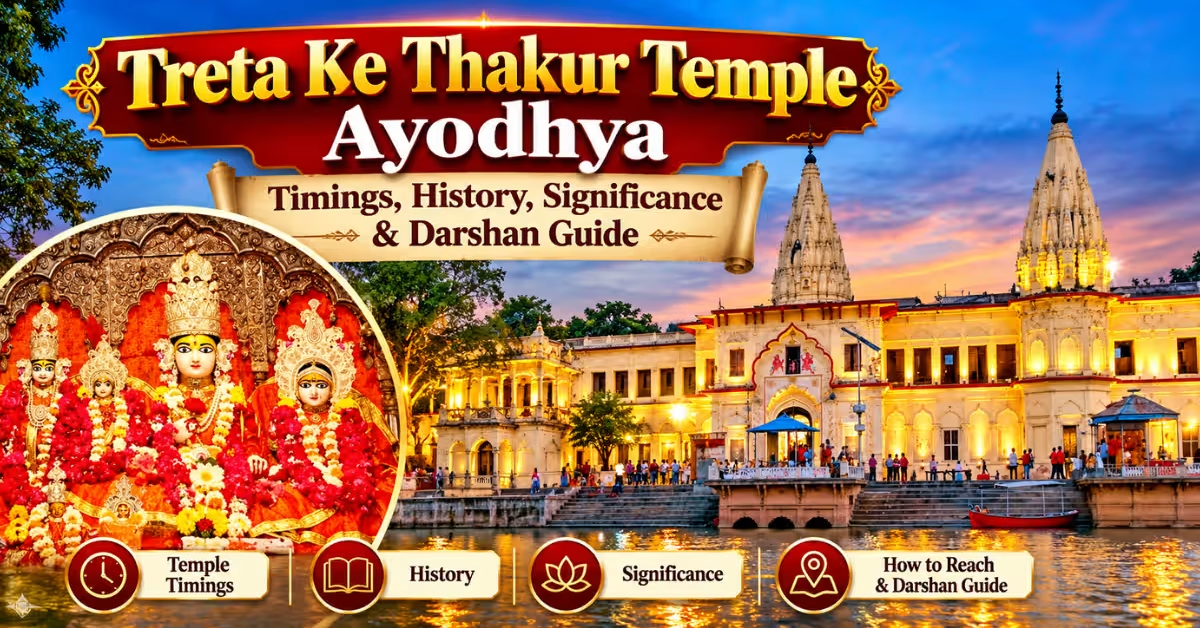
Treta Ke Thakur Temple (also: Treta Ka Thakur, Kaleram ka Mandir) is Ayodhya’s most uniquely timed temple – it opens only once a year for a 24-hour window on Kartik Shukla Ekadashi (October/November). Treta Ke Thakur 2026 opening: approximately 1-2 November 2026 (confirm exact date). Houses rare black sandstone (shyamashila) idols of Rama, Sita, Lakshmana, Bharat, Shatrughan, Hanuman and sage Vashishtha. Built by the King of Kullu, rebuilt in 1784 CE by Ahilyabai Holkar. Site of Lord Rama’s Ashwamedha Yagya. Free entry. Experience My India. WhatsApp +91-7302265809. See our Ayodhya Varanasi Tour Package or message WhatsApp +91 7302265809.
Ayodhya has over 7,000 temples – and the vast majority are open every day of the year. Treta Ke Thakur Temple is the extraordinary exception: it opens its doors to the public exactly once a year for a 24-hour window on Kartik Shukla Ekadashi, the 11th day of the bright fortnight of the Kartik month. On this single day, pilgrims from across India come to see the rarest sight in Ayodhya – an ancient set of black sandstone idols of Lord Rama and his complete family, carved from single blocks of stone, housed in a temple that has waited 364 days for this moment.
I am Gurudutt, born and raised in Braj Bhoomi and the founder of Experience My India. Since 2018, I have guided 50,000+ pilgrims through Ayodhya – and Treta Ke Thakur is consistently described as one of the most unexpectedly moving temple experiences in the entire city. Not because of its scale – it is modest – but because of what the annual opening represents: a darshan that requires planning, patience and timing and rewards all three.
What Is Treta Ke Thakur Temple – The Once-a-Year Temple of Ayodhya
Treta Ke Thakur Temple is a Hindu temple dedicated to Lord Rama located in the Naya Ghat area of Ayodhya, near the banks of the Saryu River. It houses a complete set of Rama-kula (Rama family) idols carved from black sandstone – one of the most complete and historically significant deity collections in Ayodhya.
What makes this temple completely unique in Ayodhya:
Most temple visitors expect to find a temple open at regular times – morning and evening sessions, perhaps with a midday break. Treta Ke Thakur operates on a fundamentally different principle. The temple is considered so sacred and the occasion of the Kartik Shukla Ekadashi so specific, that the physical darshan of these idols is restricted to this single annual day. On every other day of the year, the temple remains closed to public entry – attended only by the temple’s resident priests who perform the daily internal rituals.
The theological principle: Sacred restriction creates sacred significance. A darshan that is available every day becomes ordinary. A darshan that is available once a year – that requires knowing the date, planning the visit, traveling specifically for this occasion – becomes an event of concentrated devotion. The annual Treta Ke Thakur darshan is one of the pilgrimage events that serious Ayodhya devotees plan their yearly calendar around.
For the complete Ayodhya sightseeing context: Ayodhya City Tour Guide 2026. Experience My India includes Treta Ke Thakur in Ayodhya tours specifically timed for Kartik Shukla Ekadashi. WhatsApp +91-7302265809.
Treta Ke Thakur Temple Timings – The Annual 24-Hour Opening
| Timing Detail | Information |
| Annual opening | Once per year – Kartik Shukla Ekadashi only |
| Duration of opening | 24 hours (from Ekadashi sunrise to next sunrise) |
| Entry fee | Free for all visitors |
| Days open (rest of year) | Closed to public – internal ritual only |
| Crowd | Very high on the annual opening day – arrive before dawn |
| Best arrival time | Before 5:00 AM – queues form before sunrise |
The 24-hour window: Unlike most once-a-year festivals that have a specific short ceremony, the Treta Ke Thakur annual opening allows darshan for the full 24 hours of Ekadashi – from the morning of Kartik Shukla Ekadashi to the morning of Kartik Shukla Dwadashi. Pilgrims who arrive at midnight or at 3:00 AM can queue for darshan. Experience My India recommends arriving before 5:00 AM to avoid the peak morning queue that builds from sunrise onwards. WhatsApp +91-7302265809.
Book Sugam/VIP Darshan and Aarti – Ayodhya Shri Ram Janmbhoomi 2026
Treta Ke Thakur 2026 Opening Date – When to Visit
Treta Ke Thakur Temple 2026 opening date: approximately 1-2 November 2026
(Kartik Shukla Ekadashi – exact date depends on the Hindu Panchang lunar calendar. Confirm the precise date in October 2026 via WhatsApp +91-7302265809.)
| Year | Approx. Kartik Shukla Ekadashi Date |
| 2024 | 12 November 2024 |
| 2025 | 1 November 2025 |
| 2026 | Approximately 1-2 November 2026 |
How the date is calculated: Kartik Shukla Ekadashi is the 11th day (Ekadashi) of the waxing moon fortnight (Shukla Paksha) in the Hindu month of Kartik. This date falls in October or November each year and shifts annually based on the lunar calendar. The precise 2026 date will be announced by the temple trust approximately 1 month before.
Important: This is the same lunar fortnight as Dev Deepawali (Kartik Purnima – 24 November 2026 in 2026). A November Ayodhya visit timed for Treta Ke Thakur Ekadashi (early November) can be combined with Deepotsav Ayodhya (7 November 2026) and Dev Deepawali Varanasi (24 November 2026) in the same November circuit.
For the Deepotsav planning guide: Deepotsav Ayodhya. Experience My India coordinates exact dates for all November Ayodhya festival visits. WhatsApp +91-7302265809.
Why the Temple Opens Only Once a Year
The restriction of darshan to Kartik Shukla Ekadashi is rooted in the specific sacred identity of this temple and this day in the Hindu calendar.
Kartik Shukla Ekadashi (Dev Uthani Ekadashi): This specific day is known as Dev Uthani Ekadashi or Prabodhini Ekadashi – the day when Lord Vishnu (who rests during the 4-month Chaturmas period from Ashadh Shukla Ekadashi) is believed to wake from his cosmic sleep. This day marks the end of the auspicious Chaturmas period and the beginning of the season for weddings, auspicious ceremonies and major religious events.
For a temple dedicated to Lord Rama – who is the 7th avatar of Vishnu – the Dev Uthani Ekadashi (day of Vishnu’s awakening) is theologically the most appropriate day for the annual public darshan. The temple opens on the day Vishnu wakes.
The theological economy of restricted access: By limiting public darshan to this single most auspicious day, the temple ensures that every darshan received at Treta Ke Thakur carries the full weight of Ekadashi sacred timing – one of the most spiritually potent moments in the Vaishnav calendar. Experience My India explains this theology before every Treta Ke Thakur visit. WhatsApp +91-7302265809.
The Name Explained – Treta, Thakur and Kaleram ka Mandir
Treta Ke Thakur translates directly as “The Lord of the Treta Yuga”:
- Treta – the second of the four cosmic ages (yugas) in Hindu time cosmology: Satya Yuga, Treta Yuga, Dvapara Yuga, Kali Yuga. Lord Rama’s life and the events of the Ramayana took place during the Treta Yuga.
- Ke – of / belonging to
- Thakur – a Sanskrit-derived word meaning “Lord,” “God” or “Master” – used in North Indian devotional tradition as an honorific for divine beings, particularly Rama and Krishna.
The name therefore identifies the deity as “Rama – the Lord of the age in which he incarnated.” This is one of the most specific theological names of any temple in Ayodhya – pointing not merely to the deity but to the cosmic time period of his incarnation.
Kaleram ka Mandir: The temple’s alternate name “Kaleram ka Mandir” (Temple of Kaleram / the Black Rama) refers to the black colour of the idol – the shyamashila (black sandstone) from which the idols are carved gives Lord Rama a dark complexion. This dark form of Rama is rare in Ayodhya, where the dominant iconographic tradition presents Rama in green or blue skin tone rather than the naturally black-stone appearance.
For the complete Ayodhya sacred geography and Ram Mandir context: Ayodhya Ram Mandir Tour Guide 2026. Experience My India explains both names to every Treta Ke Thakur visiting group. WhatsApp +91-7302265809.
Religious Significance – Site of Rama’s Ashwamedha Yagya
The theological significance of the Treta Ke Thakur Temple’s site is specific and historically significant within the Ramayana tradition:
The Ashwamedha Yagya (Horse Sacrifice Ritual): According to the Uttara Kanda (final book) of the Valmiki Ramayana, after Lord Rama returned to Ayodhya from Lanka, he performed the Ashwamedha Yagya – the Vedic ritual of the horse sacrifice – at this specific location near the Saryu River banks. The Ashwamedha was the supreme ritual of sovereignty in Vedic tradition: a horse was released to roam freely for one year, followed by an army that claimed all land the horse traversed, then the horse was sacrificed in a grand yajna that validated the king’s absolute sovereignty.
Lord Rama’s Ashwamedha Yagya was performed at the site now marked by the Treta Ke Thakur Temple – which is why the temple is considered not merely a sacred site but a historical-mythological monument to a specific event in the Ramayana narrative.
The Dashashwamedh connection: Interestingly, Dashashwamedh Ghat in Varanasi (where the nightly Ganga Aarti is performed) also claims association with the Ashwamedha Yagya tradition – in that case, Lord Brahma’s 10-horse sacrifice. The two sites represent different traditions: Brahma’s cosmic-level Ashwamedha (Varanasi) and Rama’s royal sovereignty Ashwamedha (Ayodhya). Both are theologically significant but represent different levels of the same ritual tradition.
| Ashwamedha Site | Who Performed | Tradition |
| Treta Ke Thakur, Ayodhya | Lord Rama | Ramayana – royal sovereignty ritual |
| Dashashwamedh Ghat, Varanasi | Lord Brahma | Cosmic-level – inviting Shiva to Kashi |
For the Varanasi connection: Kashi Vishwanath Temple Varanasi and the 3 Nights 4 Days Ayodhya Varanasi Tour Package from ₹5,999 covers both sites in one trip. WhatsApp +91-7302265809.
The Black Sandstone Idols – What Makes This Sanctum Unique
The most visually distinctive feature of Treta Ke Thakur Temple is the material of its idols – shyamashila (black sandstone), carved from single blocks of stone.
| Idol Detail | Information |
| Material | Shyamashila – black sandstone |
| Source | Natural dark-coloured stone, traditionally associated with Vishnu and his avatars |
| Age | Estimated 300+ years old (original installation) |
| Carving technique | Each idol carved from a single block of stone (not assembled) |
| Number of idols | Seven primary deities |
| Condition | Well-preserved – maintained under temple priest care |
The seven idols in the sanctum:
| Idol | Significance |
| Lord Rama | Central deity – king of Ayodhya, 7th Vishnu avatar |
| Sita Devi | Rama’s consort |
| Lakshmana | Rama’s devoted younger brother |
| Bharat | Rama’s second younger brother |
| Shatrughan | Rama’s third younger brother |
| Lord Hanuman | Rama’s supreme devotee and guardian |
| Sage Vashishtha | Royal preceptor (Kulguru) of the Ikshvaku dynasty |
Why the black sandstone is significant: In Vaishnav iconography, Vishnu and his avatars are traditionally depicted with a dark blue or dark skin tone – the colour of infinite space, of the deep sky, of deep water. Black sandstone naturally approximates this divine dark complexion. The black shyamashila idols of Treta Ke Thakur present Rama in this ancient, pre-painterly tradition – not the golden or light-complexioned Rama of later iconography.
Book Sugam/VIP Darshan and Aarti – Ayodhya Shri Ram Janmbhoomi 2026
Sage Vashishtha in the Sanctum – A Rare Deity Presence
Among the seven idols in the Treta Ke Thakur sanctum, the presence of Sage Vashishtha is the most theologically unusual.
Who is Vashishtha: Rishi Vashishtha is the Kulguru (hereditary preceptor) of the Ikshvaku dynasty – the royal lineage to which Lord Rama belongs. He is one of the seven primordial Vedic sages (Saptarishi), the composer of a significant portion of the Rigveda and the teacher who guided multiple generations of the Ayodhya royal family.
Why his idol is here: The Ashwamedha Yagya performed at this site required the presence and supervision of the royal family’s Kulguru – Vashishtha. The yajna’s ritual efficacy depended on the preceptor’s presence and chanting. By including Vashishtha’s idol in the sanctum alongside the Rama family, the temple preserves the complete ceremonial tableau of the Ashwamedha – king, family, guardian and preceptor all present at the site of the ritual.
This is one of the very few temples in Ayodhya – or anywhere in India – where Sage Vashishtha is enshrined as a primary deity rather than depicted merely in subsidiary panels or described in associated scriptures. Experience My India specifically points out the Vashishtha idol at every Treta Ke Thakur visit. WhatsApp +91-7302265809.
History – Two Founders, 300 Years Apart
Treta Ke Thakur Temple’s physical history involves two distinct founding moments:
First Construction – The King of Kullu
The original structure of Treta Ke Thakur Temple was built approximately 300 years ago – in the early 18th century – by the King of Kullu (now a hill district in Himachal Pradesh). The Kullu royal family had a tradition of devotion to Lord Rama and chose this site – the traditionally identified location of Rama’s Ashwamedha Yagya – for a major temple construction.
The Kullu King’s patronage of an Ayodhya temple reflects the pan-Indian reach of Ram Bhakti (devotion to Rama) during this period – Himalayan hill kingdoms building temples in the plains sacred city they considered the supreme Vaishnav pilgrimage site.
Reconstruction – Ahilyabai Holkar (1784 CE)
The present-day structure of Treta Ke Thakur Temple was rebuilt in 1784 CE by Maharani Ahilyabai Holkar – the ruler of the Maratha Holkar dynasty of Indore, one of the most prolific temple patrons in Indian history.
Ahilyabai Holkar (1725-1795) is one of the most significant figures in North Indian sacred architectural history:
- Rebuilt the Kashi Vishwanath Temple in Varanasi (1780 CE) after Aurangzeb’s demolition
- Patronised and rebuilt temples across India – from Somnath to Ayodhya
- Established the tradition of systematic temple reconstruction in the post-Mughal period
Her 1784 reconstruction of Treta Ke Thakur gave the temple its current physical structure while preserving the original black sandstone idols that remain the temple’s most precious historical objects.
| Historical Layer | Who | When | What |
| Original construction | King of Kullu (HP) | 18th century | Temple and idol installation |
| Reconstruction | Ahilyabai Holkar (Indore) | 1784 CE | Current physical structure |
| Current maintenance | Temple trust | Ongoing | Daily ritual, annual opening |
For the historical context of Ayodhya and Ahilyabai Holkar’s role: Best Places to Visit in Ayodhya 2026. Experience My India explains the two-founder history at every Treta Ke Thakur visit. WhatsApp +91-7302265809.
Treta Ke Thakur Temple Location – Naya Ghat Area, Ayodhya
Address: Naya Ghat area, near the Saryu River banks, Ayodhya, Uttar Pradesh
| From | Distance | Time |
| Ram Janmabhoomi Mandir | 2.5 km | 15-20 min by e-rickshaw |
| Hanuman Garhi | 2.5 km | 15-20 min |
| Ram Ki Paidi (Saryu Ghat) | 1.5 km | 10 min by e-rickshaw |
| Nageshwarnath Temple | 1 km | 8 min |
| Kanak Bhawan | 2.7 km | 18 min by e-rickshaw |
| Ayodhya Dham Junction | 3.5 km | 18-20 min |
The Naya Ghat area context: Treta Ke Thakur Temple sits in the Naya Ghat area – approximately 1.5 km from Ram Ki Paidi and closer to the river than the main temple cluster around Ram Mandir and Hanuman Garhi. The Naya Ghat area is part of the Saryu riverfront that connects to Ram Ki Paidi – giving the temple a riverside character that connects the sacred geography of the Ashwamedha site to the Saryu herself.
How to Reach Treta Ke Thakur Temple
| Mode | From | Route | Cost | Time |
| E-rickshaw | Ram Mandir area | Central Ayodhya → Naya Ghat area | ₹30-₹60 | 15-20 min |
| E-rickshaw | Ayodhya Dham Junction | NH 27 direction → Naya Ghat | ₹40-₹70 | 18-22 min |
| Walk | Ram Ki Paidi | Saryu riverfront path | Free | 20-25 min |
On the annual opening day: Treta Ke Thakur is located 2.5 km from Ram Mandir in the Naya Ghat direction. On Kartik Shukla Ekadashi, the e-rickshaw route from Ram Mandir to the temple area is the standard approach – vehicles can reach the Naya Ghat area, then a short walk to the temple gate.
Experience My India manages all transport for the annual Treta Ke Thakur darshan visit. The 1 Night 2 Days Ayodhya Tour Package timed for Kartik Ekadashi includes the temple transport. WhatsApp +91-7302265809.
Treta Ke Thakur in the Complete Ayodhya Visiting Sequence
On the annual Kartik Shukla Ekadashi opening day, Experience My India recommends the following Ayodhya sequence:
| Time | Activity |
| Before 5:00 AM | Arrive at Treta Ke Thakur Temple – queue before sunrise |
| 5:00-7:00 AM | Treta Ke Thakur darshan – black sandstone idols in early lamp-light |
| 7:00-9:30 AM | Ram Janmabhoomi Mandir (Sugam Darshan ₹250 pre-booked) |
| 10:00 AM | Kanak Bhawan (300 m from Ram Mandir) |
| 11:00 AM | Hanuman Garhi – before midday closure |
| 12:00-4:00 PM | Lunch + rest (all temples close) |
| 4:30-5:00 PM | Nageshwarnath Temple |
| 7:00 PM | Ram Ki Paidi Saryu Aarti – near Treta Ke Thakur area |
Why Treta Ke Thakur is first on this day: The annual darshan window is rare and the queue builds through the morning. Arriving before sunrise on Ekadashi gives the quietest, most personal darshan. Ram Mandir (which opens at 7 AM) fits naturally as the second stop.
For the Ram Mandir Sugam Darshan guide: Ayodhya Ram Mandir Tour Guide 2026. The 2 Nights 3 Days Ayodhya Tour Package timed for the Ekadashi date covers both the Treta Ke Thakur darshan and all other Ayodhya temples. WhatsApp +91-7302265809.
Ground Truth – What Nobody Tells You About Treta Ke Thakur Temple
1. The temple opens once a year – and most travel guides simply list it as an “Ayodhya attraction” without specifying that it is closed for 364 days. Visitors who plan a standard Ayodhya visit without checking will find it closed. Experience My India receives several queries each month from pilgrims who arrived at Treta Ke Thakur Temple to find the gates closed – because no guide told them the annual opening schedule. This is the single most important practical fact about this temple.
2. The black sandstone (shyamashila) idols are among the oldest intact idol sets in Ayodhya – estimated 300 years old – and their material is almost never mentioned in tourist descriptions. Most Ayodhya temple descriptions focus on the deity names and the mythological associations. The shyamashila material of the Treta Ke Thakur idols is a specific, rare and historically significant detail. Black sandstone idols of this age in intact condition are exceptional.
3. Sage Vashishtha has his own idol in the primary sanctum alongside the Rama family – making Treta Ke Thakur one of the only temples in India where a Vedic sage is enshrined as a primary deity. Experience My India specifically explains who Vashishtha is and why his presence here (at the site of the Ashwamedha Yagya he supervised) is theologically precise and architecturally unusual.
4. Ahilyabai Holkar who rebuilt this temple in 1784 CE is the same person who rebuilt Kashi Vishwanath Temple in Varanasi in 1780 CE – meaning the two most significant temple reconstructions of 18th-century North India were both funded by the same Maratha queen within 4 years. This historical connection between Treta Ke Thakur Ayodhya and Kashi Vishwanath Varanasi through the same patroness is one of the most interesting convergence points in North Indian temple history. Experience My India tells this story in both Ayodhya and Varanasi. The 3 Nights 4 Days Ayodhya Varanasi Tour Package from ₹5,999 covers both Ahilyabai-rebuilt temples.
5. The 2026 Kartik Shukla Ekadashi falls in the same November period as Deepotsav Ayodhya (7 November) – a carefully planned November trip can include both the rare Treta Ke Thakur darshan and the Deepotsav festival in the same 2-week window. Experience My India specifically plans November Ayodhya itineraries around both events. WhatsApp +91-7302265809 for the November 2026 Ayodhya calendar coordination.
Frequently Asked Questions – Treta Ke Thakur Temple
Treta Ke Thakur Temple (also called Treta Ka Thakur or Kaleram ka Mandir) is a historic Hindu temple in Ayodhya dedicated to Lord Rama, located in the Naya Ghat area near the Saryu River. The temple houses rare black sandstone (shyamashila) idols of Lord Rama, Sita, Lakshmana, Bharat, Shatrughan, Hanuman and Sage Vashishtha – each carved from a single block of stone. Originally built by the King of Kullu (Himachal Pradesh), it was reconstructed in 1784 CE by Maratha Queen Ahilyabai Holkar. The site is traditionally identified as where Lord Rama performed the Ashwamedha Yagya. The temple’s most defining characteristic: it opens to the public only once a year. WhatsApp +91-7302265809.
Treta Ke Thakur Temple opens for public darshan only once per year – on Kartik Shukla Ekadashi (the 11th day of the bright fortnight of the Hindu month of Kartik). The opening lasts for a 24-hour window from the morning of Ekadashi to the morning of Dwadashi. In 2026, this date falls approximately in 1-2 November 2026 (confirm the exact date in October 2026). On all other days of the year, the temple is closed to public visitors. Entry is free on the annual opening day. Experience My India plans Ayodhya visits specifically timed for this annual darshan. WhatsApp +91-7302265809 for 2026 date confirmation.
Treta Ke Thakur Temple opens on Kartik Shukla Ekadashi because this day is Dev Uthani Ekadashi (also called Prabodhini Ekadashi) – the day when Lord Vishnu is believed to wake from his 4-month cosmic sleep (Chaturmas). Since Lord Rama is the 7th avatar of Vishnu, the day of Vishnu’s awakening is the most theologically appropriate day for the annual public darshan at this Rama temple. The restricted access on all other days creates a concentration of devotional significance – pilgrims who plan their year around this single day attend with heightened awareness and devotion. Experience My India explains this theology at every Treta Ke Thakur visit. WhatsApp +91-7302265809.
Treta Ke Thakur Temple holds significance on four levels. Mythological: it marks the site where Lord Rama performed the Ashwamedha Yagya (horse sacrifice) after returning from Lanka – validating his universal sovereignty. Historical: it houses 300-year-old black sandstone (shyamashila) idols of the complete Rama family including the rare presence of Sage Vashishtha. Architectural: rebuilt in 1784 CE by Ahilyabai Holkar – the same Maratha queen who rebuilt Kashi Vishwanath Varanasi in 1780 CE. Devotional: the annual Kartik Shukla Ekadashi opening creates one of the most pilgrimage-worthy single-day darshan events in all of Ayodhya. Experience My India. WhatsApp +91-7302265809.
Treta Ke Thakur Temple was built in two stages by two different patrons. The original structure was built approximately 300 years ago by the King of Kullu (now Kullu district, Himachal Pradesh) – a Himalayan royal patron of Lord Rama who chose this Saryu riverfront site for a significant temple. The current structure was rebuilt in 1784 CE by Maharani Ahilyabai Holkar – the ruler of the Maratha Holkar dynasty of Indore, the most prolific temple patron of 18th-century India who also rebuilt Kashi Vishwanath Temple in Varanasi (1780 CE). The original black sandstone idols from the Kullu King’s construction are preserved in the Ahilyabai-built structure. WhatsApp +91-7302265809.
According to the Uttara Kanda (final book) of the Valmiki Ramayana, Lord Rama performed the Ashwamedha Yagya (horse sacrifice ritual) after returning from Lanka – the supreme Vedic ritual of royal sovereignty, where a horse is released to roam for one year and all land traversed is claimed as the king’s domain. The Treta Ke Thakur Temple site in Ayodhya’s Naya Ghat area is traditionally identified as the exact location where this Ashwamedha was performed. The presence of Sage Vashishtha’s idol in the sanctum confirms this – Vashishtha was the Kulguru (royal preceptor) who would have supervised the yajna’s ritual procedure. Experience My India explains this Ramayana connection. WhatsApp +91-7302265809.
Treta Ke Thakur Temple is open to the public only on Kartik Shukla Ekadashi – which occurs once per year in October or November. On all other days, the temple is closed to visitors (internal daily rituals are performed by the resident priests). To know whether the temple is open today, check the current date against the Kartik Shukla Ekadashi of the current year. For 2026, the opening is approximately 1-2 November 2026. If you are planning an Ayodhya visit specifically for this darshan, WhatsApp Experience My India at +91-7302265809 for the confirmed 2026 Ekadashi date and itinerary planning.
Treta Ke Thakur Temple is located in the Naya Ghat area of Ayodhya, Uttar Pradesh – approximately 2.5 km from Ram Janmabhoomi Mandir and 1.5 km from Ram Ki Paidi (the central Saryu Ghat). The temple sits near the banks of the Saryu River in the same sacred riverfront zone as Nageshwarnath Temple and Swargdwar Ghat. By e-rickshaw from central Ayodhya, the journey takes 15-20 minutes (₹30-₹60). By foot from Ram Ki Paidi, approximately 20-25 minutes along the Saryu riverfront. Experience My India coordinates the complete Ayodhya temple circuit including Treta Ke Thakur transport. WhatsApp +91-7302265809.
Recommended products
-
1 Night 2 Days Ayodhya Tour Packages
Original price was: ₹6,000.00.₹5,000.00Current price is: ₹5,000.00. -
2 Night 3 Days Ayodhya Varanasi Tour Package
Original price was: ₹9,000.00.₹8,000.00Current price is: ₹8,000.00. -
5 Days Ayodhya Varanasi Tour Package
-
3 Nights 4 Days Ayodhya Varanasi Tour Package
Original price was: ₹11,000.00.₹10,000.00Current price is: ₹10,000.00.


🙏 Ready to Plan Your Treta Ke Thakur Temple Kartik Ekadashi Darshan with Experience My India?
WhatsApp us – 2026 Ekadashi date confirmed, pre-sunrise arrival planned, Ram Mandir Sugam Darshan booked for same day, Deepotsav 7 November coordinated if you want the full November Ayodhya circuit. Rated 4.5★ by 204+ pilgrims.
WhatsApp +91-7302265809 – Book Now
Jai Shri Ram 🙏