

The top ghats in Varanasi include Dashashwamedh Ghat (evening Ganga Aarti, 6:30-7:00 PM daily), Assi Ghat (sunrise Subah-e-Banaras programme, 5:00 AM), Manikarnika Ghat (eternal cremation fires, 24 hours), Scindia Ghat (partially submerged Shiva temple) and Pancha Ganga Ghat (five-river confluence; winter bamboo lamps). Varanasi has 84 named ghats; these 20 are the most significant. Experience My India includes the complete ghat circuit in every Varanasi package from ₹2,999. WhatsApp +91-7302265809.
84 Ghats, 20 That Define Varanasi
Varanasi has 84 named riverfront ghats – stone-stepped embankments descending to the Ganga, each with its own name, history and specific association. Most visitors see only 3-4 of these. This guide covers the 20 that matter most, organised by what they are best experienced for: the Ganga Aarti, the sunrise, the spiritual and historic weight and the scenic quality.
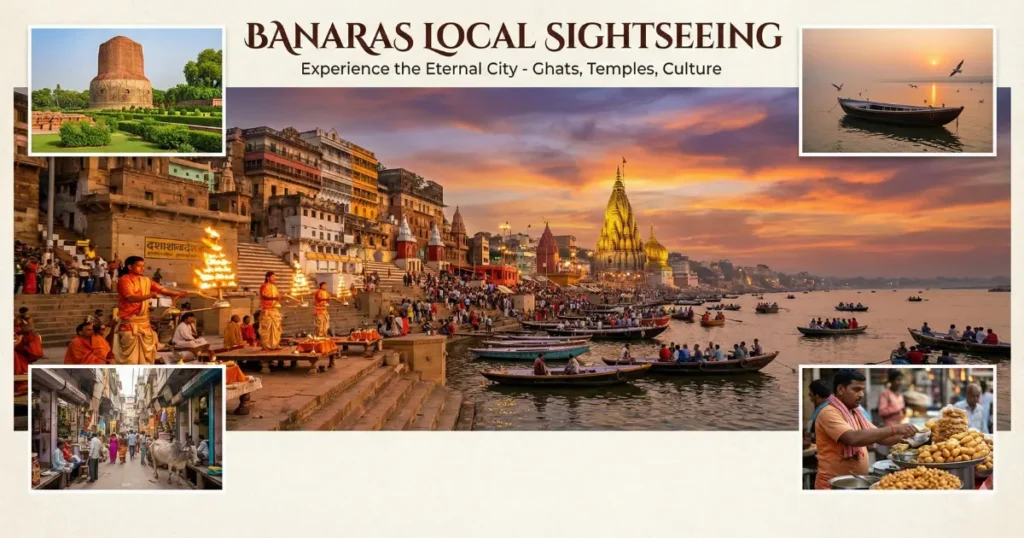
The ghats are not just a backdrop. They are the lived interface between the ancient city and the river – the site of cremations, morning rituals, yoga, boat departures, temple worship and one of the world’s most photographed fire ceremonies. Understanding which ghat is which and what each one is best for, converts a generic “let’s see the ghats” walk into a genuinely structured experience.
I am Gurudutt, born and raised in Braj Bhoomi and founder of Experience My India. Since 2018, our team has guided over 50,000 pilgrims along the Varanasi ghat circuit. This guide covers all 20 top ghats, their best times and how to sequence them.
The 20 Ghats at a Glance
| # | Ghat | Best For | Best Time |
| 1 | Dashashwamedh Ghat | Ganga Aarti | 6:00-7:30 PM |
| 2 | Assi Ghat | Sunrise, Subah-e-Banaras, yoga | 5:00-7:00 AM |
| 3 | Pancha Ganga Ghat | Evening lamps, five-river confluence | Sunset |
| 4 | Rajendra Prasad Ghat | Aarti viewing (less crowded than Dashashwamedh) | 6:00-7:30 PM |
| 5 | Tulsi Ghat | Quiet morning reflection | 6:00-9:00 AM |
| 6 | Chet Singh Ghat | Architecture, morning walk | 6:00-9:00 AM |
| 7 | Ahilyabai Ghat | Calm morning sit, smooth steps | 5:30-9:00 AM |
| 8 | Kedar Ghat | Morning puja, South Indian tradition | 6:00-9:00 AM |
| 9 | Manikarnika Ghat | Cremation; spiritual significance; 24 hrs | All day |
| 10 | Harishchandra Ghat | Cremation; quieter than Manikarnika | Morning/evening |
| 11 | Lalita Ghat | Nepali Temple, boat approach | Morning |
| 12 | Scindia Ghat | Leaning Shiva temple, photography | Morning/evening |
| 13 | Man Mandir Ghat | Jantar Mantar observatory above | Daytime |
| 14 | Darbhanga Ghat | Palace architecture, photography | Morning/evening |
| 15 | Panchganga Ghat | Theology, winter lamp tradition | Sunset (winter) |
| 16 | Munshi Ghat | Red stone, photography | Morning |
| 17 | Hanuman Ghat | South Indian pilgrimage | Morning |
| 18 | Pandey Ghat | Local neighbourhood quiet | Morning |
| 19 | Jalasainwan Ghat | Local tradition | Morning |
| 20 | Adi Keshav Ghat | Varuna-Ganga confluence, northern edge | Morning |
Experience My India sequences these into every boat ride and ghat walk. Call +91-7302265809 for a guided ghat circuit.
View Our 5 Days Ayodhya Varanasi Tour Package
Ghats for Ganga Aarti & Evening Rituals
Dashashwamedh Ghat
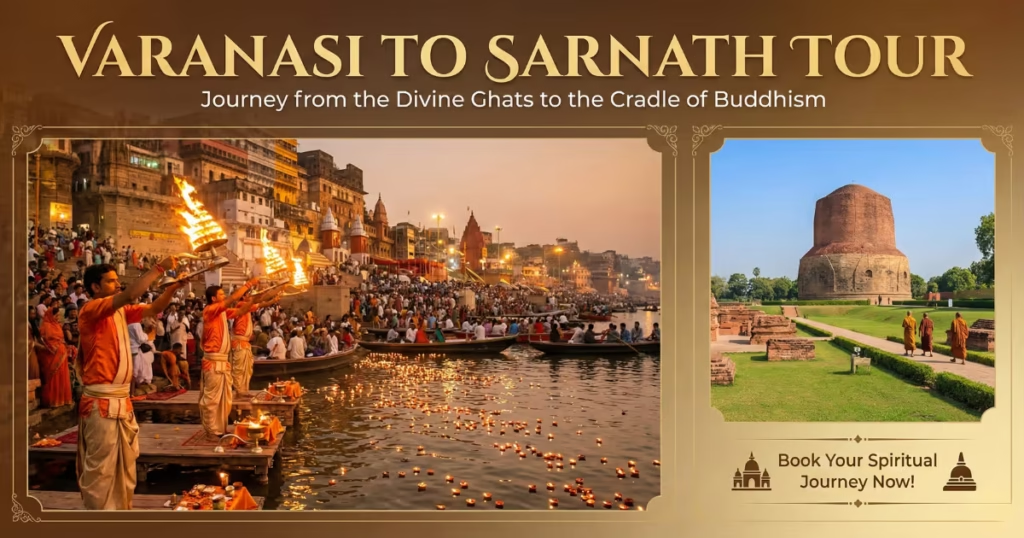
The most famous ghat in Varanasi – and the world’s most photographed riverside fire ceremony. Every evening at approximately 6:30 PM (summer) or 7:00 PM (winter), seven priests perform a synchronised fire ritual with bells, conch shells and brass lamps, before a crowd that fills the ghat steps and the river boats anchored in front.
Ganga Aarti timing: 6:30-7:00 PM (summer); 7:00-7:45 PM (winter). Duration: approximately 45 minutes.
Best position: Arrive at the ghat bank by 5:45 PM (summer) or 6:15 PM (winter) for a front-row ghat position. Alternatively, take a private boat and anchor approximately 20-30 metres directly in front by 6:00 PM. The boat view shows all seven priests simultaneously in a panoramic frame – the image most people associate with the Varanasi Ganga Aarti.
Assi Ghat
The southernmost major ghat and the most culturally active in terms of daily morning programmes. Assi Ghat is associated with the Subah-e-Banaras programme – a daily sunrise gathering of yoga practitioners, classical musicians, Vedic chanters and devotees that begins at 5:00 AM and continues until approximately 7:00 AM.
The evening aarti at Assi Ghat is smaller and more intimate than Dashashwamedh – fewer priests, softer music and a crowd that is genuinely devotional in tone rather than spectator-sized.
Pancha Ganga Ghat
The theological point of confluence of five sacred rivers in the Hindu tradition – Ganga, Yamuna, Saraswati, Kirana and Dhutpapa. The ghat is significantly quieter than Dashashwamedh and carries a depth of theological meaning that only becomes apparent with context.
In winter evenings, a distinctive local tradition involves lighting lamps on long bamboo poles – the elevated lights visible from the river create a scene unique to this ghat among Varanasi’s 84.
Rajendra Prasad Ghat
Located immediately adjacent to Dashashwamedh Ghat, Rajendra Prasad Ghat offers a side-angle view of the Ganga Aarti with significantly less crowd pressure than the main Dashashwamedh viewing area. For visitors who want the aarti atmosphere without the full Dashashwamedh density, this adjacent ghat is the practical alternative.
🙏 Planning Your Varanasi Ghat Visit? Experience My India positions every tour group at the optimal ghat – Dashashwamedh front row by 5:45 PM, sunrise boat from Assi at 5:30 AM, Manikarnika at a respectful viewing distance. Varanasi Tour Package from ₹2,999 per person · AC cab, hotel, guide WhatsApp +91-7302265809
Ghats for Sunrise & Morning Experience
Assi Ghat
In the morning, Assi Ghat transforms from its evening cultural scene into the Subah-e-Banaras venue – one of the most atmospherically distinctive early-morning experiences in Varanasi. The programme (approximately 5:00-7:00 AM) features live classical music and chanting as the sun rises over the river.
A private rowboat departing from Assi Ghat at 5:30 AM for the sunrise circuit is the most-recommended boat timing in all of Varanasi – the light quality, the mist and the activity along the ghats between Assi and Dashashwamedh in the first hour of sunlight is what makes the Varanasi sunrise boat ride one of the most memorable travel experiences in India.
Tulsi Ghat
A quiet, tree-lined ghat with a particular association with Tulsidas – the poet-saint who composed the Ramcharitmanas and is believed to have resided near this ghat. Significantly less crowded than Assi or Dashashwamedh, making it ideal for quiet morning reflection away from the more active ghat sections.
Chet Singh Ghat
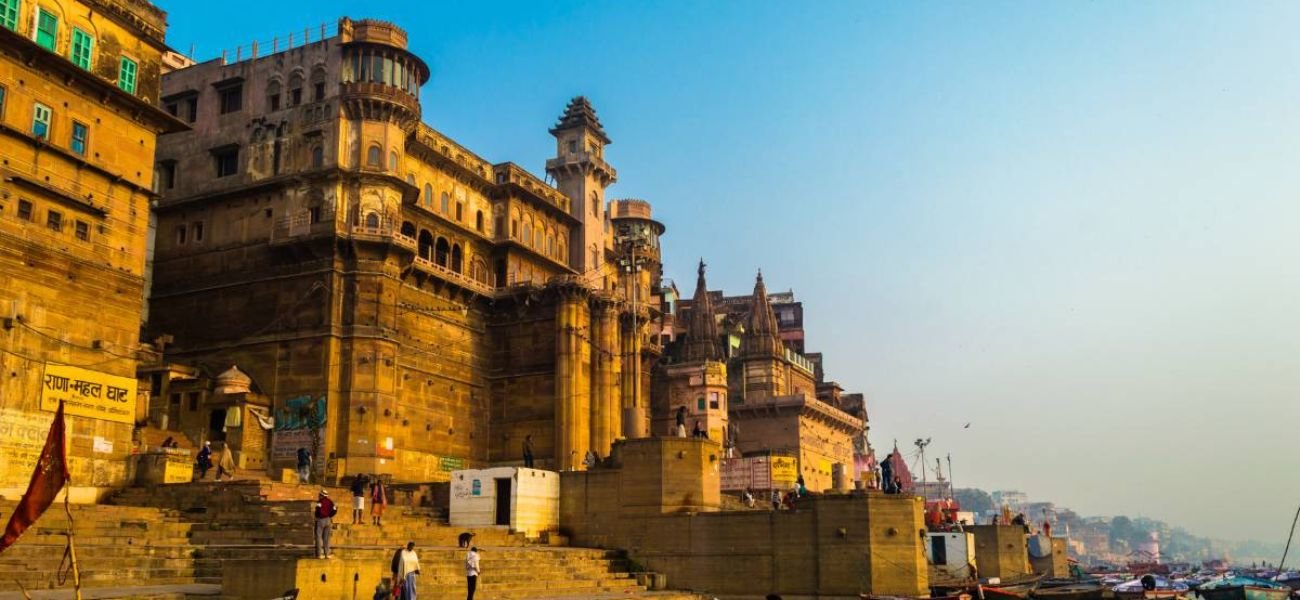
A ghat with a striking fort-like palace structure built directly at the water’s edge – the architectural drama of the building against the river makes this one of the most distinctive ghat profiles in the morning light. The ghat was historically associated with the Battle of Chet Singh against the British East India Company.
Ahilyabai Ghat
Built by the Maratha queen Ahilyabai Holkar, this ghat features smooth, well-proportioned stone steps that are among the most accessible and comfortable in the entire Varanasi ghat stretch. An excellent morning sitting position for watching the river and the gradually waking city.
Book Your Sugam Darshan and Rudrabhishek at Kashi Vishwanath
Ghats for Spiritual & Historic Significance
Manikarnika Ghat
Varanasi’s primary cremation ghat – where fires have burned continuously for as long as recorded history allows. The burning ghats of Manikarnika are not a tourist attraction in the conventional sense. They are an active site of Hindu cremation practice and the fires visible at any hour represent families performing the final rites for their deceased.
Approaching Manikarnika correctly means observing from a respectful distance without photography, speaking quietly and understanding that what you are witnessing is a sacred religious act, not a spectacle. A guide who can provide the theological context – Varanasi as a place where dying grants liberation (moksha), the significance of the river as the carrier of the soul – makes this encounter genuinely illuminating rather than merely striking.
Photography is strictly prohibited at Manikarnika Ghat and must be respected at all times.
Harishchandra Ghat
The second major cremation ghat – older in some accounts than Manikarnika, named after the legendary King Harishchandra who is said to have worked here as a cremation ground attendant as part of his trial of truth and righteousness. Quieter than Manikarnika and carries a different, more solitary atmosphere.
Lalita Ghat
The ghat immediately adjacent to the Nepali Temple (Kathwala Mandir) – the 19th-century pagoda-style temple built by the Nepalese royal family, featuring erotic wood carvings and a replica Pashupatinath lingam. The combination of Lalita Ghat’s riverbank and the distinctive pagoda visible from the water makes this a notable boat-view stop on any Ganga circuit.
Scindia Ghat
One of the most visually dramatic ghats in Varanasi – the Shiva temple at this ghat has partially sunk into the river over the centuries and now leans at a dramatic angle directly above the water. The combination of the tilted temple, the old stone steps and the river reflections makes this one of the most photographed architectural details on the entire ghat circuit.
Man Mandir Ghat
Home to the historic Jantar Mantar – an 18th-century astronomical observatory built by Maharaja Jai Singh II of Jaipur, positioned directly above the ghat. One of five Jantar Mantars in India (others are in Delhi, Jaipur, Ujjain and Mathura). Most visitors who walk the lower ghat steps never look up to notice the observatory above them.
Darbhanga Ghat
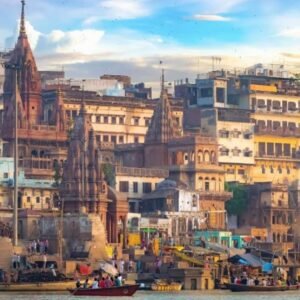
A ghat distinguished by its palace-like architectural complex – grand sandstone buildings with ornate carved details that make it among the most photogenic stretches of the Varanasi riverfront. Regularly used by professional photographers for the combination of the stone architecture with the river context.
Panchganga Ghat
The theologically significant confluence point – where Varanasi’s sacred geography locates the meeting of the Ganga with four other rivers. This is not a visible physical confluence (the other rivers flow underground in the Hindu cosmological understanding) but a point of particularly concentrated pilgrimage energy.
Book Your Ayodhya Varanasi Tour Package
Scenic & Heritage Ghats
Munshi Ghat
A compact, elegantly proportioned red-stone ghat immediately adjacent to Darbhanga – together they form the most architecturally photogenic ghat pair in Varanasi. The red stone and carved details of Munshi Ghat photograph distinctively well in morning and evening side light.
Hanuman Ghat
The ghat where the poet-saint Tulsidas is believed to have lived and written portions of the Ramcharitmanas – carrying particular significance for Ram devotees alongside its more general ghat atmosphere. A strong South Indian pilgrimage presence makes this ghat culturally distinct from the Shaiva-dominated central ghats.
Pandey Ghat
A quiet neighbourhood ghat that sees primarily local activity – early morning bathers, children and residents using the steps. One of the best places to observe everyday Varanasi ghat life away from the tourist-facing ghats. Very few visitors stop here deliberately.
Jalasainwan Ghat
A smaller ghat with deep roots in local tradition, offering a glimpse of the quieter fabric of Varanasi ghat culture away from the famous sites.
Adi Keshav Ghat
Located at the northernmost end of the Varanasi ghat circuit, at the confluence of the Varuna River with the Ganga. This is one of Varanasi’s most ancient sites – the Varuna confluence marks the original northern boundary of the old sacred city. Adi Keshav is less visited than any other ghat in this list, but for pilgrims interested in Varanasi’s deepest layers of history, it is one of the most significant.
Best Walking Route – Assi to Adi Keshav
The full Varanasi ghat walk from Assi Ghat (southernmost) to Adi Keshav Ghat (northernmost) covers all 84 ghats and approximately 6 km. For a 20-ghat focused walk, the central section from Assi to Manikarnika (approximately 3 km) covers the majority of the top 20 in sequence.
Recommended Half-Day Walking Sequence
Assi Ghat → Tulsi Ghat → Hanuman Ghat → Kedar Ghat → Harishchandra Ghat → Chet Singh Ghat → Ahilyabai Ghat → Munshi Ghat → Darbhanga Ghat → Dashashwamedh Ghat → Rajendra Prasad Ghat → Man Mandir Ghat → Scindia Ghat → Lalita Ghat → Manikarnika Ghat
Suggested timing: Begin at Assi Ghat by 5:30-6:00 AM. Complete Manikarnika by 9:00-9:30 AM. The morning light progressively improves along this route – you walk toward the sunrise light hitting the ghats from the east, which is why the morning direction (south to north) is superior for photography.
Experience My India walks every guided group in this direction. Call +91-7302265809 for a guided morning ghat walk. View Our 2 Days Varanasi Tour Package
Best Ghats at Night in Varanasi
After sunset, the ghat circuit contracts to a smaller number of actively lit and accessible locations.
| Ghat | Night Experience | Crowd |
| Dashashwamedh Ghat | Ganga Aarti (6:30-7:30 PM) – best night experience | Very High |
| Rajendra Prasad Ghat | Aarti viewing from adjacent position | High |
| Assi Ghat | Post-aarti music and cultural gathering | Moderate |
| Pancha Ganga Ghat | Winter bamboo lamps – distinctive evening sight | Low-Moderate |
| Manikarnika Ghat | Cremation fires visible 24 hours – quiet, serious | Low (local only) |
| Scindia Ghat | Evening boat view of the leaning temple | Low |
The honest answer to “which ghat is best at night”: Dashashwamedh Ghat for the Ganga Aarti is the primary evening experience in Varanasi – there is no ghat that rivals it in terms of organised evening ritual. After the aarti (approximately 7:30 PM), Assi Ghat becomes the city’s most active cultural hub, with informal music and gatherings. Manikarnika’s fires are visible all night but require respectful, quiet observation. Experience My India plans all evening ghat visits around the Dashashwamedh aarti. Call +91-7302265809.
Ground Truth – What Nobody Tells You About the Varanasi Ghats
After guiding 50,000+ pilgrims along the Varanasi ghat circuit since 2018, here is what Experience My India knows that most ghat guides will not say:
The Ganga Aarti view from Rajendra Prasad Ghat (adjacent to Dashashwamedh) is genuinely competitive with the main Dashashwamedh position – with a fraction of the crowd. Most visitors do not know this ghat exists or that its angle on the aarti is actually broader in some ways. For families with children or elderly pilgrims who cannot stand in a dense crowd, Rajendra Prasad Ghat is the practical alternative Experience My India uses.
The “lesser” ghats between Kedar and Harishchandra are where everyday Varanasi lives. The tourist ghat circuit focuses on the famous sites – Assi, Dashashwamedh, Manikarnika. The quieter ghats in between – Pandey, Ahilyabai, Chet Singh – carry the texture of an ancient city going about its morning with no awareness of being observed. This section of the walk is consistently described by our pilgrims as the most humanly moving part of the ghat circuit.
Photography at Manikarnika is prohibited, but the prohibition extends to phones within a certain proximity – not just cameras. Some visitors assume they can photograph at a distance without a telephoto lens. The guideline – and the enforceable expectation of the families present – applies to any attempt at a photograph, from any device. Experience My India briefs every group before they approach.
Adi Keshav Ghat at the northern tip is genuinely isolated from the main tourist circuit and requires a deliberate decision to go there. No casual ghat walk reaches it. But the Varuna River confluence at the northern end of Varanasi is one of the city’s most ancient and historically significant points. Pilgrims who want the full sacred geography of Varanasi without the tourist crowd find this ghat unexpectedly moving.
Know Before You Visit – Top Ghats in Varanasi
- Ganga Aarti at Dashashwamedh: 6:30-7:00 PM (summer) / 7:00-7:30 PM (winter) – arrive by 5:45 PM for a ghat-bank position
- Sunrise boat from Assi: 5:30 AM – arrange the previous evening; walk-up boats at this hour are not reliable
- Photography strictly prohibited at Manikarnika and Harishchandra ghats – no exceptions
- Walking the ghat circuit south to north (Assi to Manikarnika) in the morning is better for photography – the light comes from the east and illuminates the ghats facing you
- The Subah-e-Banaras programme at Assi Ghat runs 5:00-7:00 AM – arrive before 5:00 AM to witness the full opening sequence
- Carry small denomination cash for boat rides (₹100-₹500 per person shared) and ghat-side tea
- Wear footwear that is easy to remove – steps at many ghats are approached barefoot
- Experience My India sequences all 20 ghats in this guide into guided ghat walks and boat rides. WhatsApp +91-7302265809.
Frequently Asked Questions – Top Ghats in Varanasi
Dashashwamedh Ghat has the most famous and grand evening Ganga Aarti in Varanasi – seven priests perform a synchronised fire ritual daily at approximately 6:30-7:00 PM (summer) or 7:00-7:45 PM (winter). For a less crowded but still excellent Aarti view, adjacent Rajendra Prasad Ghat offers a broader angle with significantly fewer people. Assi Ghat holds a smaller, more intimate evening Aarti. Experience My India positions every group at Dashashwamedh by 5:45 PM. Call +91-7302265809.
The five most essential ghats in Varanasi are Dashashwamedh Ghat (evening Ganga Aarti), Assi Ghat (sunrise Subah-e-Banaras programme), Manikarnika Ghat (eternal cremation fires – approached respectfully), Scindia Ghat (partially submerged leaning Shiva temple – best from a boat) and Pancha Ganga Ghat (five-river confluence; winter bamboo lamp tradition). Experience My India covers all five in the standard Varanasi 2-day package. WhatsApp +91-7302265809.
Manikarnika Ghat is widely considered the most spiritually charged ghat in Varanasi – cremation fires have burned here continuously for as long as Varanasi’s recorded history and the ghat represents the Hindu belief that dying in Kashi grants liberation (moksha). Pancha Ganga Ghat (five-river confluence) carries the deepest Puranic significance. Dashashwamedh Ghat is the most ritually active. The specific answer depends on the dimension of spirituality – active ritual, sacred geography or theological significance. Experience My India’s guides explain each ghat’s specific meaning. Call +91-7302265809.
Dashashwamedh Ghat is the primary evening experience – the Ganga Aarti at 6:30-7:30 PM is the most organised and visually spectacular night event at any Varanasi ghat. After the aarti, Assi Ghat becomes the city’s most active cultural ghat, with informal music and gatherings until 9:00-10:00 PM. Manikarnika’s cremation fires are visible all night but require quiet, respectful observation without photography. Pancha Ganga Ghat’s bamboo lamp tradition is specific to winter evenings. Experience My India plans all evening visits. WhatsApp +91-7302265809.
Subah-e-Banaras (“Morning of Banaras”) is a daily cultural programme at Assi Ghat that begins at 5:00 AM – before sunrise – and continues until approximately 7:00 AM. It features live classical music and flute, Vedic chanting, synchronised sunrise yoga and a small morning aarti as the sun rises over the Ganga. The programme runs every day of the year and is open to all visitors at no charge. Experience My India schedules every Varanasi morning to include Assi Ghat at 5:00-5:30 AM for the full Subah-e-Banaras sequence. Call +91-7302265809.
Photography is permitted at most Varanasi ghats, including Dashashwamedh, Assi, Scindia, Darbhanga and Munshi. Photography is strictly prohibited at Manikarnika Ghat and Harishchandra Ghat (the cremation ghats) – this applies to any device including phones and from any proximity. Experience My India briefs every group on photography rules before approaching the cremation ghats. WhatsApp +91-7302265809 for a photography-focused ghat itinerary.
The best time for the ghat walk is 5:30 AM-9:00 AM for the sunrise, morning mist and Subah-e-Banaras programme. The best evening time is 5:45-8:00 PM for the Ganga Aarti at Dashashwamedh. Avoid midday (11:00 AM-4:00 PM) in summer – the stone steps become very hot and the light is harsh for photography. October to February gives the most atmospheric morning mist conditions. Experience My India builds every itinerary around these optimal windows. Call +91-7302265809.
From Varanasi Junction railway station, the main ghats (Dashashwamedh, Manikarnika) are approximately 4 km – 15-25 minutes by auto-rickshaw (₹80-₹120). Auto-rickshaws and e-rickshaws cannot enter the final 300-500 metres near the main ghats due to narrow lanes – the last stretch is on foot. Assi Ghat (southernmost) is approximately 6 km from the station. Experience My India manages all transport logistics for ghat visits. WhatsApp +91-7302265809 with your hotel address.
Recommended products
-
1 Night 2 Days Varanasi Tour Package
Original price was: ₹7,000.00.₹6,000.00Current price is: ₹6,000.00. -
10 Days Complete Uttar Pradesh Spiritual Tour
-
2 Night 3 Days Ayodhya Varanasi Tour Package
Original price was: ₹9,000.00.₹8,000.00Current price is: ₹8,000.00. -
2 Nights 3 Days Varanasi Tour Package
Original price was: ₹11,000.00.₹9,500.00Current price is: ₹9,500.00.


Ready to Plan Your Varanasi Ghat Visit with Experience My India?
WhatsApp us and receive your personalised Varanasi ghat itinerary within 30 minutes – sunrise boat from Assi, morning ghat walk, Dashashwamedh Aarti positioning and all 20 ghats in this guide sequenced into your trip duration.
Varanasi Packages from ₹2,999 per person · All inclusive
WhatsApp +91-7302265809 – Book Now
Jai Shri Ram 🙏