
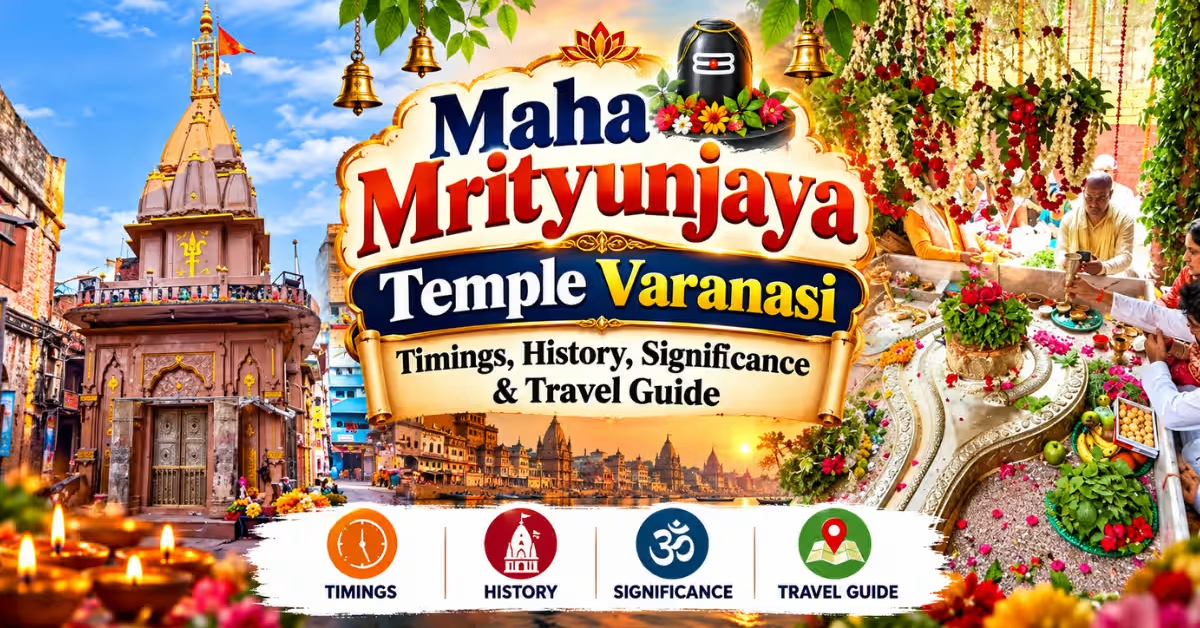
Maha Mrityunjaya Temple Varanasi (Shri Mahamrityunjay Mahadev Temple) is open 4:00 AM to 12:00 midnight daily – no midday closure, unlike most Varanasi temples. Three aartis: Morning 5:30 AM, Evening 6:30 PM, Shayan 11:30 PM. The defining feature is the Dhanvantari Kup – an ancient sacred well where devotees collect healing water. Located in Daranagar near Kotwali, reached via Maidagin. Entry free. Experience My India includes this temple in all Varanasi tours. WhatsApp +91-7302265809. See our Ayodhya Varanasi Tour Package or message WhatsApp +91 7302265809.
The Shri Mahamrityunjay Mahadev Temple in Varanasi is dedicated to Lord Shiva in one of his most theologically powerful forms – Mrityunjaya, the “Conqueror of Death.” Located in the narrow lanes of Daranagar near the Kotwali area, this is not a large or visually imposing temple. It is, however, one of Varanasi’s most intensely sacred Shaivite shrines – a place where the continuous chanting of the Maha Mrityunjaya Mantra creates an atmosphere that pilgrims consistently describe as unlike any other temple in Kashi.
I am Gurudutt, born and raised in Braj Bhoomi and the founder of Experience My India. Since 2018, I have guided 50,000+ pilgrims through Varanasi’s complete temple circuit – including this temple at 5:00 AM when the morning aarti fills the narrow sanctum with lamp-light and the Dhanvantari Kup where devotees collect sacred water for family members who are unwell. This guide gives you every practical detail you need.
By the end of this guide you will know the timings, the three aartis, the Dhanvantari Kup water tradition, the Rishi Markandeya founding story, how to reach the temple through the Daranagar lanes and exactly where it fits in the complete Kashi darshan circuit.
What Is the Maha Mrityunjaya Temple Varanasi
The Shri Mahamrityunjay Mahadev Temple is a Hindu temple dedicated to Lord Shiva in his form as Mrityunjaya – the deity who overcomes death and grants longevity, health and liberation from Akal Mrityu (untimely or unnatural death). In the 12-Jyotirlinga tradition, Mrityunjaya is one of the most potent forms of Shiva specifically for devotees seeking protection from illness, accidents and premature death.
What distinguishes this temple:
Unlike most Varanasi temples – which are famous for a historical deity form, a specific ghat location or an architectural landmark – the Maha Mrityunjaya Temple’s distinctiveness comes from three specific features:
- Continuous opening from 4 AM to midnight – no midday closure, available throughout the day
- The Dhanvantari Kup – an ancient sacred well on the premises where divine physician Dhanvantari is said to have poured his celestial medicines
- The unbroken Maha Mrityunjaya Mantra chanting – continuous recitation that creates the temple’s defining spiritual atmosphere
The temple sits in the Daranagar neighbourhood near the Kotwali area of old Varanasi – away from the main tourist ghat circuit, in the dense old city lanes that require navigation on foot or by cycle rickshaw.
Experience My India includes the Maha Mrityunjaya Temple in all multi-day Varanasi tours. The 2 Nights 3 Days Varanasi Tour Package builds this temple into the Day 2 northern cluster alongside Kaal Bhairav Temple. WhatsApp +91-7302265809.
Maha Mrityunjaya Temple Timings – Complete Daily Schedule
| Session | Timing |
| Temple opens | 4:00 AM |
| Morning Aarti (Mangala) | 5:30 AM |
| Afternoon | Open continuously (no midday closure) |
| Evening Aarti | 6:30 PM |
| Shayan Aarti (Night) | 11:30 PM |
| Temple closes | 12:00 Midnight |
The single most important practical detail about Maha Mrityunjaya Temple: It has no midday closure. While Kashi Vishwanath, Annapurna Mandir and most Varanasi temples observe a 3-5 hour afternoon closure for deity rest, the Maha Mrityunjaya Temple remains open from 4:00 AM to midnight – 20 continuous hours. This makes it one of the most accessible major temples in all of Varanasi.
Open all 7 days – Monday to Sunday, including Mondays (Shiva’s auspicious day), public holidays and festival days.
Festival extensions: During Maha Shivratri, the temple may extend hours or remain open through the night. During Sawan month (July-August), the temple draws significantly higher Monday crowds.
Experience My India confirms current-day timings for all Varanasi tour groups. WhatsApp +91-7302265809.
Book Your Sugam Darshan and Rudrabhishek at Kashi Vishwanath
The Three Daily Aartis – Times and Significance
| Aarti | Time | Significance | Crowd |
| Mangala Aarti | 5:30 AM | Opening ceremony – most intimate | Very low (20-50 people) |
| Sandhya Aarti | 6:30 PM | Evening lamp ceremony – most attended | Moderate |
| Shayan Aarti | 11:30 PM | Night ceremony – deity put to rest | Very low |
Mangala Aarti (5:30 AM): The most contemplative of the three. At 5:30 AM, the Daranagar lanes are quiet – only regular devotees and dedicated pilgrims are present. The lamp ceremony in the narrow sanctum, with the Maha Mrityunjaya Mantra chanting as backdrop, is the temple at its most intimate and powerful. Experience My India schedules the Maha Mrityunjaya Temple at 5:30 AM for groups that want the complete morning Shaivite circuit – arriving before the aarti, attending the ceremony, then walking to Kaal Bhairav Temple (5-10 minutes) before proceeding to Kashi Vishwanath at 7:00 AM.
Shayan Aarti (11:30 PM): The night aarti is for serious pilgrims and dedicated devotees. At 11:30 PM, the temple has very few visitors – the ceremony is deeply personal. The 2 Nights 3 Days Varanasi Tour Package can include the Shayan Aarti on request for groups staying in Varanasi that night. WhatsApp +91-7302265809.
The Dhanvantari Kup – The Sacred Healing Well
The most distinctive feature of the Maha Mrityunjaya Temple is the Dhanvantari Kup – an ancient sacred well located on the temple premises.
| Dhanvantari Kup Detail | Information |
| What it is | An ancient sacred well (koop) on the temple premises |
| Deity associated | Dhanvantari – the divine physician deity of Ayurveda, an avatar of Vishnu |
| Mythological significance | Dhanvantari is said to have poured all his celestial medicines into this well |
| Believed properties | Water held to have therapeutic and curative properties |
| Pilgrim practice | Collect water in a small bottle to bring home for elderly or unwell family members |
| Access | Open to all devotees – part of the temple complex |
The bottle-collection tradition: Devotees visiting the Maha Mrityunjaya Temple bring a small, empty container specifically to collect water from the Dhanvantari Kup – taking it home for family members who are ill, elderly or suffering from chronic conditions. This is one of the most practically oriented devotional traditions in all of Varanasi – the belief that the Dhanvantari Kup water, obtained at the temple of the “Conqueror of Death,” carries specific healing potential.
The Dhanvantari connection: Dhanvantari is the deity of Ayurveda – worshipped on Dhanteras (the day before Diwali) as the source of divine medical knowledge. His presence at the Maha Mrityunjaya Temple is theologically precise – Shiva as the overcomer of death, Dhanvantari as the master of healing, combined in the same sacred site.
Experience My India explains the Dhanvantari Kup tradition to every group visiting this temple and advises pilgrims to bring a small container. The 1 Night 2 Days Varanasi Tour Package includes the Maha Mrityunjaya Temple in the northern cluster circuit. WhatsApp +91-7302265809.
History and Mythology – Rishi Markandeya and the Maha Mrityunjaya Mantra
The Maha Mrityunjaya Temple’s theological foundation rests on one of Hinduism’s most beloved survival stories: Rishi Markandeya and the Maha Mrityunjaya Mantra.
The Markandeya story: According to the Shiva Purana and the Markandeya Purana, the sage Markandeya was destined to die at the age of 16 – his lifespan fixed by fate. As the hour of death approached and the god of death (Yama) sent his messengers, the young Markandeya clasped the Shivaling in the temple and began chanting the Maha Mrityunjaya Mantra with complete devotion. When Yama himself came to collect Markandeya’s life, Shiva manifested from the Shivaling, drove away the god of death with his trident and granted Markandeya immortality.
This story is the foundational myth of the Maha Mrityunjaya Mantra – the prayer that overcame Yama’s authority – and is why the mantra is specifically chanted for healing, longevity and protection from untimely death.
The Maha Mrityunjaya Mantra: “Om Tryambakam yajamahe Sugandhim pushti-vardhanam. Urvarukamiva bandhanan Mrityor mukshiya mamritat.”
Translation: “We worship the three-eyed Lord Shiva who permeates and nourishes all like a fragrance. May he liberate us from the bondage of death as a ripe cucumber falls from its vine – granting immortality, not death.”
The continuous chanting of this mantra at the Maha Mrityunjaya Temple is not incidental background music – it is the specific sacred sound that defines the temple’s atmosphere and devotional purpose.
For the complete Kashi Vishwanath guide and how Varanasi’s Shaivite temples connect: Kashi Vishwanath Temple Varanasi.
Significance of Worshipping Shiva as Mrityunjaya
Shiva has 108 names in the Hindu tradition, each describing a different aspect of the divine. Mrityunjaya (Mrityu = death, Jaya = victor/conqueror) – “the one who conquers death” – is among the most significant for devotees dealing with:
| Reason for Visit | Theological Basis |
| Protection from illness | Shiva as Mrityunjaya destroys Akal Mrityu (untimely death) |
| Healing from serious disease | Dhanvantari Kup water + Mrityunjaya blessings |
| Longevity prayer for elderly family | The same tradition as Markandeya’s prayer |
| Recovery from accidents | Worship for protection from sudden death |
| General Shiva darshan in Kashi | Part of the complete Kashi Shaivite circuit |
| Mrityunjaya Homam (fire ritual) | Specific ritual for healing and liberation |
The theological belief is specific: Mrityunjaya form of Shiva does not merely extend life – it addresses the root cause of untimely death by destroying it at source, in the same way that Shiva destroyed Yama’s authority over Markandeya.
For the complete Varanasi Shaivite circuit context: 30 Best Places to Visit in Kashi 2026 and Best Time to Visit Varanasi 2026. Experience My India plans the complete Kashi darshan circuit including Maha Mrityunjaya for all multi-day Varanasi packages. WhatsApp +91-7302265809.
Mrityunjaya Homam – The Fire Ceremony for Healing and Longevity
The Mrityunjaya Homam is a Vedic fire ritual (yajna) specifically performed for healing, longevity and liberation from Akal Mrityu – using the Maha Mrityunjaya Mantra as the central chant during the fire offering.
| Mrityunjaya Homam Detail | Information |
| What it is | Vedic fire ritual with Maha Mrityunjaya Mantra recitation |
| Primary purpose | Healing, longevity, protection from untimely death |
| Where performed in Varanasi | Various Varanasi puja centres and temple premises – coordinate with local priests |
| Duration | Typically 3-6 hours for a full Homam |
| Who performs | Vedic-trained priests specialising in the Mrityunjaya ritual |
| Cost | Varies – coordinate with Experience My India for reliable referrals |
| Best occasion | Maha Shivratri, Sawan Mondays, birthdays, health recovery |
Note: The Maha Mrityunjaya Temple at Daranagar is the primary devotional site. For a formal Mrityunjaya Homam, coordinate with Experience My India who can connect you with trusted Varanasi priests. WhatsApp +91-7302265809.
How to Reach Maha Mrityunjaya Temple Varanasi
Address: Shri Mahamrityunjay Mahadev Temple, Daranagar, near Kotwali, Varanasi, Uttar Pradesh
The temple is located in the dense old city lanes – a characteristic Banaras setting where no large vehicles can reach the final 200-500 metres.
| From | Mode | Instructions |
| Kashi Vishwanath Temple | Walk / cycle rickshaw | Head toward Maidagin via Visheshwarganj – 10-15 min |
| Kaal Bhairav Temple | Walk | 5-10 minutes – both in the northern old city cluster |
| Godowlia Chowk | Cycle rickshaw | ₹20-₹40 to Maidagin, then walk |
| Varanasi Cantt Station | Auto to Maidagin | ₹60-₹100, 20-25 min – then walk/cycle rickshaw |
| LBS Airport (VNS) | Taxi to Maidagin area | ₹400-₹600, 45 min |
Lane navigation: Take any auto or taxi to Maidagin or Visheshwarganj – these are the main junction points accessible to vehicles in the northern old city area. From Maidagin, the Maha Mrityunjaya Temple is a 5-10 minute walk or cycle rickshaw ride through the Daranagar lanes. The lanes are narrow but navigable – they are the same character as the lanes to Kaal Bhairav Temple, which most Varanasi visitors have already experienced.
Google Maps: Search “Mrityunjay Mahadev Mandir Varanasi” or “Mahamrityunjay Temple Kotwali Varanasi” for the most accurate navigation pin.
Experience My India coordinates all lane navigation for Varanasi tour groups – the driver drops at Maidagin and the guide leads the walk to the temple. The 3 Nights 4 Days Ayodhya Varanasi Tour Package includes this temple in the Day 3 northern cluster. WhatsApp +91-7302265809.
Maha Mrityunjaya Temple in the Kashi Sightseeing Circuit
Experience My India places the Maha Mrityunjaya Temple in the northern Kashi morning cluster – alongside Kaal Bhairav Temple, the two sites naturally combine before Kashi Vishwanath:
| Time | Site | Distance from Previous |
| 5:00 AM | Maha Mrityunjaya Temple | Starting point – Mangala Aarti at 5:30 AM |
| 5:45 AM | Kaal Bhairav Temple | 5-10 minutes walk |
| 7:00 AM | Kashi Vishwanath Temple | 10-15 minutes from Kaal Bhairav |
| 9:30-10:00 AM | Annapurna Devi Mandir | 15 metres from Kashi Vishwanath |
Why this sequence works: Maha Mrityunjaya Temple at 5:00-5:30 AM (Mangala Aarti, minimal crowd) → Kaal Bhairav (guardian of Kashi – traditional first stop before Kashi Vishwanath) → Kashi Vishwanath (7:00-9:30 AM, optimal queue window with Sugam Darshan). Three major Shaivite temples covered before 10 AM.
For the complete Kashi circuit: 30 Best Places to Visit in Kashi 2026. Experience My India builds this morning sequence into all 2-day+ Varanasi packages. WhatsApp +91-7302265809.
Best Time to Visit Maha Mrityunjaya Temple
| Timing | Crowd | Experience | Verdict |
| 4:00-5:30 AM (pre-Mangala) | Near-empty | Most contemplative – mantra chanting before dawn | ✅ Best for serious pilgrims |
| Mangala Aarti 5:30 AM | Very low | Most sacred aarti – 20-50 people | ✅ Best aarti experience |
| Morning 6:00-10:00 AM | Low | Good darshan, Dhanvantari Kup accessible | ✅ Good |
| Afternoon 12:00-4:00 PM | Moderate | No closure – open continuously | ✅ Accessible when other temples closed |
| Evening Aarti 6:30 PM | Moderate | Lamp ceremony, atmospheric | ✅ Good evening option |
| Shayan Aarti 11:30 PM | Very low | Personal, profound | ✅ For dedicated pilgrims |
| Sawan Mondays | High | Peak Shiva Monday + healing prayers | ⚠️ Arrive before 6 AM |
| Maha Shivratri | Very High | All-night opening – major festival | ⚠️ Plan for extended hours |
Best season: October to February – comfortable temperatures, Sawan period (July-August) over, all aarti windows accessible. For the complete Varanasi seasonal guide: Best Time to Visit Varanasi 2026. The Same Day Varanasi Tour Package from ₹2,999 can include the Maha Mrityunjaya Temple in the pre-Kashi Vishwanath morning window.
Nearby Temples – Kaal Bhairav and the Northern Kashi Cluster
The Maha Mrityunjaya Temple’s location in the Daranagar-Kotwali area puts it in natural proximity to several other significant northern Varanasi temples:
| Temple | Distance | Significance |
| Kaal Bhairav Temple | 5-10 min walk | Guardian of Kashi – must visit before Kashi Vishwanath |
| Kashi Vishwanath Temple | 15 min | Jyotirlinga – primary Kashi darshan |
| Annapurna Devi Mandir | 15 m from KV | Goddess of nourishment – in the same lane |
| Batuk Bhairav Temple | 10 min | Another Bhairav form associated with the same area |
| Trilochan Temple | 15 min | Three-eyed Shiva – historic Varanasi temple |
The Kaal Bhairav + Maha Mrityunjaya combination: Both temples are in the northern cluster, both dedicated to powerful Shaivite forms, both best visited before Kashi Vishwanath. Experience My India combines them as a single morning cluster starting at 5:00 AM. The two temples together – Mrityunjaya (conqueror of death) and Kaal Bhairav (guardian of Kashi) – represent the two primary protective Shiva forms in the Varanasi tradition.
Practical Guide – Rules, Dress Code and Sacred Water Tradition
| Rule | Detail |
| Entry fee | Completely free |
| Days open | All 7 days, 4 AM-midnight |
| Footwear | Remove at entrance |
| Dress code | Covered shoulders and knees; traditional attire preferred |
| Photography | Check locally – photography in the inner sanctum may be restricted |
| Leather items | Not recommended inside sacred precinct |
| What to bring | Small empty bottle for Dhanvantari Kup water |
| Dhanvantari Kup water | Ask the pujari for guidance on collecting water from the koop |
| Tuesdays and Sundays | More auspicious for this temple – slightly higher crowd |
The bottle tradition in practice: Many pilgrims who visit on behalf of an ill family member bring a small sealed container to the Dhanvantari Kup and collect water under the pujari’s guidance. This is not a tourist gimmick – it is a deeply held local tradition that Experience My India respects and explains to every group.
Ground Truth – What Nobody Tells You About Maha Mrityunjaya Temple Varanasi
1. The temple is open 20 continuous hours (4 AM to midnight) with no midday closure – making it the most time-flexible major temple in all of Varanasi for pilgrims with variable schedules. While Kashi Vishwanath closes 11:15 AM-12:00 PM, Annapurna Mandir closes 11:30 AM-7 PM and most Varanasi temples close for 3-5 hours, the Maha Mrityunjaya Temple is simply open. A pilgrim who misses the morning window can visit at 2:30 PM or 6:00 PM without losing any access.
2. The Dhanvantari Kup sacred well is on the temple premises and the water-collection tradition is one of the most specific and practically oriented devotional practices in Varanasi – yet almost no travel guide mentions it. Most visitors enter the temple for Shiva darshan and leave without knowing the koop exists. Experience My India specifically points out the Dhanvantari Kup and the bottle-collection tradition for every group that visits.
3. The approach via Maidagin (not directly from Godowlia or the main ghat area) is the correct and most direct route – many pilgrims arrive at the ghat area and search for the temple from the wrong direction. The temple is in Daranagar – a northern old city area accessed via Maidagin junction, not via the ghat-side Vishwanath Gali approach. Auto drivers who know the area go to Maidagin; drivers who don’t know the area go to Godowlia, which is the wrong starting point for walking to Daranagar.
4. Tuesdays (Mangalwar) and Sundays draw higher crowds at this temple than Mondays – contrary to the usual Shiva temple pattern where Monday is the peak day. At Kashi Vishwanath, Mondays are the busiest. At the Maha Mrityunjaya Temple, the healing-and-longevity focus means Tuesdays (associated with Mangal/Mars, which governs health concerns) and Sundays (traditional family visit day for health prayers) see slightly higher attendance than typical Sawan Mondays.
5. The Shayan Aarti at 11:30 PM is one of the most personally profound temple experiences available in Varanasi – and completely unknown to almost all visitors. At 11:30 PM, the lanes of Daranagar are nearly deserted. The temple has a handful of devoted regulars and the night aarti proceeds with complete intimacy. Experience My India includes the Shayan Aarti option for groups that specifically want the night experience in Varanasi.
Frequently Asked Questions – Maha Mrityunjaya Temple Varanasi
The Shri Mahamrityunjay Mahadev Temple Varanasi is dedicated to Shiva as Mrityunjaya – “the Conqueror of Death.” Its significance comes from three factors: the Maha Mrityunjaya Mantra chanted continuously here is the specific prayer associated with overcoming Akal Mrityu (untimely death); the Dhanvantari Kup (ancient sacred well) on the premises is believed to carry healing properties through divine physician Dhanvantari’s mythological connection; and the temple is linked to Rishi Markandeya’s story – the devotee who chanted this mantra to overcome death itself. Experience My India includes this temple in all Varanasi circuit tours. WhatsApp +91-7302265809.
The Shri Mahamrityunjay Mahadev Temple in Varanasi is historically and mythologically associated with Rishi Markandeya – the young sage destined to die at 16 who chanted the Maha Mrityunjaya Mantra with complete devotion as the god of death approached. Lord Shiva manifested from the Shivaling to drive away death and grant Markandeya immortality. This event is the founding narrative of the Maha Mrityunjaya Mantra and the theological basis for worshipping Shiva in this form specifically for healing and longevity. The temple is located in Daranagar near Kotwali, an area of old Varanasi associated with this ancient Shaivite tradition. WhatsApp +91-7302265809.
The Shri Mahamrityunjay Mahadev Temple Varanasi is open from 4:00 AM to 12:00 midnight daily – 20 continuous hours with no midday closure, making it significantly more accessible than most Varanasi temples which close for 3-5 hours in the afternoon. Three daily aartis: Mangala Aarti at 5:30 AM, Sandhya (Evening) Aarti at 6:30 PM and Shayan (Night) Aarti at 11:30 PM. Open all 7 days. Entry is completely free. Experience My India confirms current timings for every Varanasi tour group. WhatsApp +91-7302265809.
The Mrityunjaya Homam (Vedic fire ritual with Maha Mrityunjaya Mantra recitation) is performed at various Varanasi puja centres and temple premises – not exclusively at one temple. The Shri Mahamrityunjay Mahadev Temple in Daranagar is the primary devotional site for Mrityunjaya worship in Varanasi. For a formal Mrityunjaya Homam, Experience My India can connect pilgrims with trusted Varanasi priests who specialise in this ritual – duration approximately 3-6 hours, performed on auspicious dates like Maha Shivratri, Sawan Mondays or personal request dates. WhatsApp +91-7302265809.
The Dhanvantari Kup is an ancient sacred well (koop) located within the Maha Mrityunjaya Temple premises. According to the temple tradition, the divine physician Dhanvantari – the deity of Ayurveda and an avatar of Vishnu – poured his celestial healing medicines into this well. Devotees believe the water carries specific therapeutic and curative properties. The established practice is to bring a small empty container, collect water from the Dhanvantari Kup under the pujari’s guidance and take it home for elderly or ill family members. Experience My India specifically explains this tradition to every group visiting the temple. WhatsApp +91-7302265809.
Maha Mrityunjaya Temple is approximately 10-15 minutes from Kashi Vishwanath Temple – both are in the northern old city area. The route goes through Visheshwarganj toward Maidagin junction, then through the Daranagar lanes to the temple. Auto rickshaws go to Maidagin; the final 5-10 minutes is by cycle rickshaw or on foot. Experience My India always navigates this route for Varanasi tour groups – the driver stops at Maidagin and the guide leads the lane walk. The Maha Mrityunjaya Temple and Kaal Bhairav Temple are natural companions in the same morning circuit. WhatsApp +91-7302265809.
Yes – these are two completely different temples. The Maha Mrityunjaya Temple (Shri Mahamrityunjay Mahadev Temple) is in Daranagar near Kotwali, Varanasi – dedicated to Shiva as Mrityunjaya (Conqueror of Death), with the Dhanvantari Kup and continuous mantra chanting as distinguishing features. The Nageshwarnath Temple is in Ayodhya – founded by Kush (son of Rama), the oldest Shiva temple in Ayodhya, located near Ram Ki Paidi. Both are ancient Shiva temples but in different cities, with different theological characters and completely separate pilgrimage traditions. Experience My India covers both in the Varanasi + Ayodhya combined circuit. WhatsApp +91-7302265809.
Yes – the Maha Mrityunjaya Temple is one of the very few major Varanasi temples open throughout the afternoon. While Kashi Vishwanath closes 11:15 AM-12 PM, Annapurna Mandir closes 11:30 AM-7 PM and most Varanasi temples have a 3-5 hour midday break, the Maha Mrityunjaya Temple is open continuously from 4:00 AM to midnight with no afternoon closure. Pilgrims visiting between 12:00 PM-4:00 PM – when other Varanasi temples are closed – can use this window to visit the Maha Mrityunjaya Temple and the Dhanvantari Kup. Experience My India plans this gap strategically in all multi-day Varanasi itineraries. WhatsApp +91-7302265809.
Recommended products
-
1 Night 2 Days Varanasi Tour Package
Original price was: ₹7,000.00.₹6,000.00Current price is: ₹6,000.00. -
10 Days Complete Uttar Pradesh Spiritual Tour
-
2 Night 3 Days Ayodhya Varanasi Tour Package
Original price was: ₹9,000.00.₹8,000.00Current price is: ₹8,000.00. -
5 Days Ayodhya Varanasi Tour Package


🙏 Ready to Visit Maha Mrityunjaya Temple Varanasi with Experience My India?
WhatsApp us – Mangala Aarti at 5:30 AM scheduled, Dhanvantari Kup water collection guided, Maidagin lane navigation arranged, Kaal Bhairav + Kashi Vishwanath morning sequence planned. Complete Shaivite Varanasi circuit from ₹2,999.
WhatsApp +91-7302265809 – Book Now
Jai Shri Ram 🙏