
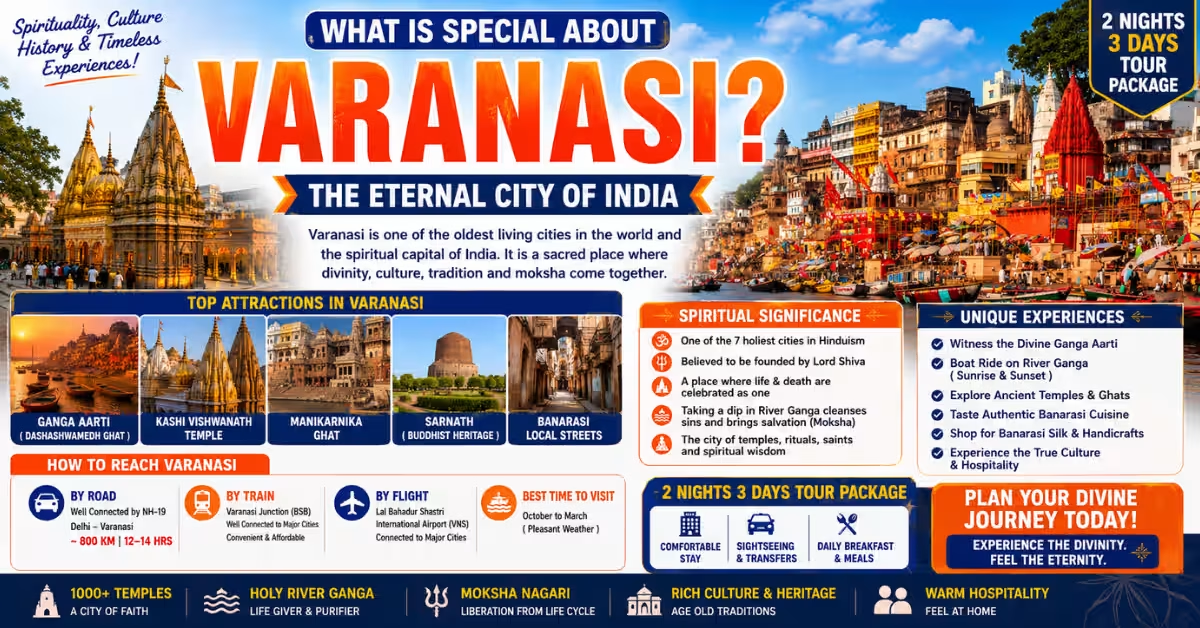
What is special about Varanasi: it is one of the world’s oldest continually inhabited cities, situated on the Ganga in Uttar Pradesh. Varanasi is the most sacred city in Hinduism – Kashi Vishwanath Temple (one of 12 Jyotirlingas), 84 ghats, the daily Ganga Aarti at Dashashwamedh Ghat (6:30-7:00 PM), Manikarnika cremation ghat and Sarnath (8 km, Buddha’s first sermon site). Guided Varanasi tours with Experience My India start from ₹3,999 per person.
Varanasi: Where Every Hour of the Day Has a Different Meaning
Varanasi – also called Kashi or Banaras – is among the oldest continually inhabited cities on earth, with settlements dating back over 3,000 years on the western bank of the Ganga in Uttar Pradesh. It is the most sacred city in Hinduism, one of the seven Sapta Puri (sacred cities) and the site of Lord Shiva’s chosen earthly abode.
What makes Varanasi genuinely different from other pilgrimage cities is the density and continuity of what happens here. Ganga Aarti at Dashashwamedh Ghat every evening at 7:00 PM, Kashi Vishwanath Temple receiving 50,000-80,000 visitors on weekdays and over 1 lakh on festival days, cremation fires at Manikarnika burning continuously for over 3,000 years, Sarnath 8 km away where Buddha delivered his first sermon – all of this exists in a 10 km radius.
I am Gurudutt, founder of Experience My India, born and raised in Braj Bhoomi and guiding pilgrims since 2018. I have coordinated over 50,000 pilgrimages through Varanasi, Ayodhya, Mathura and Prayagraj. In this guide I will answer what is special about Varanasi with specific facts, exact timings, site details, food and cultural experiences and the realities that first-time visitors most need to know. Call +91-7302265809 to plan your Varanasi visit with Experience My India. Guided tours from ₹3,999 per person.
Why Varanasi Is Famous Across the World
Varanasi is known internationally for reasons that overlap but are distinct from city to city. Here is what actually makes it famous – beyond the general descriptions:
| What Varanasi Is Known For | Specific Detail |
| Age | One of the world’s oldest continually inhabited cities – over 3,000 years of unbroken urban settlement |
| Sacred river | Located on the western (auspicious) bank of the Ganga – the only major Indian sacred city on the western bank |
| Moksha | Dying in Kashi is believed in Hindu tradition to grant Moksha – liberation from the cycle of rebirth (samsara) |
| Jyotirlinga | Kashi Vishwanath Temple houses one of 12 Jyotirlingas – the most sacred Shiva shrines in India |
| Ghats | 84 ghats stretching 7 km along the Ganga – the largest single-city ghat complex in India |
| Ganga Aarti | Dashashwamedh Ghat Aarti – one of the most attended public rituals in Hinduism, 7 priests, daily |
| Buddhism | 8 km away: Sarnath, where the Buddha gave his first sermon after enlightenment (3rd century BCE Dhamek Stupa) |
| Banarasi silk | Hand-woven Banarasi silk sarees – GI-tagged craft, among the most celebrated in India |
| Classical music | Birthplace and home of the Banaras Gharana – one of the oldest classical music traditions in North India |
| Cremation | Manikarnika Ghat – Hindu tradition holds that cremation pyres here have burned continuously for over 3,000 years |
Experience My India covers all of these through guided Varanasi tours – call +91-7302265809 to plan.
The Spiritual Significance of Varanasi in Hinduism
Varanasi occupies a unique position in Hindu theology that no other city in India holds. Its spiritual significance operates on multiple simultaneous levels.
1. Varanasi as the City of Moksha
In the Kashi Khand section of the Skanda Purana, Varanasi is described as the place where Lord Shiva personally whispers the Taraka Mantra – the mantra of liberation – into the ear of each person who dies within the city’s sacred boundary (the Panchkroshi territory). This is why dying in Kashi is considered the highest spiritual fortune in the Shaivite tradition: not because of geography, but because of this specific divine intervention attributed to Shiva himself.
This belief draws hundreds of thousands of elderly pilgrims to Varanasi each year specifically to spend their final months or years in the city – the Mukti Bhavans (liberation homes) of Kashi are unique institutions that exist nowhere else in India.
2. The Significance of the Ganga at Kashi
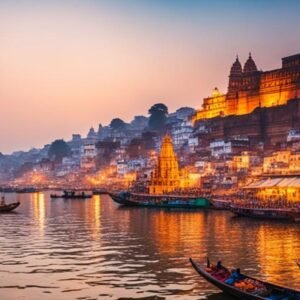
The Ganga at Varanasi is not simply a river – it is the goddess Ganga in her most direct accessible form. The western bank location of Varanasi is specifically significant: in Hindu cosmology, the western bank of the Ganga is the auspicious side. Varanasi is the only major pilgrimage city positioned on the Ganga’s western bank, while the eastern bank (where the sun rises over the river) remains undeveloped – allowing an unobstructed sunrise view from all 84 ghats.
3. Panchakaroshi Yatra – The Sacred Boundary
Varanasi is defined in the scriptures not just as a city but as a sacred geometric field – the Avimukta Kshetra – bounded by a ritual pilgrimage path of 84 km called the Panchkroshi Yatra that encircles the entire city. This 84-km walk (in multiples of 5 days) is one of the most demanding pilgrimage acts in Hindu practice.
4. Varanasi for Buddhists and Jains
Varanasi’s spiritual significance extends beyond Hinduism. Sarnath, 8 km from the main ghats, is one of the four most sacred Buddhist pilgrimage sites in the world – the place where Siddhartha Gautama gave his first teaching (the Dhammachakkappavattana Sutta) after attaining enlightenment at Bodh Gaya. The 3rd-century BCE Ashoka Pillar and Dhamek Stupa still stand at Sarnath today. Similarly, Varanasi is considered sacred in the Jain tradition as the birthplace of Suparshvanatha, the 7th Tirthankara.
Experience My India includes the theological context of Kashi’s significance in every guided Varanasi tour. Call +91-7302265809.
Famous Ghats of Varanasi – The 84-Ghat Circuit
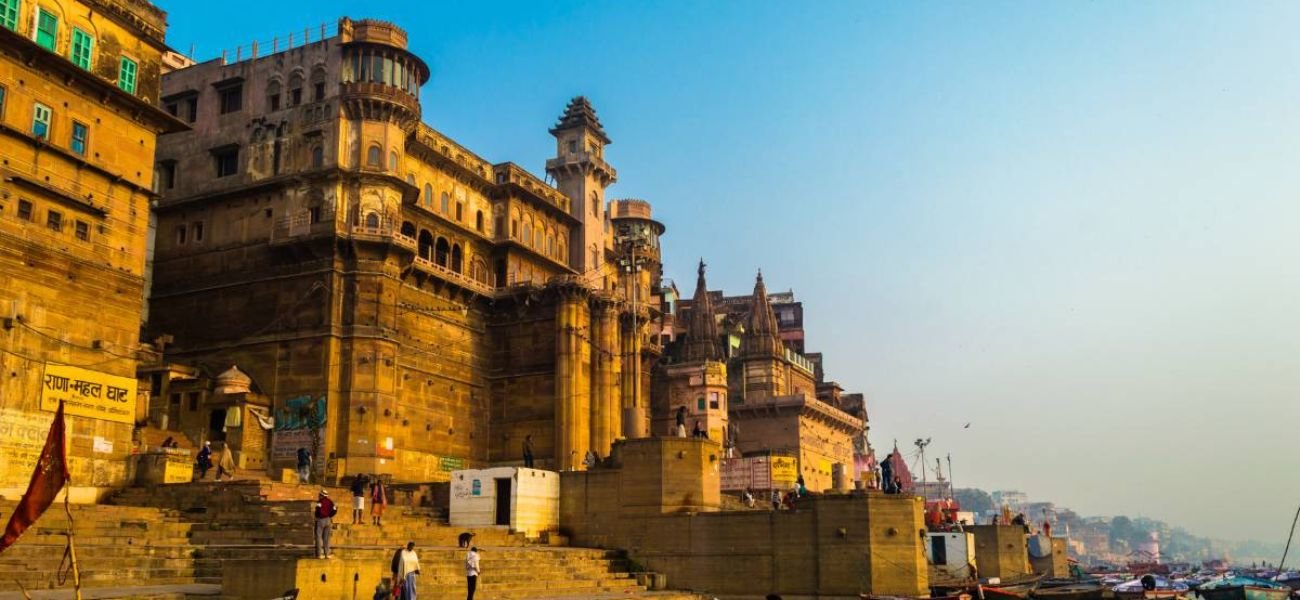
Varanasi’s 84 ghats stretch 7 km along the western bank of the Ganga from Rajghat in the north to Assi Ghat in the south. Each ghat has a distinct character and significance. These are the 10 most important:
| Ghat | Significance | Best Time to Visit | Key Activity |
| Dashashwamedh Ghat | Most famous – site of the nightly Ganga Aarti | Evening – arrive 6:00 PM | Ganga Aarti at 7:00 PM |
| Assi Ghat | Southernmost major ghat – most serene atmosphere | 5:30-8:00 AM | Subah-e-Banaras sunrise programme |
| Manikarnika Ghat | Primary cremation ghat – continuous pyres | Any time – respectful only | Observe from upper platform, no photography |
| Harishchandra Ghat | Second major cremation ghat | Any time | Cremation observation |
| Scindia Ghat | Submerged Shiva temple visible at low water | 7:00-10:00 AM | Photography, boat rides |
| Man Mandir Ghat | 17th-century Maharaja of Jaipur observatory | 8:00 AM-5:00 PM | Observatory visit |
| Panchganga Ghat | Believed to be the confluence of 5 rivers (4 underground) | 6:00-8:00 AM | Morning snan |
| Rajghat | Northernmost ghat – ferry crossing point | 7:00 AM-6:00 PM | Ferry to Ramnagar Fort |
| Tulsi Ghat | Named for saint-poet Tulsidas | 7:00 AM-9:00 PM | Peaceful – less tourist traffic |
| Brahma Ghat | Ancient ghat associated with Brahma | 6:00-9:00 AM | Quiet sunrise |
The sunrise boat ride: The most recommended Varanasi experience for first-time visitors – a 1-hour boat from Assi Ghat to Manikarnika and back between 5:30 AM and 7:30 AM, passing all 84 ghats as the city wakes up. Cost: ₹150-₹500 per person (shared) or ₹800-₹2,000 (private boat). The sunrise view from mid-river looking at the ghats is the defining visual experience of Varanasi.
Experience My India pre-arranges sunrise boat rides at confirmed rates for all Varanasi tour groups. Call +91-7302265809.
Kashi Vishwanath Temple – The Golden Temple of Shiva
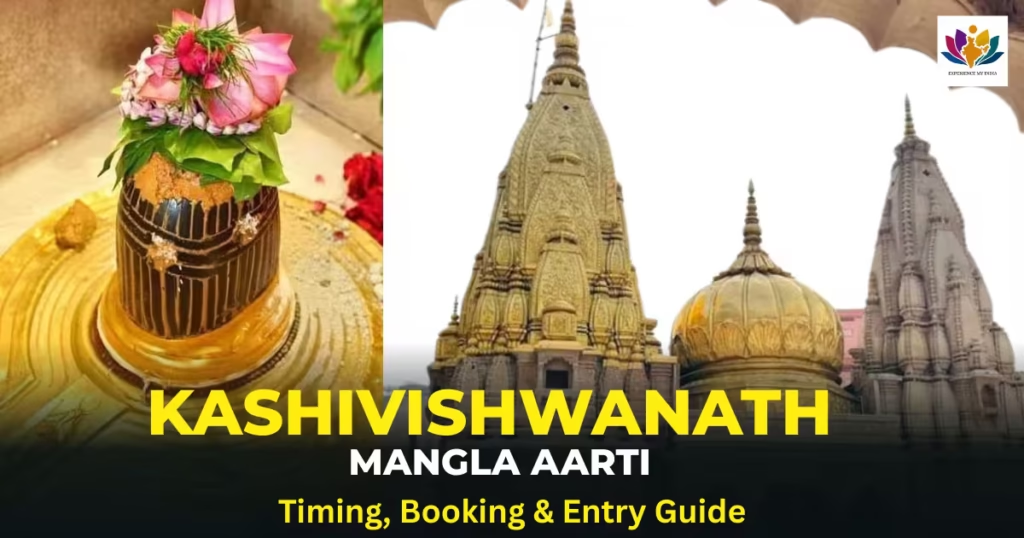
Kashi Vishwanath Temple is the most important Shiva temple in Hinduism and one of the 12 Jyotirlingas (sacred manifestations of Shiva’s light) in India. The current temple complex, significantly expanded after the Kashi Vishwanath Corridor opened in December 2021, now offers a dramatically improved darshan experience.
| Detail | Information |
| Deity | Shri Vishwanath (Lord Shiva) – one of 12 Jyotirlingas |
| Jyotirlinga significance | Most sacred Shiva shrine in Hinduism; Shiva is believed to be present in self-manifested light form |
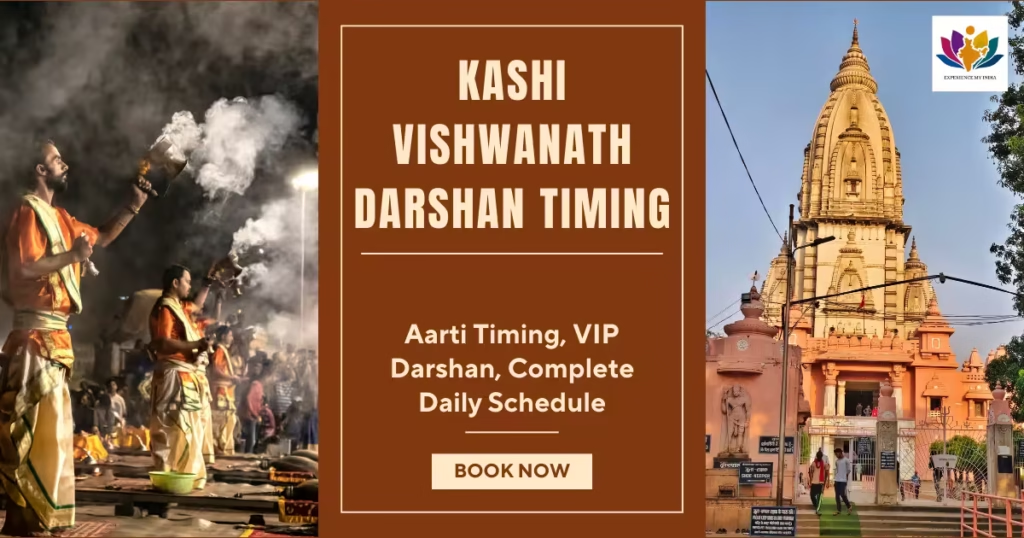
| Darshan timings | 3:00 AM (Mangala Aarti) – open until 11:00 PM daily |
| Best darshan window | 4:00-6:00 AM (Mangala session – least crowded) or 9:00-11:00 AM weekdays |
| E-pass required | Yes – free, book at srikashivishwanath.in 2-7 days ahead |
| Weekend queue (without pass) | 3-4 hours – not recommended |
| Gold | ~800 kg of gold donated to the temple spire – which is why it is commonly called the Golden Temple |
| Location | Vishwanath Gali, 400 metres from Dashashwamedh Ghat |
| Photography | Prohibited inside the sanctum; phone deposit required |
| Adjacent corridor | 5.4-lakh sq ft Kashi Vishwanath Corridor – connects temple to the Ganga ghats |
| Entry fee | Free |
Key Aartis at Kashi Vishwanath:
- Mangala Aarti: 3:00-4:00 AM (first daily Aarti – most devotionally intense)
- Bhog Aarti: 11:30 AM
- Sandhya Aarti: 7:00 PM
- Shayan Aarti: 10:30 PM (last Aarti of the day)
Experience My India coordinates Kashi Vishwanath e-pass booking and manages queue logistics for all Varanasi tour groups. The pass eliminates the 3-4 hour weekend queue entirely. Call +91-7302265809 for e-pass booking assistance.
Book Sugam Darshan and Rudrabhishek at Kashi Vishwanath
Ganga Aarti at Dashashwamedh Ghat – Timings and Guide
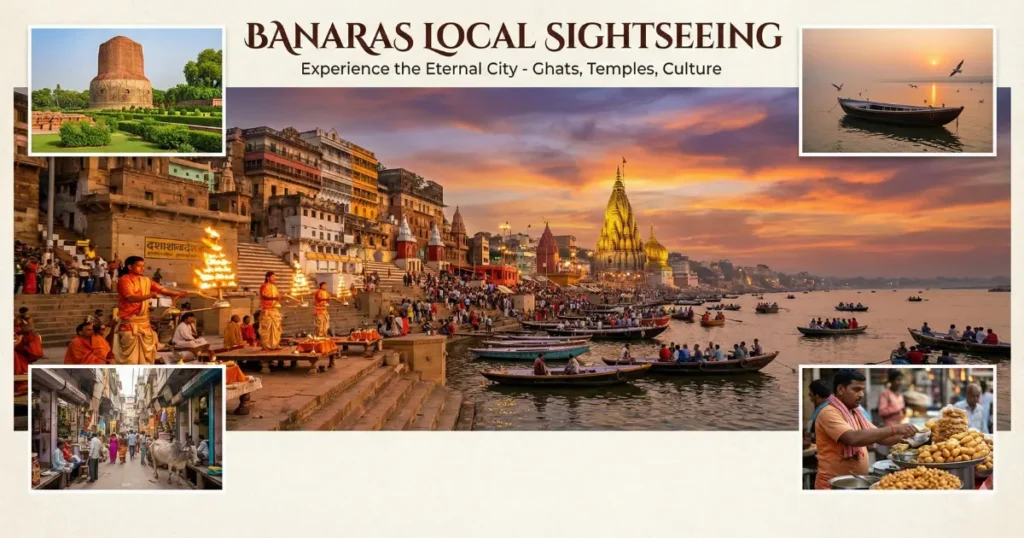
The Ganga Aarti at Dashashwamedh Ghat in Varanasi is the most widely known and most attended public religious ceremony in Hinduism – performed every single evening without exception throughout the year, regardless of weather, festival, or any other circumstance.
| Detail | Information |
| Location | Dashashwamedh Ghat, Varanasi |
| Summer Aarti timing (Apr-Oct) | 7:00 PM |
| Winter Aarti timing (Nov-Mar) | 6:30 PM |
| Duration | 45 minutes |
| Priests | 7 priests simultaneously, positioned at 7 stations along the ghat |
| Entry fee | Free |
| Best arrival time (weekdays) | 40 minutes before Aarti |
| Best arrival time (weekends) | 75-90 minutes before Aarti |
| Best arrival time (Dev Deepawali) | 3-4 hours before Aarti |
| Boat ticket for Aarti view | ₹800-₹2,000 per boat – best front-row view from water |
| Dev Deepawali 2026 | November 5, 2026 – all 84 ghats lit with 10 lakh lamps |
What Happens During the Ganga Aarti
The Aarti is performed simultaneously by 7 priests, each carrying a tiered brass lamp holder with multiple flames – the 5-foot lamp holders are raised and rotated in circular patterns while priests simultaneously ring bells, offer incense, conch shells and flower petals. The choreography of 7 priests performing identical ritual movements in synchronisation across the width of the ghat is what distinguishes the Dashashwamedh Aarti from smaller riverside Aartis elsewhere in India.
Photography: Fully permitted from the ghat steps and from boats. The best ghat photography position is the upper platform – arrive 45 minutes before start to secure standing space on the steps.
Experience My India reserves boat positions for the Ganga Aarti on all Varanasi tour packages – no ghat-side boat negotiation on the evening of your visit. Call +91-7302265809.
Sarnath – Varanasi’s Buddhist Heritage Site
Sarnath is one of the four most sacred Buddhist pilgrimage sites in the world (along with Lumbini, Bodh Gaya and Kushinagar) – and it is just 8 km from Dashashwamedh Ghat in Varanasi, making it one of the most accessible major Buddhist sites in India.
| Site at Sarnath | Significance | Entry Fee |
| Dhamek Stupa | Built by Emperor Ashoka in the 3rd century BCE – marks the exact site of Buddha’s first sermon | ₹40 (Indians) · ₹600 (foreigners) |
| Ashoka Pillar (remains) | The original pillar of Emperor Ashoka – the capital (four lions) is in Sarnath Museum | At site |
| Sarnath Archaeological Museum | Houses the Ashoka Lion Capital (India’s national emblem) – original 3rd century BCE | ₹25 (Indians) · ₹400 (foreigners) |
| Mulagandha Kuti Vihara | Temple built 1931 – houses relics of the Buddha | Free |
| Chinese, Japanese, Thai Temples | International Buddhist temples representing multiple traditions | Free |
Why Sarnath is significant: After attaining enlightenment at Bodh Gaya, Siddhartha Gautama walked to Sarnath (then called Isipatana or the Deer Park) specifically to find his former companions and share his insight. The first teaching he gave here – the Four Noble Truths and the Eightfold Path – is called the Dhammacakkappavattana Sutta (Setting the Wheel of Dharma in Motion). This single sermon is the foundational text of Buddhism.
Planning tip: Sarnath is on the main approach road from Delhi/Lucknow into Varanasi – if arriving from the north, stop at Sarnath before entering Varanasi city. Allow 2.5-3 hours for the Dhamek Stupa, museum and surrounding temples.
Experience My India includes Sarnath in all Ayodhya-Varanasi 4-day tours – no extra detour, right on the route. Call +91-7302265809.
Book Your Ayodhya Varanasi Tour Package
Unique Cultural Experiences in Varanasi
1. Subah-e-Banaras at Assi Ghat
Every morning from 5:00 AM to 7:00 AM, Assi Ghat hosts Subah-e-Banaras – a collective morning programme of classical music, yoga, devotional singing and a group aarti on the steps of the southernmost major ghat. It is free to attend, informal and one of the most authentic daily cultural experiences available in any Indian city. The combination of the rising sun over the Ganga, morning mist and live classical music makes this a distinct Varanasi-only experience.
2. The Banarasi Paan
The Banarasi Paan (betel leaf preparation) is a specific Varanasi culinary tradition – a fresh betel leaf filled with sweet ingredients including mukhwas, gulkand, cloves, fennel and sometimes edible silver foil, folded into a triangle and eaten in one bite. It is served at paan shops across the old city lanes and at roadside stalls near Godowlia crossing. Cost: ₹15-₹50 per paan. The tradition of ending a meal or a temple visit with a sweet paan is several centuries old in Varanasi.
3. Banarasi Silk Sarees – Where to Buy
Varanasi is the production centre for Banarasi silk sarees – GI-tagged (Geographical Indication) handloom fabric known for intricate gold and silver brocade work (zari). The most reliable shopping areas:
| Area | What’s Available | Price Range | Notes |
| Vishwanath Gali (old city) | Silk sarees, brocade, dupatta | ₹2,000-₹2,00,000+ | Negotiate; authentic weavers have government stamps |
| Varanasi Silk Art Expo Centre | Government-certified showroom | ₹3,000-₹5,00,000+ | Fixed price – no negotiation needed |
| Chowk market | All price ranges | ₹1,500 upwards | Best variety; crowded weekends |
| Factory outlet (Peeli Kothi area) | Direct from weaver | ₹2,500 upwards | Best prices but 6 km from ghats |
4. Banaras Gharana – Classical Music
Varanasi is the home of the Banaras Gharana – one of the oldest schools of North Indian classical music, producing legendary musicians including Bismillah Khan (shehnai), Ravi Shankar (sitar) and generations of vocalists and tabla players. Several music events happen nightly in Varanasi – at Sankat Mochan Temple (Tuesday and Saturday evenings), at cultural centres near the ghats and in private home concerts (baithaks) accessible through local guides.
5. The Old City Lanes (Galis) of Kashi
The 5-km network of lanes between Dashashwamedh Ghat and Kashi Vishwanath Temple – Vishwanath Gali, Gyanvapi Street and the lanes branching south – is 2,000-year-old urban fabric: silk traders, brass workshops, sweet shops, flower sellers, small temple alcoves and hundreds of shrines in doorways and walls. The old city is best walked between 6:00 AM and 9:00 AM when the lanes are cleanest and before the midday heat and crowd.
Experience My India includes an old city lane walk in all Varanasi 2-day Tour and longer tours – call +91-7302265809.
Varanasi Food Guide – What to Eat in Kashi
Varanasi has one of the most specific and local food cultures of any Indian city – entirely vegetarian, largely street-based and inseparable from the rhythm of the ghat and temple day.
| Food Item | Best Location | Cost | Best Timing |
| Banarasi Paan (sweet) | Godowlia crossing paan shops | ₹15-₹50 | Any time |
| Kachori Sabzi (breakfast) | Kachori Gali near Vishwanath Gali | ₹40-₹80 | 7:00-10:00 AM |
| Malaiyyo (winter only) | Old city lanes near Sankat Mochan | ₹40-₹80 per bowl | November-February only |
| Lassi (thick, sweetened) | Blue Lassi shop, Vishwanath Gali | ₹80-₹150 | Morning or evening |
| Tamatar Chaat | Chowk area stalls | ₹40-₹70 | Evening 4:00-8:00 PM |
| Baati Chokha | Riverfront restaurants | ₹120-₹200 | Lunch or dinner |
| Thandai | Any sweet shop | ₹50-₹100 | Morning |
| Jalebi Rabri | Sankat Mochan area | ₹60-₹100 | Evening |
Malaiyyo note: This is one of Varanasi’s most famous seasonal foods – a frothy, saffron-infused milk foam dessert made only in the winter months (November-February) when the cool morning mist provides the temperature conditions needed for the foam to set. It is genuinely available only in Varanasi and only in winter. If visiting in the right season, it is one food experience that cannot be replicated anywhere else.
🙏 Planning a Varanasi visit with Ayodhya? Experience My India’s Ayodhya-Varanasi 4-Day Tour covers Ram Janmabhoomi Sugam Darshan + Kashi Vishwanath + Ganga Aarti + Sarnath – hotel, AC transfers, guides confirmed. From ₹8,999 per person.
Varanasi Sightseeing – Complete Attractions Summary
| Attraction | Type | Best Timing | Entry Fee | Distance from Dashashwamedh |
| Kashi Vishwanath Temple | Shiva temple (Jyotirlinga) | 4:00-6:00 AM or 9:00-11:00 AM weekday | Free (e-pass) | 400 metres |
| Dashashwamedh Ghat Aarti | River ceremony | 7:00 PM (S) / 6:30 PM (W) | Free | On-site |
| Assi Ghat + Subah-e-Banaras | Morning programme | 5:00-7:00 AM | Free | 3 km south |
| Sunrise Ganga boat ride | River experience | 5:30-7:30 AM | ₹150-₹2,000 | Assi Ghat |
| Manikarnika Ghat | Cremation ghat | Any time | Free | 500 metres north |
| Sarnath | Buddhist heritage | 9:00 AM-5:00 PM | ₹40-₹65 | 8 km northeast |
| Ramnagar Fort | History + museum | 10:00 AM-5:00 PM | ₹25 (Indians) | 14 km via ferry |
| Old city lane walk | Culture / architecture | 6:00-9:00 AM | Free (guide recommended) | Adjacent to Kashi Vishwanath |
| Sankat Mochan Temple | Hanuman temple | 5:00 AM-12:00 PM and 4:00-9:00 PM | Free | 5 km south |
| Durga Temple (Durga Kund) | Temple | 5:00 AM-12:00 PM and 4:00-9:00 PM | Free | 5 km south |
| Tulsi Manas Temple | Ram devotional temple | 5:30 AM-12:00 PM and 3:30-9:00 PM | Free | 5 km south |
| Banaras Hindu University | Campus + New Vishwanath Temple | 8:00 AM-8:00 PM | Free | 6 km south |
What Nobody Tells You About Varanasi
After coordinating over 50,000 pilgrim visits to Varanasi since 2018, here is what I – Gurudutt, founder of Experience My India – share privately with every first-time visitor:
The Kashi Vishwanath e-pass is free but must be booked 2-7 days in advance – and without it, the weekend queue exceeds 3-4 hours. Since the Kashi Vishwanath Corridor opened in December 2021, the e-pass system has dramatically improved darshan access for those who plan ahead. With a pass, the same darshan takes 30-60 minutes. Book at srikashivishwanath.in before your visit. Experience My India coordinates this booking for every Varanasi tour group.
The Ganga Aarti timing shifts by 30 minutes between summer (7:00 PM) and winter (6:30 PM). Most travel sites give only one timing. Arriving at 7:00 PM in December means the Aarti started 30 minutes ago. On Dev Deepawali (November 5, 2026), 10 lakh lamps are lit across all 84 ghats – arrive 3 hours early.
Varanasi’s narrow lanes disorient first-time visitors significantly. The old city lane network between Dashashwamedh Ghat and Kashi Vishwanath Temple is a 2,000-year-old compressed urban maze – 20-30 minutes of wrong turns is normal on a first visit. Getting lost for 45-60 minutes is common and can cause visitors to miss their Aarti timing window. Experience My India’s guides know every entry and exit point of the Vishwanath Gali network.
Manikarnika Ghat operates 24 hours – visiting before 7:00 AM gives you a completely different, quieter experience. The cremation fires burn continuously, but the 5:30-7:30 AM window has far fewer vendors, quieter surroundings and a more contemplative atmosphere than the busy midday ghat. Maintain respectful silence and do not photograph the funeral pyres.
Sunrise boat rides are overpriced when negotiated at the ghat. The standard shared boat rate (Assi to Manikarnika and back): ₹150-₹200 per person. What ghat boatmen quote first-time visitors: ₹500-₹1,000. Private boat rates: ₹800-₹2,000 for the full circuit, not per person. Experience My India pre-arranges all boat rides at confirmed rates. Call +91-7302265809.
Know Before You Visit Varanasi
- Kashi Vishwanath e-pass is free but must be booked 2-7 days ahead at srikashivishwanath.in – without it, weekend queues exceed 3 hours
- Ganga Aarti at Dashashwamedh: 7:00 PM in summer (April-October), 6:30 PM in winter (November-March) – arrive 40 minutes early on weekdays, 75 minutes on weekends
- Dev Deepawali (November 5, 2026): all 84 ghats lit with 10 lakh lamps – book hotel 60+ days ahead, arrive at Dashashwamedh 3 hours before Aarti
- Sunrise boat ride: ₹150-₹200 per person (shared) – negotiate or pre-book; do not accept ghat-side first quotes
- Manikarnika Ghat operates 24 hours – no photography of funeral pyres; maintain silence
- Sarnath (8 km from Dashashwamedh): allow 2.5-3 hours; open 9:00 AM-5:00 PM; entry ₹40-₹65
- Old city lanes (Vishwanath Gali area) are easiest navigated 6:00-9:00 AM – attempt with a guide on first visit
- Malaiyyo (frothy milk dessert) is available only November-February – a genuinely seasonal, Varanasi-exclusive food
- All major temples in Varanasi are free – no paid entry except Sarnath archaeological sites and Ramnagar Fort
- Experience My India handles Kashi Vishwanath e-pass, boat ride pre-booking, lane walk guidance and Aarti timing for all Varanasi tours. Call +91-7302265809.
Frequently Asked Questions – What Is Special About Varanasi
Varanasi (Kashi) is special as one of the world’s oldest continually inhabited cities and the most sacred city in Hinduism. It houses Kashi Vishwanath Temple (one of 12 Jyotirlingas), 84 ghats along 7 km of the Ganga, the nightly Ganga Aarti at Dashashwamedh Ghat (7:00 PM summer / 6:30 PM winter), Manikarnika cremation ghat and Sarnath (8 km) – where Buddha delivered his first sermon. Experience My India covers all these in guided Varanasi tours from ₹3,999 per person – call +91-7302265809.
Varanasi is spiritually significant in multiple traditions. In Hinduism, dying in Kashi is believed to grant Moksha – liberation from rebirth – because Lord Shiva is believed to whisper the Taraka Mantra into the dying person’s ear (from the Kashi Khand, Skanda Purana). In Buddhism, Sarnath (8 km away) is where Buddha gave his first post-enlightenment sermon in the 5th century BCE. In Jainism, Varanasi is the birthplace of Suparshvanatha, the 7th Tirthankara. Experience My India explains this context on every Varanasi tour – call +91-7302265809.
The main attractions of Varanasi are: Kashi Vishwanath Temple (one of 12 Jyotirlingas, Mangala Aarti at 3:00 AM – free e-pass required), Dashashwamedh Ghat Ganga Aarti (7:00 PM summer / 6:30 PM winter – 7 priests, 45 minutes, free), the sunrise Ganga boat ride from Assi Ghat (5:30-7:30 AM, ₹150-₹2,000), Manikarnika cremation ghat, Sarnath with the Dhamek Stupa (3rd century BCE, entry ₹40). Experience My India covers all major sites in guided tours from ₹3,999 – call +91-7302265809.
Varanasi’s unique experiences include: Subah-e-Banaras at Assi Ghat (5:00-7:00 AM – classical music and yoga at the river, free), watching Dev Deepawali (November 5, 2026) when 10 lakh lamps light all 84 ghats simultaneously, eating Malaiyyo (frothy milk dessert available only November-February), walking the Vishwanath Gali old city lanes at 6:00 AM and attending a Banaras Gharana classical music baithak. Experience My India includes all these in extended Varanasi tours – call +91-7302265809.
Varanasi is internationally famous for three intersecting reasons: it is one of the oldest continually inhabited cities on earth (over 3,000 years), it is the holiest city in Hinduism with the Kashi Vishwanath Jyotirlinga and 84 Ganga ghats and it is 8 km from Sarnath – where the Buddha gave his first post-enlightenment teaching. The nightly Dashashwamedh Ghat Aarti draws international visitors as one of the most visually distinctive public rituals in the world. Experience My India tours from ₹3,999 – call +91-7302265809.
The Ganga Aarti at Dashashwamedh Ghat in Varanasi is performed daily at 7:00 PM in summer (April-October) and 6:30 PM in winter (November-March). It lasts 45 minutes and is conducted simultaneously by 7 priests. Arrive 40 minutes before start on weekdays, 75 minutes before on weekends. On Dev Deepawali (November 5, 2026), arrive 3 hours before – attendance exceeds 50,000 people. Experience My India reserves ghat positions and boat tickets for the Aarti on all Varanasi tours – call +91-7302265809.
Yes – Varanasi contains sites of significance to multiple traditions. Sarnath (8 km) is one of the four most sacred Buddhist pilgrimage sites in the world – the Dhamek Stupa (3rd century BCE), Ashoka Pillar and Sarnath Museum (housing the Lion Capital, India’s national emblem) are UNESCO-notable sites. The Ganga Aarti is visually and musically compelling regardless of religious tradition. The old city architecture, Banarasi silk craft and classical music traditions are cultural heritage independent of any specific belief. Experience My India tours cover all of this – call +91-7302265809.
Manikarnika Ghat is Varanasi’s primary cremation ghat – Hindu tradition holds that the cremation fires here have burned continuously for over 3,000 years. It is considered the most auspicious place to be cremated in Hinduism: families bring their deceased from across India specifically for cremation here, believing it ensures Moksha for the departed soul. 200-400 cremations occur here daily. Visitors observe from the upper platform with respectful silence; photography of funeral pyres is prohibited. Experience My India explains the ritual context before every Varanasi visit – call +91-7302265809.
October to February is the best time to visit Varanasi – temperatures of 10°C-25°C, all ghats accessible, boat rides comfortable and Ganga Aarti atmosphere at its most atmospheric in cooler weather. Dev Deepawali (November 5, 2026) is the single most spectacular evening event – 10 lakh lamps on all 84 ghats – and requires hotel booking 60 days ahead. Malaiyyo (seasonal milk dessert) is available only November-February. Experience My India plans Varanasi visits for all seasons – call +91-7302265809.
Two days cover Varanasi’s main experiences: Kashi Vishwanath Mangala Aarti (3:00-4:00 AM, Day 1), sunrise boat ride (5:30 AM), old city lane walk, Ganga Aarti (7:00 PM) and Sarnath (Day 2). Three days allow Ramnagar Fort, Chunar Fort (40 km), Sankat Mochan music evenings and the Panchkroshi Yatra starting point. Experience My India’s Varanasi 2-day tour from ₹3,999 or Ayodhya-Varanasi 4-day tour from ₹8,999 – call +91-7302265809.
Varanasi’s most famous purchase is the Banarasi silk saree (₹2,000-₹2,00,000+) – a GI-tagged handloom craft with gold and silver zari brocade. Buy from government-certified showrooms (Varanasi Silk Art Expo Centre) or directly from weaver workshops in Peeli Kothi area for the best prices. Other purchases: brass puja items, sandalwood incense, Ganga jal (sacred Ganga water) and religious books. Experience My India recommends specific trusted shops on every Varanasi tour – call +91-7302265809.
Yes. Experience My India plans complete Varanasi tours – Kashi Vishwanath e-pass coordination, sunrise boat ride at confirmed rates, Ganga Aarti ghat positioning, Sarnath with a guide, old city lane walk and hotel near Dashashwamedh Ghat. Varanasi 2-day tours from ₹3,999 per person, or combined with Ayodhya in a 4-day circuit from ₹8,999 per person. WhatsApp +91-7302265809 – personalised itinerary in 30 minutes.
Recommended products
-
1 Night 2 Days Varanasi Tour Package
Original price was: ₹7,000.00.₹6,000.00Current price is: ₹6,000.00. -
10 Days Complete Uttar Pradesh Spiritual Tour
-
2 Nights 3 Days Varanasi Tour Package
Original price was: ₹11,000.00.₹9,500.00Current price is: ₹9,500.00. -
Same Day Varanasi Tour Package
Original price was: ₹4,000.00.₹3,500.00Current price is: ₹3,500.00.

🙏 Ready to Experience What Makes Varanasi Special with Experience My India?
WhatsApp us and receive your personalised Varanasi itinerary within 30 minutes – Kashi Vishwanath e-pass, sunrise boat at confirmed rates, Ganga Aarti timing, Sarnath guide and hotel near Dashashwamedh all confirmed. Tours from ₹3,999 per person.
WhatsApp +91-7302265809 – Book Now
Jai Shri Ram 🙏