

The top places to visit in Ayodhya are Ram Janmabhoomi (Ram Mandir), Hanuman Garhi, Kanak Bhawan, Ram Ki Paidi and Treta Ke Thakur. In Varanasi: Dashashwamedh Ghat (Ganga Aarti), Kashi Vishwanath Temple, Manikarnika Ghat, Assi Ghat and Sarnath. Ayodhya to Varanasi is 220 km – 4.5 hours via Purvanchal Expressway. Ideal plan: 2 days Ayodhya + 2 days Varanasi. Experience My India has guided 50,000+ pilgrims through this exact circuit since 2018. Tours from ₹4,999. WhatsApp +91-7302265809.
Ayodhya and Varanasi are the two most spiritually significant cities in the Ram-Shiva devotional tradition of North India – and they sit just 220 km apart. Together, they form the most natural pilgrimage circuit in eastern Uttar Pradesh: Ayodhya for the birthplace of Lord Rama, Varanasi for the city of Lord Shiva where liberation is believed to be granted to those who die within its borders.
I am Gurudutt, born and raised in Braj Bhoomi and the founder of Experience My India. Since 2018, I have guided 50,000+ pilgrims through both cities – coordinating Ram Mandir Sugam Darshan passes, sequencing Kal Bhairav with Kashi Vishwanath and positioning groups at the Dashashwamedh Ghat Aarti before the first priest arrives. This guide reflects exactly how we plan the circuit.
By the end of this guide you will have a complete list of the top places in both cities with darshan timings, a practical 3-day itinerary with specific timing blocks, the correct traditional darshan sequence for each city and the honest advice on what to book before you travel.
Ayodhya & Varanasi Together – The North India Pilgrimage Axis
Ayodhya and Varanasi represent two complementary poles of the North India sacred geography. Ayodhya is the birthplace of Lord Rama – a city of devotion, celebration and the Ram Katha tradition. Varanasi is the city of Shiva – ancient, continuous and deeply connected to the Hindu understanding of death and liberation.
Most pilgrims who visit one eventually return for the other. The natural question becomes: which first? Experience My India always recommends Ayodhya first, then Varanasi – travelling east from the birthplace of Ram to the city where Shiva grants liberation forms a devotional journey with a clear narrative arc. Practically, this also places you on the Purvanchal Expressway for a smooth 4.5-hour connection between the two cities.
View the Ayodhya Varanasi 3-Day Package
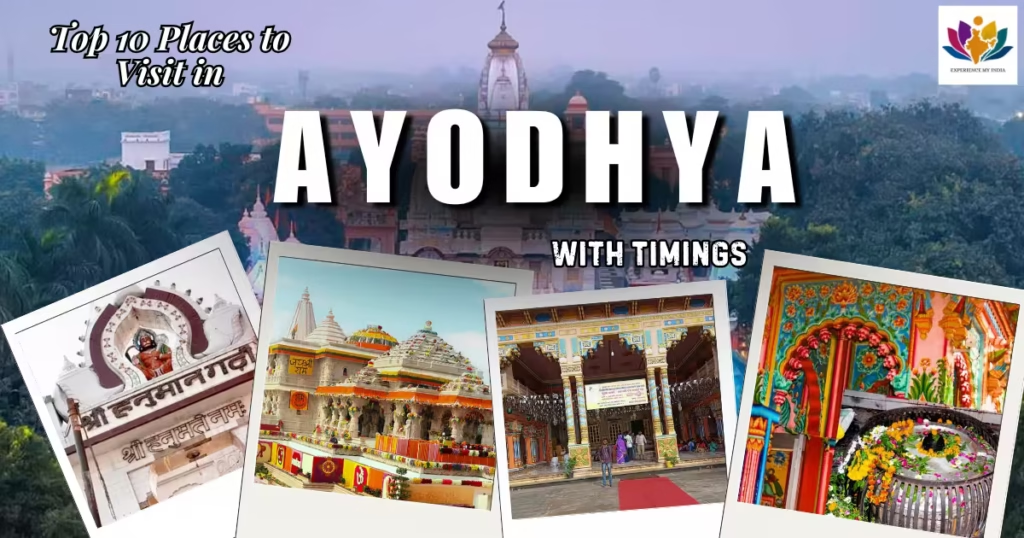
Top Places to Visit in Ayodhya
1. Shri Ram Janmabhoomi Mandir (Ram Mandir) The central pilgrimage draw of Ayodhya – built at the site traditionally identified as the birthplace of Lord Rama. Consecrated in January 2024, the temple is constructed in Nagara architectural style with a 161-foot main tower and intricate stone carvings. Darshan is free; Sugam Darshan E-pass (also free) significantly reduces queue time. No mobile phones, cameras or bags inside. The Sugam E-pass is bookable at online.srjbtkshetra.org, 15 days before your darshan date.
2. Hanuman Garhi A 10th-century temple-fortress on a natural mound overlooking the Ram Janmabhoomi area. Dedicated to Lord Hanuman – revered as Ayodhya’s divine guardian and gatekeeper. 76 stone steps to the main sanctum; ropeway-equivalent via doli (₹100-₹300) for elderly pilgrims. The tradition of visiting Hanuman Garhi before Ram Mandir is maintained by local pujaris and Experience My India alike – it is not optional for a complete Ayodhya darshan.
3. Kanak Bhawan The “Golden Palace” of Ayodhya – a palace-temple housing three pairs of golden-adorned Rama and Sita idols in the inner sanctum. Built on the site traditionally said to have been gifted to Goddess Sita by Queen Kaikeyi. Architecturally the most refined temple in Ayodhya, with 19th-century painted ceilings. Free entry. The Sandhya Aarti at 7:00 PM is the most devotionally charged evening session in the city.
4. Ram Ki Paidi (Saryu Ghat) A series of curved river-front ghats on the banks of the Saryu River – the primary sacred water body of Ayodhya. The Saryu Aarti takes place at sunset daily (timing varies with season). Boat rides on the Saryu: ₹50-₹100 per person shared. The ghat is best experienced before 8:00 AM for the morning ritual atmosphere or at the evening aarti timing.
5. Treta Ke Thakur An ancient temple housing black sandstone idols of Lord Rama, Sita, Lakshmana and Hanuman – said to have been carved from the same single stone used in the Ashwamedha Yagna of Treta Yuga. One of Ayodhya’s oldest places of worship, less frequently covered in mainstream guides. Located approximately 1.5 km from the Ram Mandir complex – a short e-rickshaw ride. Free entry. Best visited as a morning addition before or after Kanak Bhawan.
Other Ayodhya sites worth including:
- Dashrath Mahal – palace associated with King Dasharatha, Ram’s father; interesting for historical-mythological context
- Sita Ki Rasoi – traditional kitchen of Goddess Sita; a small but devotionally significant shrine
- Ram Katha Park – open parkland near the Saryu Ghat with Ramayana story panels; good for families
Ayodhya Temple Timings 2026
| Temple / Site | Morning Opens | Afternoon Closes | Evening Opens | Evening Closes | Entry |
| Ram Janmabhoomi | 7:00 AM | 11:30 AM | 2:00 PM | 7:00 PM | Free (Sugam pass recommended) |
| Hanuman Garhi | 5:00 AM | 11:30 AM | 4:00 PM | 10:00 PM | Free |
| Kanak Bhawan | 8:00 AM | 11:30 AM | 4:30 PM | 9:30 PM | Free |
| Ram Ki Paidi / Saryu Ghat | All day | No break | Aarti at sunset | – | Free |
| Treta Ke Thakur | 7:00 AM | 12:00 PM | 4:00 PM | 9:00 PM | Free |
All Ayodhya temple timings verified by Experience My India’s local team – June 2026. Festival-period hours vary.
Book Your Sugam Darshan and Rudrabhishek at Kashi Vishwanath
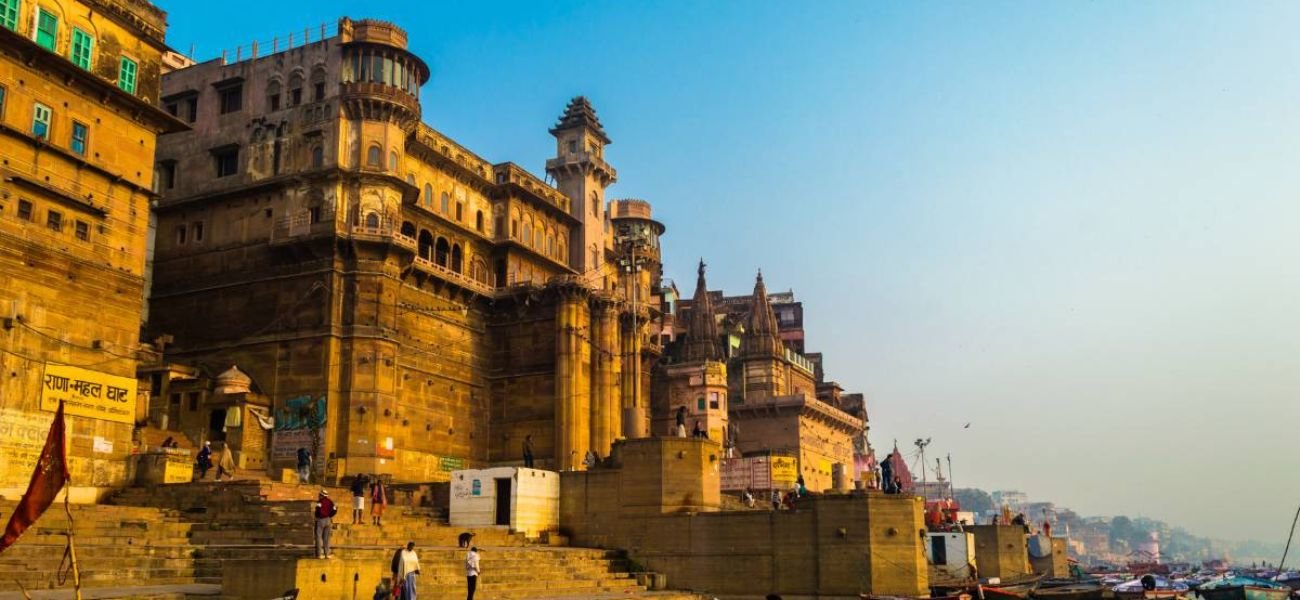
Top Places to Visit in Varanasi
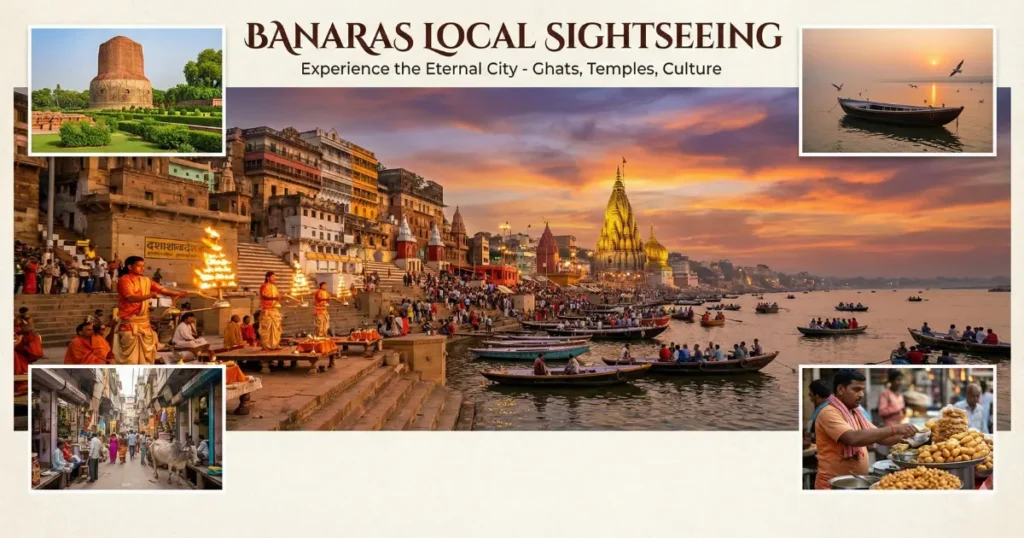
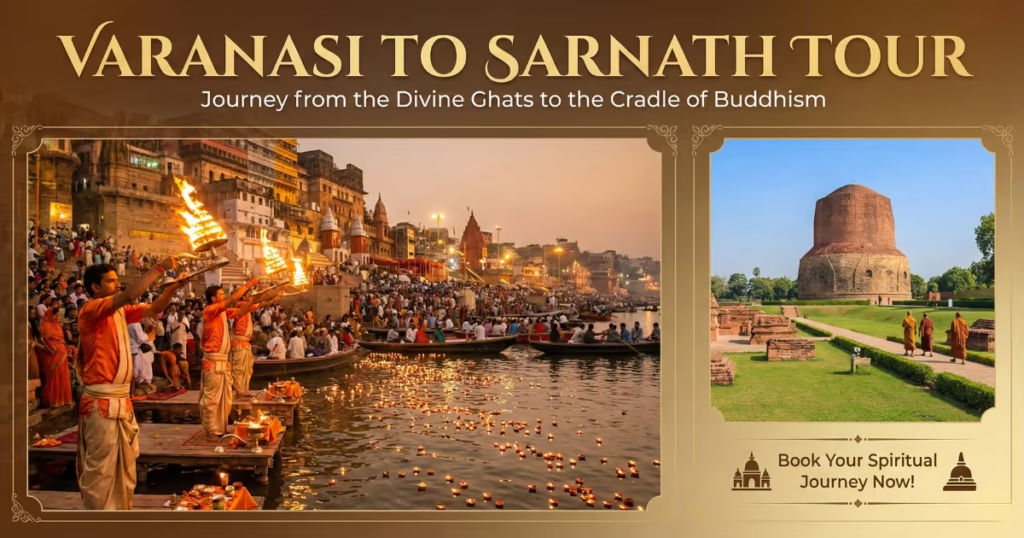
1. Dashashwamedh Ghat – Ganga Aarti The most celebrated daily ceremony in all of Varanasi – seven priests in synchronised formation, multi-tiered brass lamps, incense and conch shells, held every evening at sunset (approximately 6:45 PM in summer, 5:45 PM in winter). The ghat dates to ancient times; the name translates as “the ghat of ten horse sacrifices.” Attend from the steps (free, arrive 45 minutes early) or from a river boat (₹300-₹500 shared, ₹3,000-₹6,000 private).
2. Kashi Vishwanath Temple One of the 12 Jyotirlingas – the most sacred Shiva temples in Hinduism. The current temple was rebuilt in 1780 by Ahilya Bai Holkar after earlier destruction. Visit Kal Bhairav Temple first by tradition (see the Kal Bhairav section of this guide). Kashi Vishwanath E-pass: available at the official temple portal – significantly reduces queue time. No mobile phones or bags inside.
3. Manikarnika Ghat Varanasi’s ancient cremation ghat – open 24 hours, 100 to 300 cremations daily. The fires here are said to have burned without interruption for centuries. In Hindu tradition, dying in Varanasi and being cremated at Manikarnika is believed to guarantee moksha (liberation). Photography is strictly prohibited – phones must be in bags before entering the approach lanes. Best observed from a river boat or from the ghat steps between 8:00 AM and 7:00 PM.
4. Assi Ghat Located at the southern end of Varanasi’s 84-ghat line, Assi Ghat is known for the Subah-e-Banaras morning programme – a combination of yoga, bhajan and the sunrise Aarti at approximately 5:30 AM daily. Far calmer than Dashashwamedh, Assi Ghat is where Varanasi residents practice yoga and bathe in relative peace. Sunrise boat rides from Assi Ghat offer a different perspective on the full ghat line.
5. Sarnath Located 12 km from Varanasi city centre, Sarnath is the site where the Buddha delivered his first sermon after attaining enlightenment under the Bodhi Tree at Bodh Gaya. Key sites: Dhamek Stupa (one of India’s oldest Buddhist monuments), the Sarnath Archaeological Museum (holds the original Lion Capital of Ashoka – India’s national emblem) and the Mulagandha Kuti Vihara. Sarnath is a half-day addition to any Varanasi itinerary – approximately 45 minutes by auto-rickshaw from the main ghats.
Other Varanasi sites worth including:
- Kal Bhairav Temple – the divine gatekeeper of Kashi; always visit before Kashi Vishwanath by tradition (5:00 AM to 1:30 PM, 4:30 PM to 9:30 PM)
- Tulsi Manas Temple – built on the site where Tulsidas wrote the Ramcharitmanas
- Banaras Hindu University (BHU) Vishwanath Temple – on campus; architecturally distinct modern temple
Varanasi Ghat & Temple Timings 2026
| Site | Timings | Aarti / Key Event | Entry |
| Kashi Vishwanath Temple | 3:00 AM-11:00 PM (multiple breaks) | Multiple aartis daily; Mangala Aarti 3:00 AM | Free (Sugam pass recommended) |
| Kal Bhairav Temple | 5:00 AM-1:30 PM; 4:30 PM-9:30 PM | Mangala 5:00 AM; Sandhya ~6:30 PM | Free |
| Dashashwamedh Ghat | All day | Ganga Aarti: 6:45 PM (summer) / 5:45 PM (winter) | Free |
| Manikarnika Ghat | 24/7 | Active cremation – no formal aarti | Free; no photography |
| Assi Ghat | All day | Subah-e-Banaras: ~5:30 AM | Free |
| Sarnath | 9:00 AM-5:00 PM | Museum: 10:00 AM-5:00 PM (closed Mon) | ₹30 (Stupa complex); Museum ₹20 |
Varanasi timings verified by Experience My India’s local Varanasi team – June 2026.
Ayodhya to Varanasi: Distance, Route & Travel
| Detail | Information |
| Distance | ~220 km |
| Best route | Purvanchal Expressway (via NH27 exit) |
| Travel time by car (Expressway) | 4 to 4.5 hours |
| Travel time by car (NH330 via Sultanpur) | 4.5 to 5.5 hours |
| Best departure time | 8:00 AM to 10:00 AM – avoids Ayodhya city exit and Varanasi approach traffic |
| Private cab fare (Ayodhya to Varanasi) | ₹3,000-₹4,500 (sedan/SUV) |
| Train option | No direct Ayodhya-Varanasi train; Lucknow-Varanasi via Mau or Jaunpur Junction |
Purvanchal Expressway is the consistent recommendation – it covers the 220 km with minimal congestion for most of its length and delivers you to the Varanasi eastern approach without going through Jaunpur city. Experience My India uses this route for all guided Ayodhya-Varanasi transfers.
Book Your Ayodhya Varanasi Tour Package
3-Day Ayodhya & Varanasi Itinerary 2026
Day 1 – Ayodhya
| Time | Activity | Notes |
| 5:00-6:00 AM | Hanuman Garhi Mangala Aarti | First darshan of the day – quietest window |
| 6:00-6:15 AM | Walk to Ram Janmabhoomi area | 500 metres from Hanuman Garhi |
| 7:00-9:30 AM | Ram Mandir morning darshan | Sugam pass – 15-30 min queue |
| 10:00-11:00 AM | Kanak Bhawan morning visit | Before 11:30 AM closure |
| 11:30 AM-4:00 PM | Rest + lunch | Temple closure window |
| 4:30-5:30 PM | Kanak Bhawan Sandhya Aarti | Opens 4:30 PM |
| 6:00-7:00 PM | Saryu Ghat Aarti | At sunset |
Day 2 – Ayodhya to Varanasi (Transit Day)
| Time | Activity | Notes |
| 7:00-8:00 AM | Treta Ke Thakur + Sita Ki Rasoi | Morning round before departure |
| 9:00 AM | Depart Ayodhya for Varanasi | Purvanchal Expressway |
| 1:00-2:00 PM | Arrive Varanasi, hotel check-in | Hotel near ghats recommended |
| 3:00-4:30 PM | Kal Bhairav Temple darshan | Visit before Kashi Vishwanath by tradition |
| 5:00-7:00 PM | Kashi Vishwanath Temple | Evening darshan |
| 8:00-9:00 PM | Old city walk – Vishwanath Gali | Varanasi street food, chai |
Day 3 – Varanasi
| Time | Activity | Notes |
| 5:00-6:00 AM | Subah-e-Banaras at Assi Ghat | Sunrise aarti and morning yoga programme |
| 6:00-8:30 AM | Sunrise boat ride – full ghat line | Includes Manikarnika viewing from river |
| 9:30-11:00 AM | Manikarnika Ghat approach | Walking the ghat lane – no photography |
| 11:00 AM-1:00 PM | Sarnath (12 km from city) | Dhamek Stupa, Lion Capital Museum |
| 2:00-4:00 PM | Rest at hotel | Afternoon break |
| 5:30-7:00 PM | Dashashwamedh Ghat – Ganga Aarti | Arrive by 5:45 PM in summer; boat view recommended |
| 7:30-9:00 PM | Banaras street food – Kachori sabzi, chaat | Best near Vishwanath Gali and Dashashwamedh |
Tips for Families & Senior Pilgrims
Ayodhya-specific:
- Ram Mandir’s security queue involves standing for 45 to 90 minutes – senior pilgrims should use the Sugam Darshan E-pass (free) which reduces this to 15 to 30 minutes
- Hanuman Garhi’s 76 steps can be managed by most pilgrims; doli (palanquin) is available at the base for ₹100-₹300 for those who need it
- Kanak Bhawan is flat and accessible once inside – no step challenge after the main entrance
- The Saryu Ghat area has been significantly upgraded with wide concrete steps and good lighting for evening visits
Varanasi-specific:
- Manikarnika Ghat’s lane approach is narrow and has uneven surfaces – not suitable for wheelchair users; a river boat provides a more comfortable viewing option
- Sarnath is flat, well-maintained and ideal for elderly visitors – the museum and Dhamek Stupa gardens are accessible
- For the Ganga Aarti, a pre-booked private boat eliminates ghat-step standing for elderly groups – Experience My India arranges private boats for all senior citizen Varanasi groups
- Old city lanes are very narrow – electric wheelchairs and walking aids are challenging to navigate; guides should be consulted before attempting the Vishwanath Gali approach
WhatsApp +91-7302265809 for specific accessibility requirements on either city.
Ground Truth – What Nobody Tells You About the Ayodhya Varanasi Circuit
Two days in Ayodhya is the minimum for the circuit to feel unhurried. A single Ayodhya day forces you to skip either the morning Hanuman Garhi aarti, the Kanak Bhawan Sandhya Aarti or the Saryu Ghat evening. The ideal Ayodhya-Varanasi trip is 2 days Ayodhya + 2 days Varanasi minimum.
The Sugam Darshan pass at Ram Mandir is the single most impactful preparation action. It is free, available 15 days in advance and reduces a potential 3-hour queue to 15 minutes. Yet most travellers arrive without it and lose half a day to the general queue. Book it before you leave home.
Kal Bhairav Temple before Kashi Vishwanath is not a suggestion – it is the tradition. Most tourist itineraries go straight to Kashi Vishwanath without stopping at Kal Bhairav first. Local pujaris and the Varanasi pilgrimage tradition firmly hold that Kal Bhairav must give permission before a pilgrim enters Kashi Vishwanath. Experience My India builds this into every Varanasi itinerary as a non-negotiable first stop.
The Purvanchal Expressway journey from Ayodhya to Varanasi takes 4.5 hours – not 3 as some guides state. The Expressway itself covers the distance efficiently, but the Ayodhya city exit and the Varanasi city approach together add 45 to 60 minutes to the Maps estimate. Plan your departure accordingly.
Sarnath is frequently treated as a rushed 30-minute stop – it deserves at least 2 hours. The Dhamek Stupa, the Archaeological Museum (Lion Capital of Ashoka) and the modern Mulagandha Kuti Vihara each require time. If Sarnath is on your list, give it a dedicated morning rather than a post-lunch pitstop.
FAQ – Places to Visit in Ayodhya & Varanasi
The most famous Ayodhya tourist spots are Ram Janmabhoomi (Ram Mandir) – the birthplace temple of Lord Rama, consecrated January 2024 – Hanuman Garhi (the guardian temple, visit first by tradition), Kanak Bhawan (the Golden Palace temple), Ram Ki Paidi and Saryu Ghat (sacred river ghats with evening aarti) and Treta Ke Thakur (one of Ayodhya’s oldest temples). All are free to enter. Experience My India covers all five in every guided Ayodhya tour. WhatsApp +91-7302265809.
The five most significant tourist places in Varanasi are: Dashashwamedh Ghat (daily Ganga Aarti at sunset – the most attended ritual in the city), Kashi Vishwanath Temple (one of the 12 Jyotirlingas), Manikarnika Ghat (ancient cremation ghat, open 24/7), Assi Ghat (morning yoga and Subah-e-Banaras aarti at 5:30 AM) and Sarnath (12 km from the city – the site of the Buddha’s first sermon). Experience My India includes all five in guided Varanasi tours from ₹3,499. WhatsApp +91-7302265809.
The ideal Ayodhya Varanasi trip takes 3 to 4 days: 2 days in Ayodhya (Hanuman Garhi, Ram Mandir, Kanak Bhawan, Saryu Ghat) + 1.5 to 2 days in Varanasi (Kal Bhairav, Kashi Vishwanath, Ganga Aarti, Sarnath). Travel between the cities by private cab via the Purvanchal Expressway (220 km, 4.5 hours). Book the Ram Mandir Sugam E-pass at online.srjbtkshetra.org, 15 days before your darshan date. Experience My India plans the complete circuit with station pickups, hotel booking and darshan sequencing from ₹4,999. WhatsApp +91-7302265809.
Always visit Hanuman Garhi first. Ayodhya’s tradition – maintained by local pujaris – holds that Hanuman is the city’s guardian and his blessing must be sought before entering Ram Janmabhoomi. Practical benefit: visiting Hanuman Garhi (7:00-8:30 AM) positions you perfectly for Ram Mandir morning darshan (from 9:00 AM) before queues peak. Experience My India follows this sequence in every Ayodhya itinerary without exception. WhatsApp +91-7302265809.
Ayodhya is approximately 220 km from Varanasi. The fastest road route is via the Purvanchal Expressway – 4 to 4.5 hours by private cab. The alternative via NH330 and Jaunpur is 4.5 to 5.5 hours. There is no direct train between the two cities; rail connections require a change at Lucknow or Jaunpur Junction. Experience My India arranges Ayodhya to Varanasi private cab transfers as part of all Ayodhya Varanasi tour packages from ₹4,999. WhatsApp +91-7302265809.
Three days is achievable but tight: Day 1 Ayodhya (all main temples), Day 2 transit to Varanasi and evening programme (Kal Bhairav, Kashi Vishwanath, Ganga Aarti), Day 3 Varanasi (Assi Ghat morning, Manikarnika, Sarnath). For a more relaxed and complete experience, 4 days (2 + 2) is the standard. Experience My India’s 3-Day Ayodhya Varanasi Package is designed for the tighter schedule. WhatsApp +91-7302265809.
October to March is the best period for both cities – comfortable temperatures (12°C to 26°C) for walking, temple queuing and ghat visits. Avoid April to June summers where temple queues in 40°C heat and ghat exposure are challenging. Ram Navami (March 2026) is the most significant Ayodhya festival; Mahashivaratri (February 2026) and Dev Deepawali (November 2026) are the most spectacular Varanasi events. Experience My India adjusts itineraries for each season and festival. WhatsApp +91-7302265809.
Yes – with the right planning. Hanuman Garhi doli (₹100-₹300) eliminates the 76-step climb. Ram Mandir Sugam pass eliminates the long general queue. At Varanasi, a private boat for the Ganga Aarti (₹3,000-₹6,000) removes the need to stand in the ghat crowd. Experience My India’s Senior Citizen Ayodhya Varanasi Package at ₹9,499 solves every accessibility challenge in both cities. WhatsApp +91-7302265809 with specific requirements before booking.
Recommended products
-
2 Night 3 Days Ayodhya Varanasi Tour Package
Original price was: ₹9,000.00.₹8,000.00Current price is: ₹8,000.00. -
5 Days Ayodhya Varanasi Tour Package
-
Varanasi Ayodhya Tour Package with Prayagraj
Original price was: ₹13,000.00.₹12,000.00Current price is: ₹12,000.00. -

7 Days Uttar Pradesh Sacred Circuit Tour

CONCLUSION
Ayodhya and Varanasi together represent the most complete North India sacred pilgrimage available in a 3 to 4 day window – Ram’s birthplace and Shiva’s eternal city, 220 km apart, connected by the Purvanchal Expressway and a journey that has been made by pilgrims in some form for thousands of years.
Experience My India plans every detail: Ram Mandir Sugam pass, Kal Bhairav before Kashi Vishwanath, private boat for the Ganga Aarti and every temple timed to its correct darshan window.
Ayodhya Varanasi tours from ₹4,999 per person. Rated 4.5★ by 204+ pilgrims.
WhatsApp +91-7302265809 – Book Now
Jai Shri Ram 🙏